
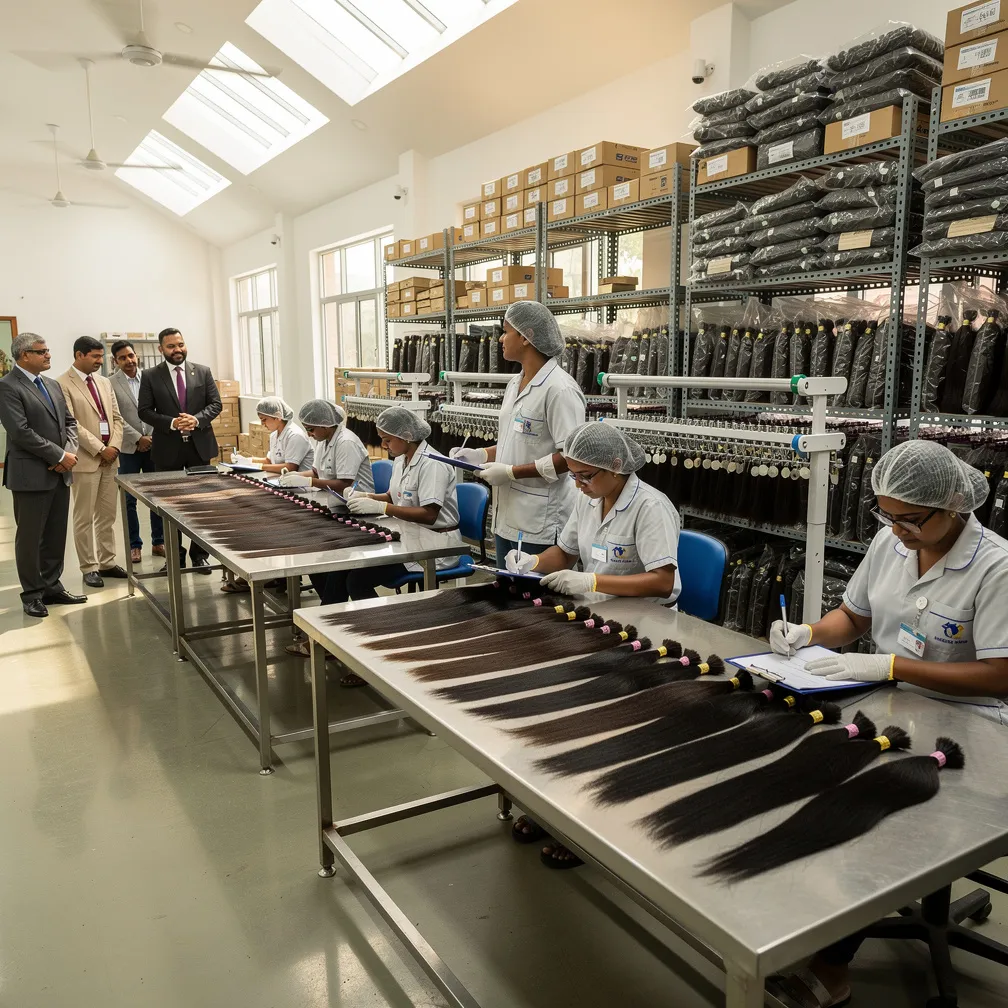
Hair Extension Factory Visit in India — What to Expect and How to Prepare
A hair extension factory visit in India is one of the most valuable investments a wholesale buyer, distributor, or brand owner can make when building a long-term supply chain relationship. No amount of sample testing, video calls, or email correspondence fully replaces the insight gained from standing in a factory, watching production processes firsthand, meeting the team responsible for your products, and asking unscripted questions. India — and specifically the Faridabad-Delhi manufacturing corridor — is home to some of the world’s most capable Remy human hair extension producers, and visiting them in person gives you the verification and confidence that remote evaluation simply cannot provide. This guide walks you through every aspect of planning a factory visit to India, from visa requirements and travel logistics to what to inspect and what questions to ask.
Hair Extensions By Nature welcomes international buyers at our factory at Booth No 71, Sector 16 Huda Market, Faridabad, Haryana, India – 121002. We are 30-45 minutes from Delhi’s Indira Gandhi International Airport and regularly host buyers from the USA, UK, UAE, Europe, and Australia for factory tours and product evaluations. This guide shares what you should expect and prepare for a productive visit — whether to our facility or any other Indian hair extension manufacturer.
Why Visit a Hair Extension Factory in India?
Remote sourcing has become dramatically more accessible through video calls, detailed sample orders, and third-party inspection services. Yet there are things you can only learn in person:
You can observe production capacity — the number of workers, machines, and production lines — and judge whether a manufacturer can actually fulfill large volume orders on schedule. You can see quality control processes in action, not as they are described in a proposal email but as they are actually executed on the factory floor. You can meet the team — the quality manager, production supervisor, and account manager — and assess whether communication and professionalism standards meet your requirements. And perhaps most importantly, you can inspect raw material — the source and condition of the hair going into production — which is the single most important determinant of finished product quality.
For buyers committing to annual orders of $50,000 or more, the cost of a return flight to India and a three-to-five day sourcing trip is minimal relative to the risk reduction and relationship-building value it provides.
Planning Your India Sourcing Trip
Best Time to Visit
India’s climate varies dramatically by season. For sourcing trips to Faridabad and the Delhi-NCR region, the optimal travel window is October through February, when temperatures range from 10-25 degrees Celsius and conditions are comfortable for factory visits and travel between sites. March through May brings increasingly hot weather (temperatures can reach 40+ degrees Celsius by May), and June through September is the monsoon season — functional but uncomfortable. If your schedule requires visiting in summer, ensure that your accommodation and transport are air-conditioned.
Visa Requirements
India’s e-Visa system has made obtaining a business visa significantly more straightforward for most nationalities. Citizens of the USA, UK, Australia, Germany, UAE, Canada, and most other countries can apply for an e-Business Visa online at indianvisaonline.gov.in. The e-Business Visa allows stays of up to 180 days per visit and is typically processed within 3-5 business days of application. Apply at least 4 weeks before your travel date to allow for any processing delays.
Required documents for an e-Business Visa include a valid passport with at least 6 months’ validity, a recent photograph, your invitation letter from the Indian factory (manufacturers can provide this on company letterhead), and evidence of business activity. The visa fee varies by nationality — check the current fee schedule on the official portal.
Getting to Faridabad from Delhi Airport
Faridabad, Haryana is located approximately 30 kilometers from Indira Gandhi International Airport (IATA code: DEL). The most convenient transport options are prepaid airport taxis (book at the official taxi counter at the arrivals hall), Uber or Ola ride-hailing apps (download before arrival and link to an international payment card), or a prearranged pickup from your factory host. Travel time is typically 35-60 minutes depending on traffic, which in the Delhi-NCR corridor can be significant during morning and evening rush hours.
If you plan to visit multiple factories across Delhi and Faridabad during your trip, hiring a car and driver for the duration of your stay is more efficient than booking individual rides. Rates for a full-day car with driver in the Delhi-NCR region are approximately $30-60 USD per day, varying by vehicle type and duration.
Ready to schedule your factory visit to Hair Extensions By Nature? Contact us via WhatsApp to arrange your visit: https://wa.me/919289358222
What to Inspect During a Factory Visit
Raw Material Sourcing and Storage
The quality of a hair extension manufacturer’s finished product is determined almost entirely by the quality of their raw material. During your visit, ask to see the raw hair storage area. Look for organized, labeled inventory with clear origin documentation. Ask whether the hair is sourced from temples, villages, or other collection points. Ask to see recent documentation from their suppliers — invoices, origin certificates, or collection agreements. A manufacturer with legitimate temple-sourced Remy hair will have this documentation available.
Examine the raw hair itself: it should feel naturally textured (not artificially softened with silicone), strands should run in one direction from root to tip, and the root-to-tip differential in texture should be minimal. Hold a small bundle up to light — the cuticles on properly collected temple hair have a natural sheen that is visually distinct from processed or acid-washed hair.
Production Processes
Walk the production floor and observe each stage of manufacturing. For weft production, watch the wefting machines in operation — check that the weft is being constructed tightly with no shedding from the track. For tape-in production, examine the tape strip application process — tape should be applied evenly and completely to the weft edge. For keratin bond production, watch the bond formation process and ask about the keratin source and temperature standards used.
At every stage, note the cleanliness of the work environment, whether workers use appropriate protective equipment, and whether quality checks are being conducted at each production stage or only at the end of the process. End-of-line-only quality control is a red flag — defects discovered late are costlier and more likely to reach finished goods.
Quality Control Systems
A professional manufacturer will have documented quality control procedures — ask to see them. Key QC processes to verify include: cuticle alignment inspection of raw material before production, bundle weight verification (scales should be calibrated and in use), color consistency checking for processed hair using a visual standard or color card, and final product inspection before packing. Ask what percentage of finished goods are inspected before shipment — a rigorous manufacturer inspects 100% of finished bundles, not a random sample.
Capacity and Lead Times
Ask about current production capacity: how many bundles per day, what is the current order backlog, and what is the realistic lead time for an order of your anticipated size. Cross-reference what you are told with what you observe — a factory claiming 5,000-bundle monthly capacity but running only 10 workers at 5 machines is likely overstating their capabilities. Ask to see recent shipping records or production schedules to verify output claims.
For ongoing wholesale relationships, understanding actual capacity — not stated capacity — is critical for supply chain planning. Know whether the manufacturer can scale for your peak seasons and whether they have contingency plans for raw material shortages.
Factory Visit Checklist
| Category | Inspection Point | What to Look For | Red Flags |
|---|---|---|---|
| Raw Material | Source documentation | Temple/village collection certificates, supplier invoices | No documentation, vague answers about origin |
| Raw Material | Cuticle alignment | All strands root-to-tip in same direction | Mixed direction, excessive silicone coating |
| Raw Material | Storage conditions | Clean, labeled, organized inventory | Unlabeled, mixed grades together |
| Production | Wefting machine quality | Tight weft construction, minimal shedding | Loose weft, excessive shed during machine run |
| Production | Worker skill level | Experienced workers, efficient movements | High worker turnover, inconsistent technique |
| Production | Work environment cleanliness | Clean floors, organized workstations | Excessive waste, disorganized or dirty facility |
| Quality Control | QC documentation | Written QC procedures available | No written procedures, verbal-only standards |
| Quality Control | Bundle weight verification | Scales in use, calibrated, 100% weighing | No scales visible, sample weighing only |
| Quality Control | Color consistency | Color reference cards, visual standard | No color standard, subjective assessment only |
| Capacity | Worker count | Sufficient workforce for stated capacity | Worker count inconsistent with claimed output |
| Capacity | Production records | Willing to show recent production logs | Refuses to show records |
| Capacity | Lead time honesty | Realistic lead times based on current backlog | Unrealistically short lead time promises |
| Documentation | Export capability | IEC (Import Export Code), GST registration | Cannot provide export documentation |
| Documentation | Business registration | Company registration certificate | Reluctance to share legal documentation |
| Communication | English proficiency | Account manager speaks functional English | Communication entirely through intermediary |
| Communication | Response time | Questions answered promptly and accurately | Deflection, vague answers, delayed responses |
| Ethics | Worker conditions | Fair working conditions, no child labor | Any signs of unsafe or exploitative conditions |
| Ethics | Hair sourcing ethics | Documented consent and fair payment for hair | Inability to describe or document hair sourcing |
Questions to Ask During Your Factory Visit
Prepare a structured list of questions before your visit. The most revealing questions are those that require specific, verifiable answers rather than general claims.
On quality: “Can you show me your last quality control report?” “What percentage of orders are rejected at final inspection?” “Have you ever had a buyer return a shipment for quality reasons — what happened?” On capacity: “What is your maximum monthly output and what is your current utilization?” “What is your current order backlog?” “What is your raw material lead time from supplier?” On business stability: “How long have you been exporting?” “Can you provide references from buyers in my country or region?” “What is your annual export volume in USD?”
Pay close attention to whether answers are given confidently and specifically or deflect into vague generalities. A manufacturer with nothing to hide answers quality and capacity questions with data, not marketing language.
After the Factory Visit
Document everything immediately after the visit — photos of the facility, your inspection notes, business cards, and any samples provided. Compare the visit findings against your pre-visit checklist and any claims made in prior communications. Prepare a follow-up email summarizing your product specifications, required MOQ, lead time requirements, and target pricing, and use the visit to anchor a realistic negotiation.
If you are satisfied with the factory, request formal quotations with complete product specifications, payment terms, shipping terms (FOB, CIF, or EXW), and lead time guarantees in writing before placing your first order.
To schedule your visit to Hair Extensions By Nature or request wholesale pricing in advance, contact us via WhatsApp: https://wa.me/919289358222 | Email: info@hairextensionsbynature.com | Address: Booth No 71, Sector 16 Huda Market, Faridabad, Haryana, India – 121002 | Phone: +91 9289358222
Frequently Asked Questions
How do I get a business visa to visit hair extension factories in India?
Apply for an e-Business Visa at indianvisaonline.gov.in. Most nationalities (USA, UK, Australia, Germany, UAE, Canada) are eligible. You will need a valid passport, passport photo, invitation letter from your Indian factory host, and evidence of business activity. Processing typically takes 3-5 business days. Apply at least 4 weeks before your intended travel date to allow for delays.
How far is Faridabad from Delhi Airport?
Faridabad is approximately 30 kilometers from Indira Gandhi International Airport (DEL). Travel time by car ranges from 35-60 minutes depending on traffic. Pre-paid airport taxis, Uber/Ola, and prearranged manufacturer pickups are all practical transport options. Hiring a full-day car with driver (approximately $30-60 USD) is recommended if you are visiting multiple factories.
How much time should I allocate for a factory visit?
Plan for a minimum of three hours per factory — ideally a half-day. Rushed visits miss important inspection opportunities. If you are evaluating multiple manufacturers on one trip, schedule no more than two factory visits per day to maintain focus and energy for thorough inspection. Allow additional time for sample review, commercial discussions, and documentation review.
What should I bring to a hair extension factory visit?
Bring a printed or digital inspection checklist, a pocket scale for verifying bundle weights, a portable magnifier or macro phone lens for cuticle inspection, a notepad, a camera (confirm photographing policies with the manufacturer), business cards, and your product specification documents. Dress professionally — factory environments in India are formal business settings.
Is it safe to travel to Faridabad, India for a business visit?
Faridabad is a major industrial city in Haryana, part of the Delhi-NCR metropolitan area. It is a standard business travel destination and is considered safe for international visitors with normal travel precautions. Stay in established hotels, use reputable transportation, and follow standard travel safety practices. Register your trip with your country’s embassy in India as a precaution for longer stays.
Can I visit multiple hair extension factories in one India trip?
Yes — most buyers visiting India for sourcing purposes visit 3-6 manufacturers over 3-5 days. Most Indian hair extension manufacturers are located in a relatively compact geographic area (Faridabad, Delhi, Gurgaon), making it practical to visit multiple facilities by car within a single day. Scheduling visits at least 4 weeks in advance is recommended to ensure your target factories can accommodate your schedule.
What is the best way to evaluate raw temple hair during a factory visit?
Hold a bundle up to natural light and examine the root-to-tip consistency. Run your fingers from root to tip and tip to root — properly aligned cuticles feel smooth root-to-tip and resist in the other direction. Perform a burn test on a few strands — human hair burns slowly to a gray ash with a keratin smell, never melts. Ask to see the temple collection documentation and trace the supply chain from temple to factory door.
![Custom Hair Extension Brand Development India [2026 Guide]](https://hairextensionsbynature.com/wp-content/uploads/2026/04/12-custom-hair-extension-brand-development-hero-768x768.webp)
![Wholesale Closure Wigs (4×4, 5×5) from India — Manufacturer Guide [2026]](https://hairextensionsbynature.com/wp-content/uploads/2026/04/09-wholesale-closure-wigs-4x4-5x5-india-hero-768x768.webp)
![Hair Extension White Label Manufacturing India [2026 Guide]](https://hairextensionsbynature.com/wp-content/uploads/2026/04/11-hair-extension-white-label-manufacturing-india-hero-768x768.webp)
![Hair Extension Payment Methods — How to Pay Indian Manufacturers Safely [2026]](https://hairextensionsbynature.com/wp-content/uploads/2026/04/46-hair-extension-payment-methods-international-hero-768x768.webp)
![Wholesale Silk Base Wigs and Toppers from India — The Most Natural Look [2026]](https://hairextensionsbynature.com/wp-content/uploads/2026/04/18-wholesale-silk-base-wigs-toppers-india-hero-768x768.webp)