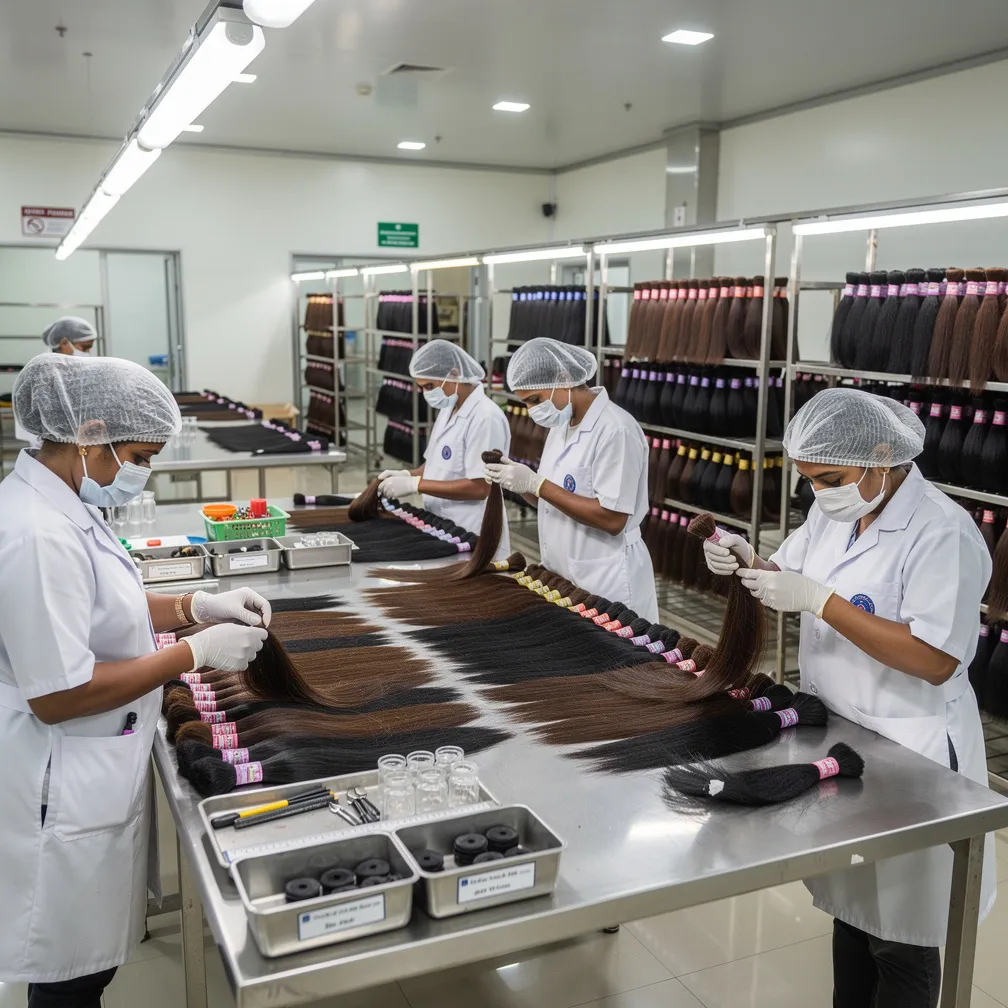
How Indian Temple Hair Is Processed
Indian temple hair is processed through a carefully sequenced manufacturing chain that begins with voluntary hair donations at South Indian Hindu temples and ends with finished Remy hair extensions that are exported to salons, distributors, and brands in over 80 countries. The process involves collection, raw sorting, cuticle verification, acid-free cleaning and conditioning, length grading and drawing, wefting or tipping based on the final product type, multiple quality inspections, and retail-ready packaging. Understanding this process in detail is valuable for any wholesale buyer — it explains why genuine Indian temple hair performs significantly better than alternatives, and it gives you the knowledge to ask the right questions when evaluating potential manufacturing partners. For more details, see our guide on complete guide to sourcing hair extensions from India. For more details, see our guide on Hair Extension Return Policies.
Stage 1 — Temple Collection
The hair supply chain begins at temples, most prominently in the South Indian states of Andhra Pradesh and Tamil Nadu. The Tirumala Tirupati Devasthanam (TTD) in Andhra Pradesh is the world’s most famous hair collection site — with millions of devotees visiting annually and many performing the ritual of tonsuring (mundan), the temple collects an estimated 500–1,000 kg of hair per day.
The tonsuring ritual is a centuries-old Hindu tradition of offering one’s hair as an act of gratitude or devotion to the deity. The hair is shaved by trained barbers at the temple, collected immediately, and stored in designated facilities. Because the hair is removed by professionals in a clean, organized environment from a single person at a time, it retains its natural condition: the cuticles are intact and the entire strand from root to tip is from one donor, running in the same direction.
Temples auction their collected hair periodically — the TTD famously holds auctions that attract Indian and international hair processors. The auction price varies based on hair quality, length composition, and market demand. Manufacturers who source directly from these auctions or through established temple hair brokers have access to the most traceable, verifiable supply of raw Remy hair available anywhere in the world.
Other temples across Tamil Nadu, Karnataka, and Kerala also supply hair, as do certain religious ceremonies outside the temple system. Hair collected at these locations follows similar quality characteristics — single-donor, cuticle-aligned, unprocessed.
Stage 2 — Initial Sorting and Raw Quality Assessment
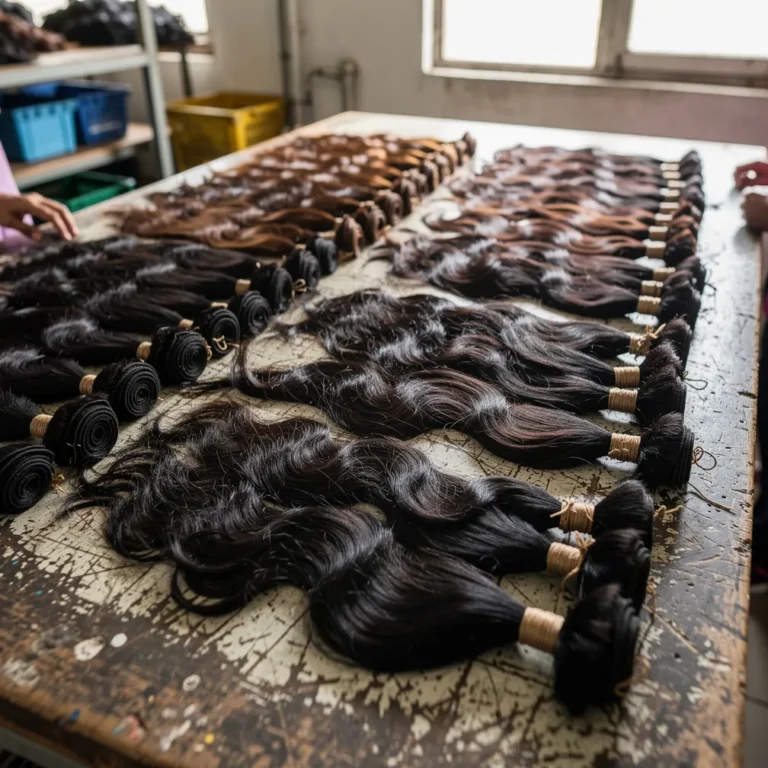
Raw temple hair arrives at processing facilities in bundles or bags, mixed by the circumstances of collection. The first processing stage is initial sorting and quality assessment, which involves several sub-steps.
Workers first segregate hair by approximate length. Temple hair naturally contains a wide range of lengths because donors have different hair growth histories — a single collection lot may include strands from 6 inches to 36 inches. These are broadly separated into length categories: short (under 10″), medium (10″–20″), and long (20″+). Long hair commands significantly higher prices and receives careful handling from the earliest stage.
Foreign material removal is the second sub-step: any non-hair material, broken strands, and extremely short pieces are removed manually. Workers in gloves examine the hair visually and by feel, removing debris before the hair proceeds to cleaning.
A cuticle alignment check is performed at this stage. Because temple hair is single-donor, the cuticles should naturally be running in the same direction. Workers verify this by running fingers root-to-tip vs. tip-to-root — Remy-grade hair feels smooth in the root-to-tip direction and slightly rough in reverse. Hair that does not pass this check is separated for different processing treatment.
Stage 3 — Cleaning and Conditioning (Acid-Free Process)
Cleaning is one of the most quality-critical stages in the entire process, and it is where the most significant quality differentiation occurs between premium Indian manufacturers and lower-quality processors.
Raw temple hair carries natural scalp oils, environmental dust, and sometimes chemical residues from the donor’s own hair care practices. It must be thoroughly cleaned before further processing. The critical choice at this stage is whether to clean with a mild, acid-free process or with a sulfuric or hydrochloric acid bath.
Low-quality processors use acid baths because they are fast and cheap — the acid strip the hair’s outermost cuticle layer, removing all dirt and impurities in a single aggressive chemical treatment. The problem is that acid stripping also permanently damages the cuticle, leaving the hair surface rough and prone to tangling. Processors compensate by coating the hair with silicone, which temporarily restores a smooth feel. The silicone washes off after several weeks, revealing the damaged, tangled hair beneath.
Premium Indian manufacturers use an acid-free process: a series of mild alkaline and neutral pH cleaners, gentle brushing, and pH-balanced conditioning treatments. This takes longer and requires more careful handling, but it preserves the natural cuticle layer intact. The result is hair that remains smooth and tangle-resistant not because of a coating, but because its own natural structure is undamaged.
After cleaning, hair is treated with a deep conditioning treatment — typically argan oil or a protein-based conditioner — to restore moisture and enhance luster. This is a standard step, not a cover-up; it is equivalent to the conditioning a person would do after shampooing their own hair.
Ask Us About Our Acid-Free Processing Standards on WhatsApp →
Stage 4 — Length Grading and Drawing
After cleaning and conditioning, the hair is ready for precise length grading and the drawing process that determines the final quality tier of the product.
Length Grading
Hair is measured and sorted into precise length categories — 16″, 18″, 20″, 22″, 24″, 26″, 28″, 30″, and so on. This is done using measuring boards or length frames that allow workers to sort strands quickly into the appropriate length bin. Precise length grading is what allows manufacturers to sell extensions in specific lengths and guarantees buyers receive the length they ordered.
Single Drawing vs. Double Drawing
Drawing is the process of combing through sorted hair to remove short strands and create a more uniform bundle. It is one of the primary differentiators between standard (single drawn) and premium (double drawn) hair extensions.
In single drawn hair, the bundle has been passed through a drawing comb once. The result is a bundle where the root end is full and dense, but the ends taper because approximately 30–50% of the strands are shorter than the labeled length. A single drawn 20″ bundle might contain strands ranging from 14″ to 20″, with the 20″ strands forming a minority. Single drawn hair is less expensive but produces a naturally tapered look similar to uncut natural hair.
In double drawn hair, the bundle is passed through the drawing process twice — the second pass specifically removes the shorter strands that survived the first pass. The result is a bundle where 70–80% of strands are at or very close to the labeled length. Double drawn hair is significantly denser at the ends, feels fuller in the hand, and produces a more uniform finished look. It is more expensive due to the additional process and because a larger volume of raw hair is required to produce the same weight of finished product after the short strands are removed.
Stage 5 — Wefting, Tipping, or Other Finishing Processes
At this stage, the prepared, sorted, drawn hair is ready to be transformed into the specific extension product type. The finishing process varies significantly by product.
Production Process by Extension Type
| Extension Type | Finishing Process | Typical Production Time | Key Equipment |
|---|---|---|---|
| Machine weft | Aligned bundles fed through industrial weft sewing machine | Minutes per piece | Weft sewing machine |
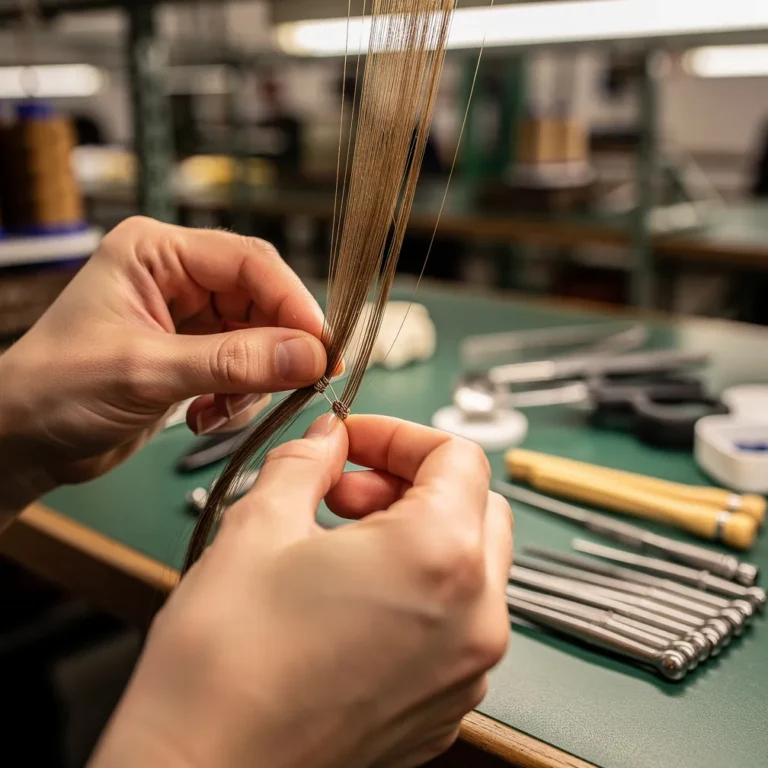
| Hand-tied weft | Small sections individually knotted by hand onto thread base | Several hours per piece | Manual skill only |
| I-tip / stick tip | Individual strands bonded with Italian keratin into cylindrical tip | Medium — semi-automated | Keratin bonding machine |
| U-tip / nail tip | Individual strands bonded with keratin into U-shaped tip | Medium — semi-automated | Keratin tip machine |
| Flat tip | Strands flattened with keratin into flat rectangular tip | Medium | Flat tip press |
| Tape-in | Machine weft cut to width, medical-grade adhesive tape applied to root | Fast — semi-automated | Tape application machine |
| Clip-in | Machine weft segments with pressure-sensitive clips attached | Medium — manual clip attachment | Weft cutter, clip press |
| Lace closure/frontal | Individual strands hand-ventilated onto lace base | Slow — skilled hand work | Ventilation needles |
Stage 6 — Color Processing (Where Applicable)
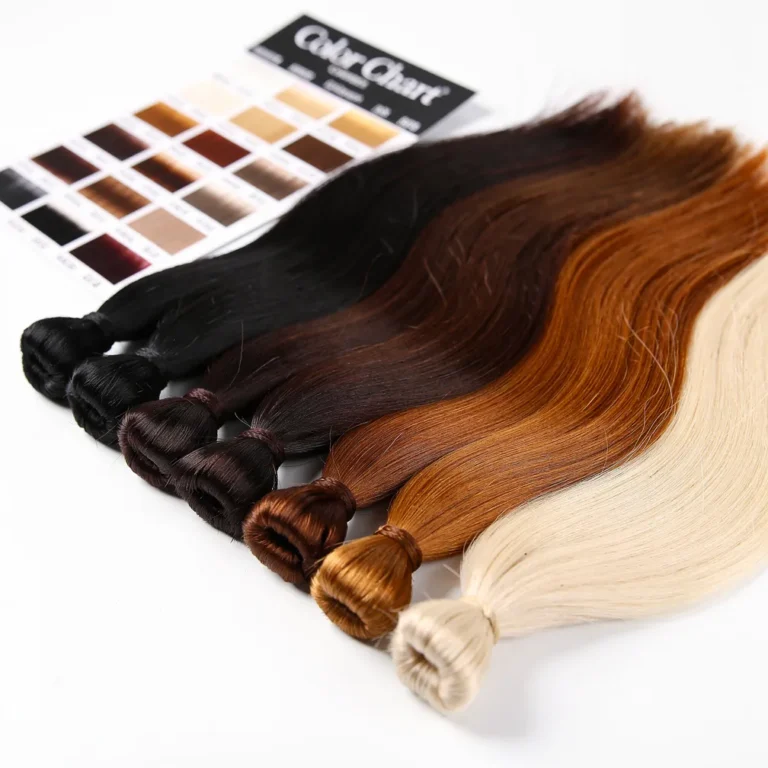
Natural temple hair is collected in its original color — ranging from jet black (most common) through dark brown shades. Buyers who require specific colors request color processing, which occurs after the drawing stage and before or after wefting depending on the product type.
Color processing on Remy hair uses professional-grade oxidative hair dye. Because the cuticle layer is intact (in quality processing), the hair accepts color evenly and holds it well. Color results are predictable and consistent. Bleaching to achieve lighter shades (blondes, highlights) is also available but requires more aggressive processing that affects hair integrity — buyers requesting light colors should evaluate samples carefully for texture and longevity.
Virgin hair and raw hair orders skip the color stage entirely, which is one reason buyers who plan to color extensions themselves prefer purchasing undyed product from India rather than pre-colored alternatives from other sources.
Stage 7 — Quality Control Inspection
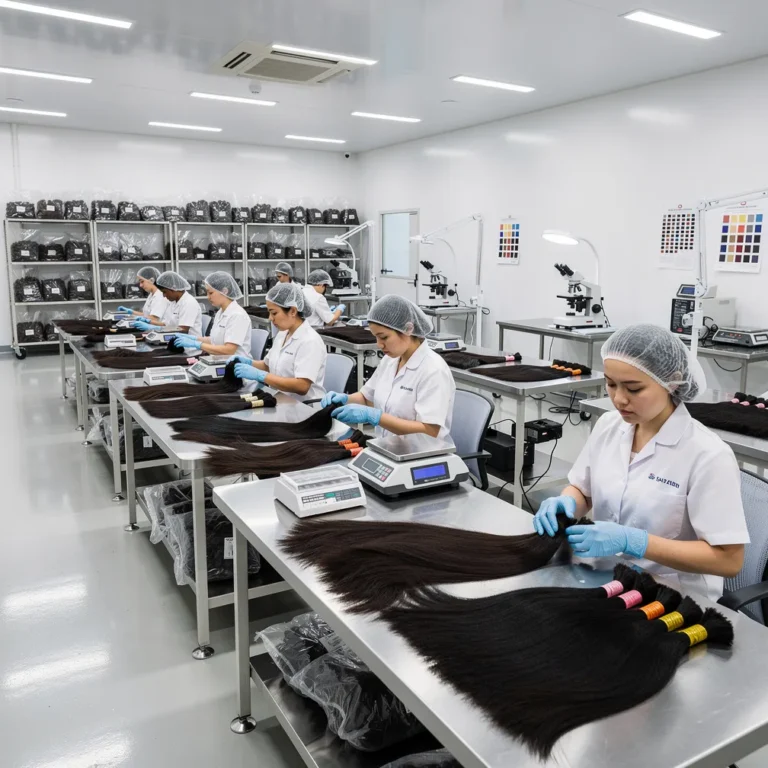
Quality control in a well-run Indian hair extension facility involves multiple checkpoints rather than a single end-of-line inspection. The most thorough manufacturers inspect at 3–5 points across the production process.
A final pre-packaging inspection typically includes: weight verification (each bundle weighed to confirm it meets the specified gram weight); length measurement (random strands measured against the specified length); cuticle check (the root-to-tip smoothness test repeated); visual inspection for uniformity of texture and color; and shedding check (bundle flexed and assessed for loose strands).
For branded or private label orders, the quality control stage also includes packaging verification — confirming that the right product is in the right packaging with the correct labels, hangtags, and brand elements.
Stage 8 — Packaging and Export Preparation
Finished extensions are packaged per the buyer’s specification — standard manufacturer packaging for wholesale buyers, or custom private label packaging for brand clients. Products are then prepared for export: packed in shipping cartons, weighed and measured for the shipping manifest, and accompanied by commercial invoice, packing list, and certificate of origin documentation required for international customs clearance.
For wholesale buyers interested in understanding why certain products cost more and perform better, this eight-stage process is the answer. Every additional step — double drawing vs. single drawing, acid-free vs. acid processing, hand-tied vs. machine weft — adds cost but also adds the performance quality that end clients can see and feel. See our article on single drawn vs. double drawn hair for a deeper look at how the drawing stage affects the final product.
Request a Factory Process Overview and Sample Kit on WhatsApp →
Why Manufacturing Transparency Matters for Wholesale Buyers
A manufacturer who is transparent about their processing methods is a manufacturer worth doing business with. Legitimate manufacturers welcome questions about their process because their process is their quality advantage. Ask specifically: Do you use acid or acid-free processing? Can you show me your sorting and drawing process on video? What is your quality control procedure? How many grams does each bundle actually weigh?
Manufacturers who are evasive about these questions, who cannot show their factory on video, or who cannot explain their processing steps clearly are likely trading companies purchasing from workshops with inconsistent quality control — not manufacturers in control of their own production chain.
Frequently Asked Questions
How is Indian temple hair collected?
Temple hair is collected through the Hindu tradition of tonsuring (mundan), where devotees voluntarily shave their heads as a religious offering at temples. The hair is cut by trained barbers, immediately collected, and stored in temple facilities. Major collection centers include the Tirumala Tirupati Devasthanam in Andhra Pradesh.
What makes temple hair different from other Indian hair?
Temple hair is single-donor hair removed in a single shaving session, ensuring all strands from that donor run in the same cuticle direction. This natural Remy alignment makes it superior to hair collected from brushes, salon floors, or multiple donors mixed together.
What is the difference between acid and acid-free hair processing?
Acid processing strips the hair cuticle with sulfuric or hydrochloric acid to clean and realign it, then coats the hair with silicone to restore smoothness. Acid-free processing uses mild pH-balanced cleansers that preserve the natural cuticle intact. Acid-free processed hair lasts significantly longer because it retains its own natural structure.
How long does it take to process temple hair into finished extensions?
The complete process from raw collection to finished, packaged extensions typically takes 14–30 days depending on the product type. Standard machine weft bundles can be produced faster; hand-tied wefts, lace frontals, and complex custom orders require more time.
What is the drawing process in hair extension manufacturing?
Drawing is the process of combing through sorted hair to remove short strands and create a more uniform bundle. Single drawing creates a naturally tapered bundle. Double drawing removes shorter strands a second time to create a fuller, more uniform bundle where most strands are at or near the labeled length.
Can I visit the manufacturing facility before placing a wholesale order?
Yes. Legitimate Indian hair manufacturers welcome factory visits from serious wholesale buyers. For international buyers who cannot visit in person, a detailed video call factory tour is the standard alternative, showing the sorting, processing, and production areas live.
Does Indian temple hair require any chemical processing to be usable?
Only cleaning and conditioning — not chemical alteration. Acid-free washing removes natural oils and environmental residue. Conditioning restores moisture. The hair’s natural structure, color, and cuticle alignment are all preserved. No acid treatment, silicone coating, or artificial cuticle realignment is required for genuine Remy temple hair.
Source Authentically Processed Indian Temple Hair
Hair Extensions By Nature processes raw temple hair in our own facility in Faridabad, Haryana. We use acid-free processing throughout, maintain transparent quality standards, and welcome wholesale buyers to conduct factory visits or video call tours before placing their first order. Our commitment to process transparency is the foundation of long-term supply relationships with buyers in over 40 countries.
Contact Us on WhatsApp to Discuss Sourcing →
Email: info@hairextensionsbynature.com
Hair Extensions By Nature — Manufacturer and Exporter of Remy Indian Human Hair Extensions. Factory: Booth No 71, Sector 16 Huda Market, Faridabad, Haryana, India – 121002. Phone/WhatsApp: +91 9289358222.