Custom Hair Extension Brand Development India
Custom Hair Extension Brand Development India [2026 Guide]
Building a custom hair extension brand with an Indian manufacturer is now achievable with an initial investment as low as USD 3,000-5,000, MOQs starting at 50 pieces per SKU, and a timeline of 6-10 weeks from concept to first inventory shipment. The global hair extensions market exceeded USD 4.5 billion in 2026, and the fastest-growing segment is independent and digitally native brands selling directly to salons and consumers. This guide covers the complete brand development process — from market positioning and brand identity through packaging design, manufacturer selection, and launch execution.
At Hair Extensions By Nature, we have helped hundreds of brand owners across 30+ countries bring their hair extension vision to market from our manufacturing facility in Faridabad, Haryana. The process below reflects what actually works, based on two decades of production experience and direct feedback from brand partners at every stage of growth.
Ready to start building your hair extension brand? Hair Extensions By Nature offers complete brand development support — from product selection through custom packaging and international delivery. Talk to our team today.
WhatsApp Us for Brand Development
Step 1: Define Your Market Position and Target Customer
Before selecting products or designing packaging, you need to answer three questions that will determine every decision downstream: Who are you selling to? What price point will you compete at? And how will your brand be different from the hundreds of hair extension brands already in the market?
Customer segment. Are you targeting professional salon buyers who value consistency and bulk pricing? Direct-to-consumer customers buying through Instagram and your website? Wholesale distributors who need competitive margins? Each segment has different product preferences, packaging expectations, and price sensitivity.
Price positioning. The hair extension market naturally segments into three tiers: budget (synthetic and non-Remy blends), mid-range (Remy human hair, standard processing), and premium (virgin/raw temple hair, custom colors, luxury packaging). Your price tier determines your product selection, packaging investment, and target margin. Most successful independent brands in 2026 operate in the mid-range to premium segment where brand differentiation creates pricing power.
Brand differentiation. Your differentiator might be ethical sourcing transparency, a specific texture focus (curly, wavy, or straight), color specialization, salon-exclusive distribution, or an underserved demographic. The strongest brands solve a specific problem for a specific customer rather than trying to be everything to everyone.
Step 2: Develop Your Brand Identity
Your brand identity is the visual and verbal system that makes your product recognizable and memorable. For hair extensions specifically, this system appears on packaging, your website, social media, care cards, and every customer touchpoint.
Brand name. Choose a name that is easy to spell, easy to remember, and available as a domain name and social media handle. Avoid names that are too similar to established brands — this creates legal risk and customer confusion. Check trademark databases in your target markets before committing.
Logo and visual identity. Invest in a professional logo that works at small sizes (hang tags) and large formats (website headers, packaging). Your visual system should include primary and secondary colors, typography choices, and a consistent aesthetic that reflects your price positioning. Premium brands use clean, minimal design. Younger, trend-driven brands can be bolder with color and typography.
Brand story. Your brand story is not your biography — it is the reason your customer should choose you over alternatives. Effective brand stories in the hair extension space focus on quality commitment, sourcing transparency, the founder’s personal connection to the product, or a specific mission (empowering women, supporting ethical trade, salon-grade quality at accessible prices).
Brand voice. How does your brand communicate? Professional and clinical? Warm and empowering? Edgy and fashion-forward? Your voice should be consistent across packaging copy, website text, social media captions, and customer service interactions.
Step 3: Select Your Product Line
The most common mistake new brand owners make is launching with too many SKUs. A focused initial product line is easier to manufacture, easier to market, and easier to manage from an inventory perspective. Here is a framework for building your launch collection.
Start with 4-6 hero SKUs. Choose the products and variants that your target customer is most likely to buy first. For a salon-focused brand, this might be three lengths of weft bundles in natural black and dark brown plus a closure. For a consumer brand, it might be clip-in sets in four popular colors.
Test before expanding. Use your first 3-6 months of sales data to identify which SKUs perform and which sit in inventory. Then expand into adjacent products (additional colors, lengths, or extension types) based on actual demand rather than assumptions.
| Brand Type | Recommended Launch SKUs | Estimated Launch Investment |
|---|---|---|
| Salon-Focused (Bundles + Closures) | 3-4 lengths x 2 colors + 1 closure style | USD 3,000-5,000 |
| DTC Consumer (Clip-Ins) | 2 lengths x 3-4 colors | USD 3,500-6,000 |
| Wig Brand | 3-4 styles x 2 colors | USD 4,000-8,000 |
| Full-Line Distributor | Bundles + clip-ins + tape-ins (3 colors each) | USD 8,000-15,000 |
Need help selecting the right launch SKUs for your market? Our team advises brand builders every day on product selection based on destination market demand. Get in touch for a product consultation.
WhatsApp Us for Wholesale Pricing
Step 4: Design Your Packaging
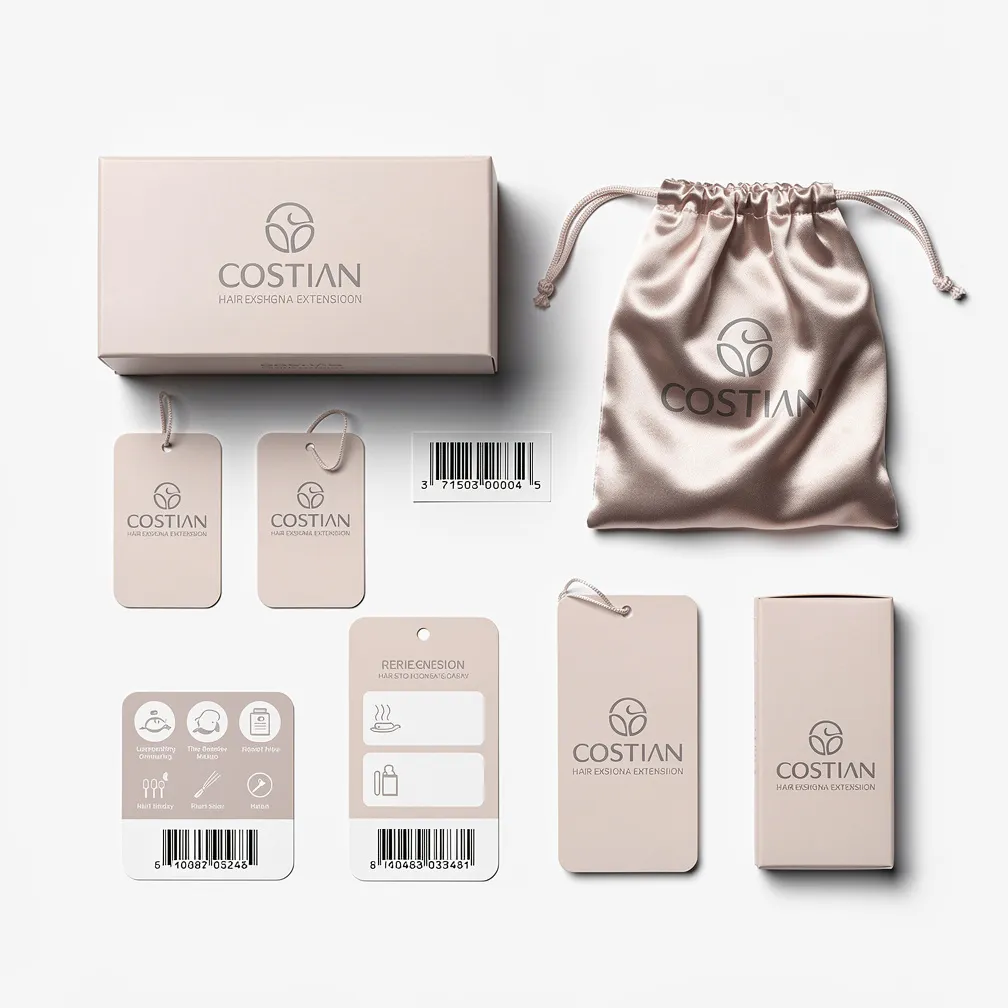
Packaging is where your brand becomes tangible. In hair extensions, the unboxing experience directly influences perceived value and repeat purchase likelihood. Your packaging design should accomplish three things: protect the product during shipping, communicate your brand identity at first glance, and provide essential product information.
Box design. Custom printed boxes are the standard for any brand positioning above entry-level. Key decisions include box style (tuck end, magnetic closure, sleeve), material (coated cardboard, rigid board), and finish (matte, gloss, soft-touch laminate). Your box should include your logo, product name, length/weight/color information, and a barcode if selling through retail channels.
Hang tags. Even if your product is packaged in a box, a hang tag adds a secondary branding touchpoint. Hang tags typically include your logo, product variant information, care instructions summary, and website/social media handles.
Care instruction cards. A printed care card inside the packaging serves dual purposes — it helps the end customer maintain the product (reducing complaints and returns) and reinforces your brand as professional and customer-oriented. Include washing instructions, heat styling guidelines, storage recommendations, and a QR code linking to your website for detailed care videos.
Label placement on wigs and extensions. For wigs, brand labels are typically sewn into the inner cap near the nape area. For weft extensions, a small woven label can be stitched at the end of the weft. For clip-in sets and tape-in packs, branding is primarily on the packaging rather than the product itself. Discuss placement options with your manufacturer to ensure labels are secure but not visible when worn.
Step 5: Partner With the Right Manufacturer
Your manufacturer is your most important business partner. The right manufacturer acts as an extension of your brand — delivering consistent quality, meeting deadlines, supporting your customization needs, and scaling with you as your brand grows.
Key criteria for evaluating a manufacturing partner for brand development:
- Own production facility: Not a trading company or middleman. Verify with factory videos and export documentation
- White label and private label capability: The manufacturer should handle packaging procurement, label application, and shelf-ready fulfillment
- Flexible MOQs: Essential for new brands that cannot commit to 500+ pieces per SKU on the first order
- Design support: Packaging design assistance or willingness to work with your design files
- Sample program: Ability to produce branded samples before bulk production
- Communication quality: Responsive, English-fluent export team available on WhatsApp and email
- International shipping experience: Proper documentation for customs clearance in your market
Step 6: Manage the Production and Launch Process
Once you have finalized your product selection, brand identity, packaging designs, and manufacturer partnership, the production process follows a predictable timeline. Effective project management at this stage prevents costly delays and quality issues.
Weeks 1-2: Order confirmation and packaging finalization. Confirm product specifications, quantities, and pricing in writing. Approve final packaging artwork and print-ready files. Pay the advance deposit per agreed payment terms.
Weeks 3-4: Production and packaging manufacturing. The factory produces your hair extensions while packaging is printed simultaneously. Request progress photos or videos at key milestones — particularly after coloring and before final assembly.
Week 5: Assembly, packaging, and quality check. Finished extensions are packaged in your branded materials. A quality audit confirms product specifications, packaging accuracy, and piece counts. Pre-shipment photos are sent for your approval.
Week 6: Shipping and delivery. International express shipping (DHL, FedEx) typically delivers within 5-7 business days from dispatch. Sea freight is more economical for large orders but adds 3-5 weeks of transit time.
While your inventory is in production, focus on building your sales infrastructure — website, social media accounts, salon outreach, and launch marketing content. Your inventory should arrive to a market that is already primed to buy.
Get a production timeline for your brand launch. Tell us your product requirements and target launch date, and we will map out a production schedule to meet your deadline.
WhatsApp Us for Wholesale Pricing
Why Build Your Brand With Hair Extensions By Nature?
Hair Extensions By Nature is a vertically integrated Remy hair extension manufacturer based in Faridabad, Haryana — India’s leading hair extension export hub. We specialize in supporting brand builders from concept through ongoing production. Here is what sets our brand development program apart:
- End-to-end support: Product selection, packaging design, production, quality control, and international shipping — all handled from one facility
- 20 years of manufacturing expertise: We understand what sells in every major market because we ship to 30+ countries
- Low MOQs for new brands: Start with 50 pieces per SKU and scale as your brand grows
- 100% Remy human hair: Cuticle-aligned, ethically sourced — the quality foundation your brand reputation depends on
- Packaging coordination: We manage box printing, tag production, and assembly so you receive shelf-ready inventory
- Dedicated WhatsApp support: Direct communication with our export team throughout the process
Frequently Asked Questions
How much does it cost to start a hair extension brand?
A focused hair extension brand can launch with an initial inventory investment of USD 3,000-5,000 for a small collection of 4-6 SKUs sourced from an Indian manufacturer. This includes product cost, custom packaging, and international shipping. Additional costs include website development (USD 500-2,000), logo design (USD 100-500), and initial marketing (variable). Total startup costs for a lean brand launch typically range from USD 5,000-10,000.
How long does it take to develop a hair extension brand from scratch?
From initial concept to receiving your first branded inventory typically takes 6-10 weeks. This includes 1-2 weeks for brand planning and product selection, 1-2 weeks for packaging design and approval, 2-3 weeks for production, and 1-2 weeks for shipping. Brands that have their identity and packaging design ready before approaching a manufacturer can compress this timeline to 4-6 weeks.
What should a hair extension brand packaging include?
Professional hair extension packaging should include a custom-printed box with your logo and product information, a hang tag with variant details, a care instruction card with washing and styling guidelines, and barcode labeling if selling through retail or marketplace channels. Premium brands also include satin or organza bags, tissue paper, branded sealing stickers, and QR codes linking to care videos or warranty registration.
Can I trademark my hair extension brand name internationally?
Yes. You can register trademarks in each country where you plan to sell. The Madrid Protocol allows filing a single international trademark application that designates multiple countries. Filing costs range from USD 250-600 per class per country. It is advisable to conduct a trademark search and file for registration before investing in packaging and marketing to avoid costly rebranding if your name conflicts with an existing mark.
Where should brand labels be placed on hair extensions and wigs?
For wigs, brand labels are typically sewn into the inner cap near the nape area so they are hidden when worn. For weft extensions, a small woven label can be stitched at the weft edge. For clip-in sets and tape-in packs, branding is primarily on the external packaging rather than the product itself. Discuss placement options with your manufacturer to ensure labels are durable but discreet during wear.
Do I need a business license to sell hair extensions under my own brand?
Requirements vary by country and state. In the United States, you typically need a general business license, a sales tax permit, and potentially a resale certificate. Some states classify hair extensions as cosmetic products with additional labeling requirements. In the UK, EU, Nigeria, and other markets, local regulations apply. Consult a business attorney or accountant in your market to ensure compliance before launching.
Start Your Hair Extensions Dropship Business
Zero inventory. Premium Indian Remy hair. Ship worldwide under your brand. MOQ as low as 5 pieces.
Start Building Your Hair Extension Brand Today
The barrier to entry for launching a hair extension brand has never been lower. With the right manufacturing partner, a clear brand vision, and a focused product line, you can go from concept to market in under 10 weeks. Hair Extensions By Nature provides the manufacturing backbone — you bring the brand and the customer relationships.
Let us help you build your brand.
WhatsApp: +91 9289358222
Email: info@hairextensionsbynature.com
Website: www.hairextensionsbynature.com
Factory: Booth No 71, Sector 16 Huda Market, Faridabad, Haryana, India – 121002