Hair Extension Pricing Formula and Markup Guide
Hair Extension Wholesale Pricing Formula and Markup Guide [2026]
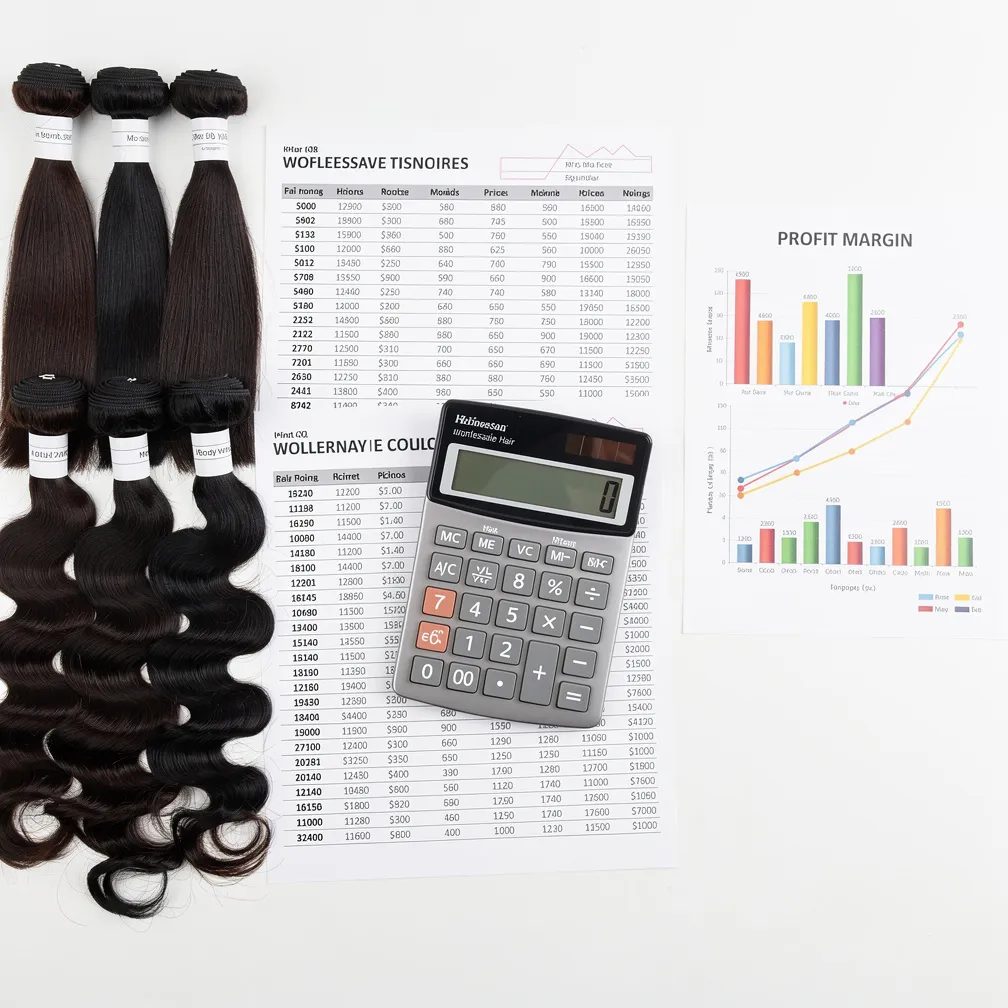
The hair extension wholesale pricing formula that consistently produces profitable retail businesses starts with an accurate landed cost calculation — not just the ex-factory price — and applies a markup multiplier between 2.0x and 3.5x based on hair grade, target market positioning, and competitive landscape. In 2026, with the global hair extensions market valued at over USD 5.36 billion and growing at a 12.1% CAGR, getting your pricing strategy right is the difference between a sustainable business and one that bleeds margin on every sale. This guide breaks down the exact cost components, markup formulas, and margin optimization strategies that successful hair extension retailers and salon owners use to build profitable product lines.
The pricing framework below is based on direct manufacturing experience at Hair Extensions By Nature, a factory-direct supplier based in Faridabad, India, that exports Remy and raw temple hair extensions to wholesale buyers in over 30 countries. We share these numbers openly because informed buyers make better long-term partners.
Need factory-direct pricing to build your margins? Hair Extensions By Nature supplies Remy and raw Indian hair extensions at manufacturer pricing with MOQs starting from 1 kg. WhatsApp us for a custom price list based on your target product mix.
WhatsApp Us for Wholesale Pricing
Understanding Your True Landed Cost
The most common pricing mistake new hair extension retailers make is calculating markup based only on the product purchase price. Your landed cost — the true cost of getting that hair extension into your hands, ready to sell — includes several additional components that must be accounted for before you set any retail price.
Here is the complete landed cost formula:
Landed Cost = Product Cost + International Shipping + Import Duties/Taxes + Domestic Freight + Handling/Inspection + Payment Processing Fees
| Cost Component | Typical Range | Notes |
|---|---|---|
| Product Cost (FOB India) | Base price | Varies by grade, length, and volume |
| International Shipping | $8-15 per kg (express); $3-6 per kg (sea) | DHL/FedEx for small orders; sea freight for 50+ kg |
| Import Duties | 0-12% of declared value | US: 0% (HS 6703); UK: 2.2%; Nigeria: 20% |
| Domestic Freight | 1-3% of product cost | Port/airport to your warehouse |
| Handling and Inspection | 1-2% of product cost | Receiving, quality check, repackaging |
| Payment Processing Fees | 1.5-4% of transaction | Wire transfer fees, PayPal, or LC charges |
As a general rule, your total landed cost will be 15-30% higher than the FOB product price, depending on your destination country and shipping method. Failing to account for these costs means your actual margin is significantly lower than what your spreadsheet says.
The Markup Formula for Hair Extensions
Once you have your accurate landed cost, the retail pricing formula is straightforward:
Retail Price = Landed Cost x Markup Multiplier
The markup multiplier you choose depends on your market positioning, competition, and the specific product category. Here are the standard ranges used by successful hair extension retailers across different markets:
| Product Category | Markup Range | Gross Margin | Positioning |
|---|---|---|---|
| Remy Weft Bundles | 2.5x – 3.0x | 60-67% | Mid-premium retail |
| Raw Temple Hair | 3.0x – 3.5x | 67-71% | Premium/luxury |
| Clip-In Sets | 2.5x – 3.0x | 60-67% | Consumer retail |
| Tape-In Extensions | 2.5x – 3.5x | 60-71% | Salon professional |
| Lace Wigs | 2.0x – 2.5x | 50-60% | Competitive market |
| Hand-Tied Wefts | 3.0x – 3.5x | 67-71% | Premium salon |
Pricing by Length: The Length Premium Strategy
Hair extension pricing is not linear with length — it is exponential. A 24-inch bundle does not cost twice as much as a 12-inch bundle; it costs three to four times as much because longer donor hair is significantly rarer. Smart retailers use this natural cost curve to their advantage by applying progressively higher markups to longer lengths.
For example, if your 14-inch Remy bundle has a landed cost of $30 and you apply a 2.5x markup ($75 retail), your 22-inch bundle with a landed cost of $65 should command a 3.0x or higher markup ($195+ retail). Consumers expect to pay more for length, and the incremental value perception is stronger than the actual cost increase.
This length-based tiered pricing strategy is standard among the most successful hair extension brands we supply at Hair Extensions By Nature. Buyers who implement it consistently report 10-15% higher overall margins compared to flat-rate markup approaches.
Competitive Pricing Without Destroying Margins
Price competition in the hair extension market is intense, particularly in online channels. However, competing solely on price is a losing strategy — the factory in China or the trading company with questionable quality will always undercut you. Here are the margin-preserving strategies that work:
- Differentiate on quality documentation: Provide certificates of authenticity, sourcing transparency, and quality guarantees that cheaper competitors cannot match
- Bundle strategically: Sell three-bundle deals or bundle plus closure sets at a slight per-unit discount that increases average order value by 40-60%
- Offer salon-exclusive pricing: Create a professional program with 15-20% discount for licensed stylists that locks in repeat volume
- Build aftercare into the price: Include maintenance guides, free replacement clips, or aftercare kits that add perceived value for under $2 per unit
- Use psychological pricing: Price at $179 instead of $180 — this is well-documented to improve conversion rates by 8-15% in the beauty category
Volume Discount Structures from Manufacturers
Your wholesale cost is not fixed — it decreases with volume, and understanding manufacturer discount tiers allows you to plan purchases that maximize margin. Here is a typical volume discount structure from a direct Indian manufacturer:
| Order Volume | Typical Discount | Impact on Retail Margin |
|---|---|---|
| 1-5 kg (starter) | Base price (0%) | Standard margin at 2.5x-3.0x |
| 5-10 kg | 5-10% off base | +3-5% margin improvement |
| 10-25 kg | 10-15% off base | +5-8% margin improvement |
| 25-50 kg | 15-20% off base | +8-12% margin improvement |
| 50+ kg | 20-25% off base | +12-15% margin improvement |
The math is clear: a buyer purchasing 25 kg at a 15% volume discount and maintaining the same retail prices sees their gross margin increase from 60% to nearly 68% — a meaningful difference that compounds across hundreds of sales per month.
Get volume-optimized pricing for your business. Hair Extensions By Nature offers tiered wholesale pricing with transparent volume discounts. Tell us your monthly volume and target product mix, and we will build a custom price sheet that maximizes your margins.
Common Pricing Mistakes to Avoid
After working with hundreds of wholesale buyers over the years, we consistently see these pricing errors that erode profitability:
- Ignoring landed cost: Calculating markup on product price alone, forgetting shipping, duties, and handling — this understates your true cost by 15-30%
- Flat markup across all lengths: Applying the same multiplier to 12-inch and 26-inch hair leaves significant money on the table for longer lengths
- Racing to the bottom on price: Matching the cheapest competitor who is likely selling non-Remy or blended hair while you sell genuine Remy product
- Not accounting for returns: Build a 3-5% return allowance into your pricing — hair extensions have industry-average return rates of 3-8%
- Underpricing salon services: If you sell both product and installation, price the service at 1.5x-2.0x the product cost, not as a flat fee
- Failing to adjust for seasonality: Prices can be higher during peak seasons (wedding season, back to school, holidays) without losing customers
Why Source From Hair Extensions By Nature
Hair Extensions By Nature (legal entity: Hair Envy LLP) is a direct manufacturer based in Faridabad, Haryana, India. We supply factory-direct pricing that eliminates intermediary markups, giving our wholesale buyers a cost advantage of 30-50% compared to trading companies. Our pricing transparency means you know exactly what you are paying for — raw material, processing, packaging, and shipping — with no hidden costs.
We support our buyers’ pricing strategies with flexible MOQs starting from 1 kg for raw hair and 50 pieces for finished products. Our tiered volume discount structure is designed to reward growing businesses with progressively better pricing as order volumes increase. Contact us at info@hairextensionsbynature.com or visit our facility at Booth No 71, Sector 16 Huda Market, Faridabad, Haryana, India – 121002.
Frequently Asked Questions
What is the standard markup for hair extensions?
The standard markup for hair extensions ranges from 2.0x to 3.5x the landed cost. Remy weft bundles typically carry a 2.5x to 3.0x markup, raw temple hair commands 3.0x to 3.5x, and lace wigs are marked up 2.0x to 2.5x due to higher competition. These multipliers yield gross margins of 50-71% depending on product category and market positioning.
How do I calculate the landed cost of hair extensions from India?
Landed cost equals the product purchase price plus international shipping ($8-15 per kg via express courier), import duties (0-20% depending on destination country), domestic freight (1-3% of product cost), handling and inspection costs (1-2%), and payment processing fees (1.5-4%). Total landed cost is typically 15-30% higher than the FOB product price.
What profit margin should I target for a hair extension business?
Successful hair extension retailers target a gross margin of 55-70% on product sales. After accounting for operating expenses (marketing, website, rent, staff), the net profit margin for well-run hair extension businesses typically falls between 20-35%. Salon owners who install extensions can achieve combined product-and-service margins of 70-80%.
Should I charge more for longer hair extensions?
Yes. Hair extension pricing should follow a tiered structure where longer lengths carry progressively higher markups. Since longer donor hair is exponentially rarer and more expensive to source, consumers expect higher prices. Apply a 2.5x markup for shorter lengths (10-16 inches) and increase to 3.0x-3.5x for longer lengths (20-28 inches) to maximize overall profitability.
How much discount can I get on bulk hair extension orders from India?
Volume discounts from direct Indian manufacturers typically range from 5-10% for orders of 5-10 kg, 10-15% for 10-25 kg, 15-20% for 25-50 kg, and 20-25% for orders exceeding 50 kg. These discounts are applied to the base wholesale price and can improve your retail margin by 3-15 percentage points depending on order size.
Start Your Hair Extensions Dropship Business
Zero inventory. Premium Indian Remy hair. Ship worldwide under your brand. MOQ as low as 5 pieces.