Hair Extension Salon Menu — How to Price Extensions for Maximum Profit [2026]
Pricing hair extension services for maximum salon profitability requires a cost-plus markup approach that accounts for three components: hair product cost, labor time, and overhead allocation. The target gross margin for professional hair extension services is 50–70%, with the most profitable salons achieving the upper end of that range by sourcing hair directly from Indian manufacturers (eliminating distributor markups of 30–50%) and pricing services based on value delivered rather than cost-plus minimums. This guide gives you the complete framework — cost calculation, pricing formulas, menu structure, maintenance pricing strategy, and upselling mechanics — to build a salon extension menu that generates consistent, high-margin revenue. For more details, see our guide on Hair Extension Dropshipping from India. For more details, see our guide on Hair Extension Brand Marketing Strategy.
Understanding the Three Cost Components
Before setting any prices, you need accurate cost data for each extension service on your menu. There are three cost components to account for for every service.
Component 1: Hair Product Cost
This is the wholesale cost of the extension hair used in the service — the amount you paid per pack or per bundle, multiplied by the quantity needed for the service. This is the component most salons can most significantly improve: sourcing direct from an Indian manufacturer versus buying through a local distributor typically reduces hair product cost by 30–50%.
For example: tape-in extensions purchased from a local distributor at $15 per pack (20-piece pack) require 4–5 packs for a full head — $60–$75 in hair cost. The same quality extensions sourced directly from India at $9–$11 per pack wholesale would cost $36–$55 in hair product — a saving of $20–$40 per application that directly increases your margin.
Component 2: Labor Cost
Labor cost is your total compensation cost for the stylist’s time, including their hourly rate or commission and any applicable employer taxes. Calculate this as: (service duration in hours) x (stylist’s fully-loaded hourly cost).
For a senior stylist costing the salon $45 per hour (after factoring in base pay, commission, and employer costs): a 2.5-hour tape-in application costs $112.50 in labor. A 4-hour I-tip fusion application costs $180 in labor. A 45-minute maintenance service costs $33.75 in labor. These labor costs are non-negotiable — they must be covered by the service price before any margin is generated.
Component 3: Overhead Allocation
Overhead includes a proportional allocation of all fixed and variable costs that are not directly tied to a specific service: rent, utilities, insurance, supplies, booking software, marketing, and administrative costs. A practical approach is to calculate your total monthly overhead, divide by total monthly service hours, and allocate that overhead cost per hour to each service.
If your salon’s monthly overhead is $8,000 and you perform 200 service hours per month, your overhead allocation is $40 per service hour. A 2.5-hour extension application carries $100 in overhead allocation. This number feels arbitrary to many stylists but is essential for accurate service pricing.
The Pricing Formula
Once you have the three cost components, the pricing calculation is:
Total Service Cost = Hair Product Cost + Labor Cost + Overhead Allocation
Service Price = Total Service Cost / (1 – Target Gross Margin)
For a 60% target gross margin: Service Price = Total Service Cost / 0.40
Example for a full tape-in application: Hair product cost $55 + Labor cost $112.50 + Overhead $100 = Total cost $267.50. At 60% target margin: $267.50 / 0.40 = $668.75 — round to $675.
This is the mathematics of sustainable extension service pricing. Many salons charge below this level because they underestimate their costs or copy competitor prices without knowing whether those prices are profitable. The pricing formula ensures your prices reflect your actual economics.
Reduce Your Hair Cost with Factory-Direct Indian Wholesale Pricing →
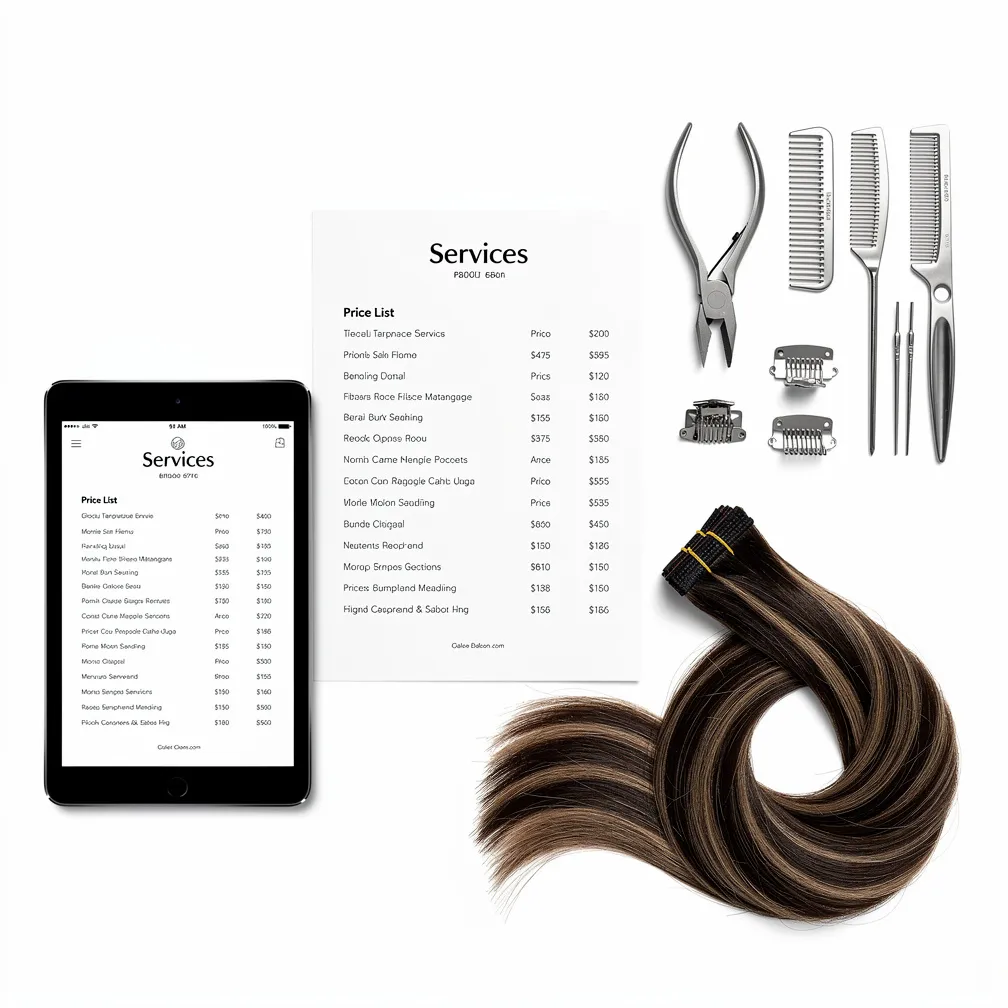
Hair Extension Service Pricing Table
The following table provides recommended service pricing ranges for the US market based on the cost framework above. These ranges reflect mid-market to premium salon positioning in metropolitan areas. Adjust for your specific market, client base, and cost structure.
| Service | Application Time | Hair Cost (wholesale-direct) | Recommended Price Range (USA) | Target Gross Margin |
|---|---|---|---|---|
| Tape-in full head (20–22″) | 2–3 hours | $50–$70 (4–5 packs) | $400–$700 | 55–65% |
| Tape-in partial (volume only) | 1.5–2 hours | $30–$45 (2–3 packs) | $250–$400 | 55–65% |
| Tape-in maintenance (reapplication) | 2–2.5 hours | $0 (client’s existing hair) | $180–$280 (labor + product fee) | 65–75% |
| I-tip fusion full head (20–22″) | 3.5–5 hours | $55–$90 (100–150 strands) | $500–$900 | 55–65% |
| I-tip maintenance/reposition | 2.5–3.5 hours | $0–$20 (replacement strands) | $200–$350 | 65–75% |
| U-tip / flat-tip full head (20″) | 3–4.5 hours | $55–$85 (80–120 strands) | $450–$850 | 55–65% |
| Hand-tied weft (full head, 20″) | 3–4 hours | $60–$110 (weft meters) | $500–$1,000 | 55–70% |
| Clip-in fitting consultation | 0.5–1 hour | $60–$100 (7-piece set) | $150–$250 (includes set) | 45–60% |
| Extension removal only | 1–1.5 hours | $0 | $80–$150 | 70–80% |
| Extension color service (toning) | 1–2 hours | $15–$30 (color product) | $120–$220 | 60–70% |
How Wholesale Cost Directly Affects Your Margin
The single most controllable variable in your extension service margin is the cost of the hair. Labor and overhead are relatively fixed once your salon is operating. But the hair cost is a choice — and sourcing direct from an Indian manufacturer versus buying through a distributor or local supplier can dramatically change your economics.
Margin Impact Example: Tape-In Full Head Application
Distributor pricing scenario: Hair purchased at $14 per pack, 5 packs needed = $70 hair cost. Labor $125. Overhead $100. Total cost $295. Service price $550. Gross margin = ($550 – $295) / $550 = 46%.
Direct India sourcing scenario: Hair purchased at $9 per pack, 5 packs = $45 hair cost. Labor $125. Overhead $100. Total cost $270. Service price $550 (unchanged — the client does not know or care where the hair came from). Gross margin = ($550 – $270) / $550 = 51%.
The 5-percentage-point improvement in gross margin translates to an additional $27.50 per application. For a salon doing 20 tape-in applications per month, that is $550 in additional monthly gross profit from the same service volume — $6,600 per year — simply from optimizing the supply chain.
Maintenance Services: The Highest-Margin Revenue Stream
Maintenance services — repositioning, reapplication, removal and reset — are typically the highest-margin services in an extension salon for one simple reason: there is no or minimal hair product cost. When a client comes for tape-in maintenance, they bring their existing hair extensions. The service is predominantly labor, priced at rates that reflect the skill and time required.
A well-structured maintenance service schedule creates predictable, recurring revenue. Tape-in clients return every 6–8 weeks. I-tip and fusion clients return every 8–12 weeks. Hand-tied weft clients return every 6–8 weeks. A salon with 30 active extension clients on rotation generates 15–20 maintenance appointments per month — steady, high-margin revenue that requires no client acquisition effort beyond retaining existing clients.
Maintenance pricing strategy: charge for maintenance by time rather than by a flat rate where possible. Clients who have more extensions, longer hair, or hair that has grown significantly will require more time. A time-based maintenance rate ($100–$150 per hour for senior stylist maintenance services) reflects the actual cost more accurately than a flat fee that may significantly underprice complex maintenance.
Upselling Strategies for Higher Average Ticket
The highest-revenue extension salons are not those with the most clients — they are those with the highest average service ticket. Upselling within the extension service framework is natural and serves client interests when done correctly.
Method Combination Upsell
Offer a primary extension method (e.g., tape-in for length) plus a complementary method for specific needs (e.g., I-tip for crown volume). Combined method services are less common and can be positioned as a premium offering that addresses the client’s full hair goals rather than a partial solution. These services command 30–50% premiums over single-method applications.
Length and Density Upgrade
When a client inquires about a 20-inch application, present the 22-inch and 24-inch options side-by-side with clear visual references to the different results. Many clients who came in thinking 20 inches will upgrade when they see how much more dramatic a 22-inch result looks. The additional packs or strands needed add $30–$60 in hair cost to you and $80–$150 to the service price.
Hair Care Retail
Every extension client needs extension-specific shampoo, conditioner, and styling products. Selling one retail kit per new extension client (priced at $45–$80) adds a high-margin product sale to every installation appointment. Retail margins on professional hair care products are typically 40–60%, and recommending specific products the client genuinely needs is a service, not just a sales act.
Lower Your Wholesale Cost with Direct India Sourcing — Get Pricing Now →
Menu Design Principles for Extension Services
How you present extension services on your salon menu affects how clients perceive value and make purchasing decisions. Several evidence-based menu design principles apply to extension service menus.
Lead with the experience, not the product: “Hand-tied weft extensions — invisible bonds, maximum natural movement, 12-week wear” communicates benefit. “Hand-tied weft — starting at $600” communicates cost. Lead with value, follow with price.
Use anchor pricing: List your most comprehensive (highest-priced) service first or prominently. This anchors the client’s price perception at the higher end, making mid-range options appear more accessible. A $1,200 premium package at the top of the menu makes a $550 service look reasonable by comparison.
Bundle consultation into the first appointment: A complimentary 15-minute consultation before all new extension clients’ first appointment is both a sales conversion tool (time with the client before they commit) and a quality assurance measure (ensuring you are recommending the right method for their hair type). Many salons find that consultation appointments convert at 80%+ to full bookings.
Simplify the selection for clients: Offer 3–4 extension methods, not 8. Choice overload causes purchasing paralysis. Present your most popular methods clearly, with a brief description of who each method is ideal for, and let your consultation guide clients to the right option.
For more on building a cost-effective hair supply chain that supports your margin goals, see our Complete Guide to Sourcing Hair Extensions from India.
Frequently Asked Questions
What is a typical gross margin for salon hair extension services?
Well-run hair extension services achieve gross margins of 55–70%. Initial installation services (where both hair and labor are sold) typically achieve 55–65% margin. Maintenance services (primarily labor, minimal product) achieve 65–75%+ margin. Salons achieving the higher end of these ranges typically source hair directly from manufacturers rather than through distributors.
How does sourcing from India improve salon extension margins?
Indian manufacturer direct pricing is typically 30–50% below what local distributors charge for comparable quality. On a service priced at $550 where hair costs $45 (direct) versus $70 (distributor), the difference is $25 per service — pure additional gross profit at the same service price. Over 20 services per month, that is $500 per month, or $6,000 per year in recovered margin.
Should I charge separately for hair and installation, or bundle them?
Bundled pricing (one total price for hair plus installation) is the most common approach and simplest for clients to understand. Separate pricing (client purchases hair, pays installation separately) gives clients more flexibility but creates administrative complexity and potential client objections about hair pricing. Bundled pricing also allows you to build the higher margin into the product component without clients directly comparing your hair prices to retail sources.
How should I price maintenance appointments?
Maintenance appointments are best priced on a time basis ($100–$150 per hour for a senior stylist) rather than a flat rate, as maintenance time varies significantly based on the number of extensions, hair growth, and condition of the bonds. Flat-rate maintenance underprices complex appointments. Communicate the hourly rate clearly at booking and provide an estimate based on the client’s extension count.
How do I introduce premium pricing for extension services in a competitive market?
Position on quality, not price. Educate clients on the difference between Remy Indian hair and lower-quality alternatives — explain why your extensions last 12–18 months versus 3–6 months for cheaper alternatives. When a client understands that your $550 service delivers 12 months of wear compared to a $350 alternative that needs replacing at 4 months, the value calculation favors premium pricing. Demonstrations, before-and-after portfolios, and client testimonials are your most powerful pricing justification tools.
What is the most profitable extension service to add to a salon menu?
Maintenance and repositioning services are typically the most profitable per hour because the hair product cost is zero or minimal. However, the most strategically valuable service to add is the highest-priced initial install method your market supports (often hand-tied weft or premium keratin fusion), because it sets the price anchor for your menu and attracts the highest-value clients with the strongest repeat maintenance revenue.
Improve Your Extension Margin Starting with Wholesale Cost
The fastest route to improving your extension service profitability is reducing the wholesale cost of your hair — without compromising the quality your clients expect. Sourcing directly from our Faridabad factory gives you access to the same Indian Remy hair that local distributors are marking up by 30–50% before it reaches you. Our minimum first order starts at 25 pieces, and we can ship samples for quality evaluation within 48 hours of your inquiry.
Get Factory-Direct Wholesale Pricing on WhatsApp →
Email: info@hairextensionsbynature.com
Hair Extensions By Nature — Manufacturer and Exporter of Remy Indian Human Hair Extensions. Factory: Booth No 71, Sector 16 Huda Market, Faridabad, Haryana, India – 121002. Phone/WhatsApp: +91 9289358222.
![Best Indian Hair for Salons Wholesale — Texture, Color & Buying Guide [2026]](https://hairextensionsbynature.com/wp-content/uploads/2026/04/02-best-indian-hair-salons-wholesale-hero-768x768.webp)

![Hair Extension Dropshipping from India — Can It Work for Your Business? [2026]](https://hairextensionsbynature.com/wp-content/uploads/2026/04/44-hair-extension-dropshipping-from-india-hero-768x768.webp)