
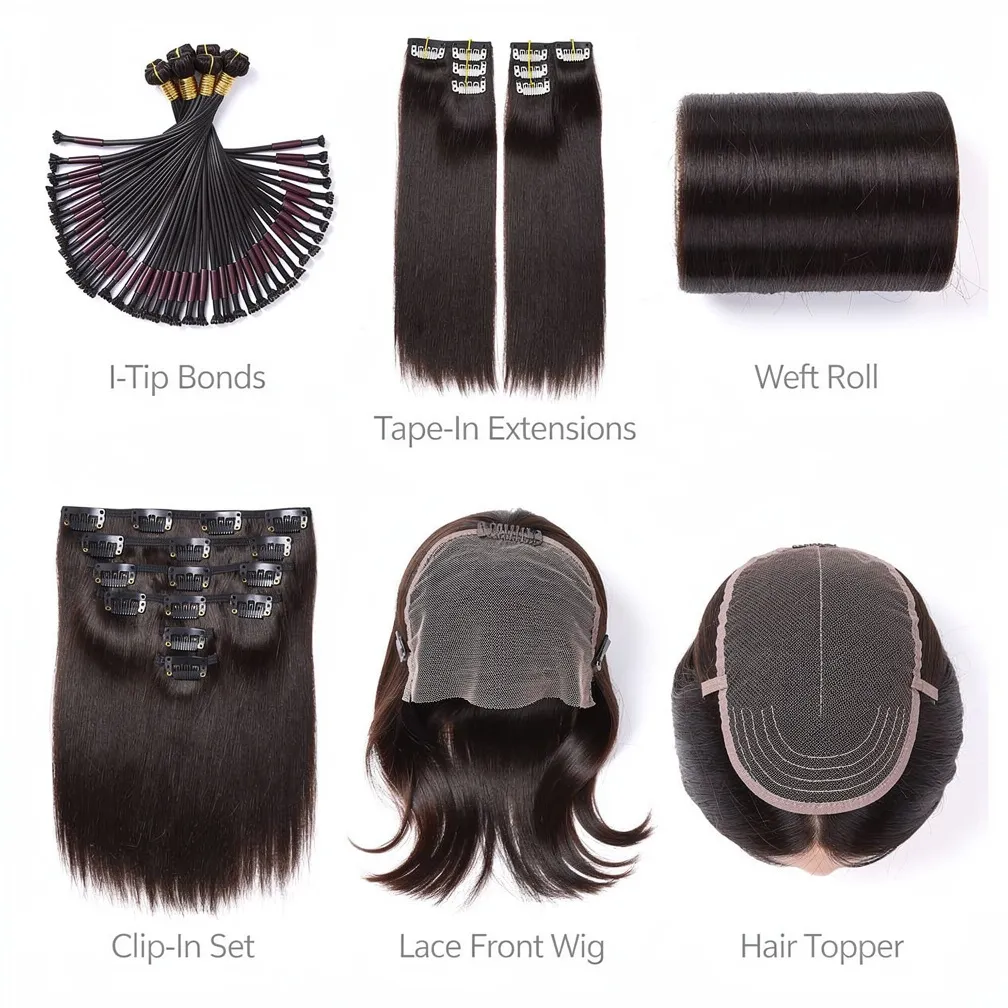
All Hair Extension Types Explained — Wholesale Buyer Guide 2026
All Hair Extension Types Explained — Wholesale Buyer Guide 2026
The wholesale hair extension market in 2026 encompasses 14 distinct product categories, each with different application methods, target customer profiles, retail price points, and dominant geographic markets. For wholesale buyers building a product range — whether for salon supply, distributor accounts, or private label retail — understanding the commercial profile of each extension type is essential for making the right stocking decisions. This guide covers every major extension type from individual bond methods (I-tip, U-tip, flat tip, nano tip) through wefts and tape-ins to wigs, toppers, and men’s hair systems, with a comprehensive comparison table and market performance analysis to inform your 2026 procurement strategy. For more details, see our guide on Hair Extension Return Policies. For more details, see our guide on Hair Extension Textures Explained.
Hair Extensions By Nature manufactures all product types listed in this guide at our Faridabad factory and supplies them to wholesale buyers across 30+ countries. Read our Complete Guide to Sourcing Hair Extensions from India for broader supply chain context.
Build your full product range with one manufacturer. Hair Extensions By Nature produces all major extension types — bond methods, wefts, tape-ins, clip-ins, wigs, and men’s systems — under one roof. Contact us for a complete catalog and wholesale pricing.
Request Our Full Catalog on WhatsApp
Master Comparison Table — All Hair Extension Types
| Type | Application Method | Reusable | Wear Time | Typical Retail Range | Best Market | Wholesale MOQ |
|---|---|---|---|---|---|---|
| I-Tip (Micro Bead) | Micro bead/ring clamped to natural hair; no heat or glue | Yes (2-3x) | 3-5 months per application | USD 120-300 per set | Europe (UK, Italy, France), Australia | 100 strands |
| U-Tip (Keratin Bond) | Keratin tip melted with heat tool; bonded to natural hair | No (single use) | 3-6 months | USD 140-350 per set | Europe, US professional salons | 100 strands |
| Flat Tip | Flat keratin tip melted with heat tool | No (single use) | 3-6 months | USD 130-320 per set | Europe, fine hair markets | 100 strands |
| Nano Tip | Nano bead — smallest bead method; minimal weight | Yes (2-3x) | 3-5 months | USD 150-380 per set | Europe, fine/thin hair clients | 100 strands |
| Machine Weft | Sew-in, glued, or braided onto natural hair | Yes (multiple) | 6-8 weeks per install | USD 40-120 per weft (100g) | West Africa, US, Caribbean | 50 wefts |
| Hand-Tied Weft | Sewn into braids with needle and thread | Yes (multiple) | 6-8 weeks per install | USD 70-180 per weft (100g) | US, UK premium salon market | 50 wefts |
| Tape-In | Medical-grade adhesive tape; sandwiches natural hair | Yes (2-3x) | 6-8 weeks | USD 60-180 per set | US, UK, Australia, Canada | 50 sets |
| Clip-In | Pressure-snap clips; self-applied, no professional needed | Yes (many) | Daily/occasional removal | USD 50-150 per set | Global; e-commerce; all markets | 50 sets |
| Halo Extension | Invisible wire placed over head; no attachment to hair | Yes (many) | Daily/occasional removal | USD 70-200 | UK, US, online retail | 50 units |
| Lace Front Wig | Adhesive or wig grip; lace at hairline for natural look | Yes (many) | Varies; daily or extended wear | USD 150-600 | US, UK, West Africa, globally growing | 10 units |
| Full Lace Wig | Full lace cap; can be styled in any direction | Yes (many) | Varies; protective wear | USD 300-900 | Premium US, UK, luxury retail | 10 units |
| Glueless Wig | Elastic band, combs, or wig grip; no adhesive needed | Yes (many) | Daily or extended wear | USD 180-500 | US, growing globally | 10 units |
| Hair Topper | Clip-in attachment to crown; covers thinning at top | Yes (many) | Daily wear | USD 120-400 | US, UK; alopecia and thinning market | 20 units |
| Men’s Hair System | Adhesive or tape; bonded to scalp; custom-fit | Yes (2-6 months wear) | 4-8 weeks per bond | USD 180-500 | US, UK, Japan, UAE; growing globally | 5 units |
Bond Extension Types — Detailed Overview
I-Tip (Micro Bead) Extensions
I-tip extensions are individual hair strands with a small keratin or polymer tip (shaped like the letter I) that are attached to the natural hair using a micro bead or ring, clamped closed with pliers. No heat or adhesive is applied to the hair, making this one of the most hair-safe application methods. They are reusable — typically 2-3 application cycles — by re-beading the same hair strand after move-up appointments.
Best markets: Dominant in European markets, particularly the UK, Italy, France, and Germany, where professional salon application is the norm. Popular in Australia and Canada. Less common in the US market where tape-in dominates.
U-Tip (Keratin Bond) Extensions
U-tip extensions have a U-shaped keratin bond that is melted using a heated fusion tool and bonded directly to a section of natural hair. They are considered the most natural-looking and longest-lasting bond extension method. The trade-off is that they are single-use — the bond must be dissolved with a removal solution at the end of the wear period.
Best markets: Strong in European and Australian professional salon markets. Particularly popular for clients with thick, medium to coarse hair. Less suitable for fine hair due to bond weight.
Flat Tip Extensions
Flat tip extensions have a flat, ribbon-like keratin bond that distributes weight more evenly than the round U-tip. This makes them especially suitable for fine or thin hair, where U-tip bonds can create visible lumps. Application and removal mirror U-tip methods.
Best markets: European fine hair market; increasing popularity in UK and Scandinavian salon markets. A growing professional alternative to U-tip for clients with thinner natural hair.
Nano Tip Extensions
Nano tips are the smallest bead-method extension on the market — approximately 80% smaller than a standard micro bead. This makes them virtually invisible in fine hair and extremely lightweight. Installation is more time-consuming due to the precision required with the smaller bead size.
Best markets: European premium salon market; clients with very fine or thinning hair; alopecia-adjacent applications. Command the highest per-set retail price of all bond methods.
Weft Extension Types
Machine Weft
Machine weft is the most widely produced and widely sold extension type globally. Hair is sewn onto a thread weft using industrial sewing machines. Machine weft is durable, available at multiple price points, and suitable for sew-in installation (braided), glue-in, and beaded methods. It can be cut without significant shedding due to the tight machine stitch.
Best markets: West Africa (Nigeria, Ghana — the dominant product category in this market), Caribbean, US African-American market, South Africa. High-volume commodity market with competitive pricing.
Hand-Tied Weft
Hand-tied wefts are sewn by hand using a needle and thread, creating a thinner, flatter weft with a more flexible body. They shed more than machine weft if cut in the middle of the weft (cutting must be done at specific bind points), but they lie flatter against the head and create a more seamless blend.
Best markets: US and UK premium salon market; professional stylists who perform hand-tied weft installation as a premium service. Retail prices are significantly higher than machine weft at equivalent length and grade.
All extension types, one factory. Hair Extensions By Nature manufactures machine weft, hand-tied weft, I-tip, U-tip, flat tip, nano tip, tape-in, clip-in, wigs, toppers, and men’s hair systems. Request our full product catalog and wholesale pricing list.
Get the Full Catalog on WhatsApp
Adhesive and Clip Extension Types
Tape-In Extensions
Tape-in extensions are the highest-volume professional salon extension type in the US and Australian markets. They consist of weft sections with medical-grade adhesive on one side; two pieces sandwich a thin section of natural hair. Installation takes 45-90 minutes for a full head. They are reusable 2-3 times with fresh tape applied at move-up appointments.
Best markets: US, UK, Australia, Canada. The dominant professional extension method in most English-speaking markets. Strong e-commerce market for at-home users in the US.
Clip-In Extensions
Clip-in sets are the most accessible extension type — self-applied, no professional required, and removable daily. A standard set contains 7-10 weft pieces of varying widths with pressure-snap clips sewn in. Clip-ins are the entry-point product for most new hair extension consumers and are the most widely sold extension type on e-commerce platforms globally.
Best markets: Global. The highest-volume e-commerce extension SKU in all English-speaking markets. First-time buyer product in Africa and Southeast Asia. Strong demand in all markets regardless of professional application infrastructure.
Halo Extensions
Halo extensions use a thin, clear monofilament wire worn like a headband, with a weft of hair attached that falls naturally over the natural hair. Completely non-damaging; no attachment to hair at all. Gaining significant e-commerce market share in 2026.
Wig and Coverage Products
Lace Front Wig
The fastest-growing hair product category in 2026. Lace front wigs have a lace panel at the hairline (typically 13×4 or 13×6 inches) that creates a natural-looking hairline when adhesive-applied. The back and sides are a more durable weft construction. They are reusable and versatile.
Best markets: US African-American market (largest market segment), UK, West Africa, increasingly global. The lace front wig category has expanded significantly from a salon-only product to a mainstream consumer product through social media and e-commerce.
Hair Toppers
Hair toppers cover thinning at the crown and parting areas. They attach via clips and blend with the wearer’s existing hair. The target customer is typically experiencing hair thinning due to age, alopecia, or medical treatment. This is a niche but high-margin category with strong repeat purchase behavior.
Men’s Hair Systems
Men’s hair systems are the most specialized category in this guide. They are custom-fitted hairpieces bonded to the scalp with adhesive or tape, designed to be indistinguishable from natural hair. The target market — men experiencing baldness or significant thinning — is large, brand-loyal, and high-repeat-purchase. Hair systems are replaced every 4-8 weeks, creating a recurring revenue model for the salon or distributor supplying them.
Best markets: US, UK, Japan (particularly strong men’s hair system culture), UAE, and globally growing. A high-margin, specialist category with lower competition than mainstream extension types.
Which Extension Types Sell Best by Market — 2026
| Market | Top Selling Type | Secondary Type | Growing Category |
|---|---|---|---|
| United States | Tape-in, Lace Front Wig | Clip-in, Weft (sew-in) | Glueless wig, Hand-tied weft |
| United Kingdom | I-tip, Tape-in | Clip-in, Halo | Lace front wig, Nano tip |
| Nigeria / West Africa | Machine weft bundles | Lace front wig, Clip-in | Full lace wig, Glueless wig |
| Australia | Tape-in, I-tip | Clip-in, Nano tip | Hand-tied weft, Halo |
| Germany / Europe | I-tip, U-tip, Flat tip | Tape-in, Nano tip | Hand-tied weft |
| UAE / Gulf | Machine weft, Tape-in | Lace front wig, Clip-in | Men’s hair systems |
| Japan | Men’s hair systems, Clip-in | I-tip, U-tip | Hair toppers |
Manufacture all your SKUs with one factory partner. Hair Extensions By Nature produces every extension type in this guide. Whether you need I-tip strands for your UK salon supply line or lace front wigs for your US e-commerce brand, we have the manufacturing capability and export experience to support your business. Contact us to discuss your 2026 product range.
Discuss Your Product Range on WhatsApp
Frequently Asked Questions
What is the most popular type of hair extension for wholesale in 2026?
Tape-in extensions are the highest-volume professional salon extension type globally in 2026, particularly strong in the US, UK, and Australia. Machine weft bundles dominate the West African and US African-American bundle market. Lace front wigs are the fastest-growing category across all major markets. Clip-in sets have the widest distribution footprint across all geographies as an accessible self-application product.
What is the difference between I-tip and U-tip hair extensions?
I-tip extensions use a micro bead or ring to attach to natural hair — no heat or glue — and are reusable for 2-3 application cycles. U-tip extensions use a keratin bond melted with a heat tool and are single-use. I-tip is considered more hair-friendly as it requires no heat at the attachment point. U-tip creates a very natural look and strong bond but requires solvent removal. I-tip is dominant in European markets; U-tip is common in both European and US professional salon markets.
What is a nano tip hair extension?
Nano tip extensions use the smallest bead in the market — approximately 80% smaller than a standard micro bead. This makes them ideal for very fine or thin hair where standard micro bead I-tip extensions would be too visible or too heavy. Nano tips are virtually invisible in fine hair and extremely lightweight. They command a premium retail price and are most popular in European markets serving clients with fine or thinning natural hair.
What is the difference between machine weft and hand-tied weft extensions?
Machine weft is sewn on industrial sewing machines — thicker weft, more durable, can be cut anywhere without shedding, and is more affordable. Hand-tied weft is sewn by hand using needle and thread — thinner and flatter, lies closer to the head for a more seamless blend, but must only be cut at specific bind points to prevent shedding. Hand-tied weft commands a significantly higher retail and wholesale price and is targeted at premium salon professional installation.
Which hair extension types are best for the West African market?
Machine weft bundles are the dominant product in the West African market, particularly Nigeria and Ghana. Bundle sets (typically 3-4 bundles plus a closure or frontal) are the standard retail unit. Lace front wigs and full lace wigs are growing rapidly in this market. Wave and curl textures (body wave, deep wave, kinky curl) are the most popular styles. Price sensitivity is high, making competitive bulk pricing from Indian manufacturers a key competitive advantage for distributors serving this market.
What is a hair topper and who is it for?
A hair topper is a partial hairpiece that attaches via clips to the crown or parting area, covering thinning or hair loss at the top of the head while blending with the wearer’s existing hair around the sides and back. The primary market is women experiencing diffuse thinning, alopecia, or post-treatment hair loss. Hair toppers command premium retail prices and have strong repeat purchase behavior — clients typically replace or alternate toppers every 6-12 months — making them a high-margin, loyal customer category.
![Wholesale I-Tip and U-Tip Extensions from India — Complete Guide [2026]](https://hairextensionsbynature.com/wp-content/uploads/2026/03/18-wholesale-i-tip-u-tip-extensions-india-hero-768x768.webp)
![Wholesale Lace Front Wigs from India — Complete Buying Guide [2026]](https://hairextensionsbynature.com/wp-content/uploads/2026/04/06-wholesale-lace-front-wigs-india-hero-768x768.webp)
![Wholesale Hair Toppers from India — Manufacturer Guide for Salons [2026]](https://hairextensionsbynature.com/wp-content/uploads/2026/03/20-wholesale-hair-toppers-manufacturer-india-hero-768x768.webp)
![Wholesale Human Hair Wigs from India — Manufacturer Direct Guide [2026]](https://hairextensionsbynature.com/wp-content/uploads/2026/03/15-wholesale-wigs-manufacturer-india-hero-768x768.webp)
![Wholesale Lace Closures and Frontals from India — Wig Maker Guide [2026]](https://hairextensionsbynature.com/wp-content/uploads/2026/04/31-wholesale-lace-closures-frontals-india-hero-768x768.webp)
![Wholesale Men’s Hair Systems from India — Manufacturer Guide [2026]](https://hairextensionsbynature.com/wp-content/uploads/2026/04/30-wholesale-mens-hair-systems-india-hero-768x768.webp)