Indian Hair Extension Export Statistics 2026
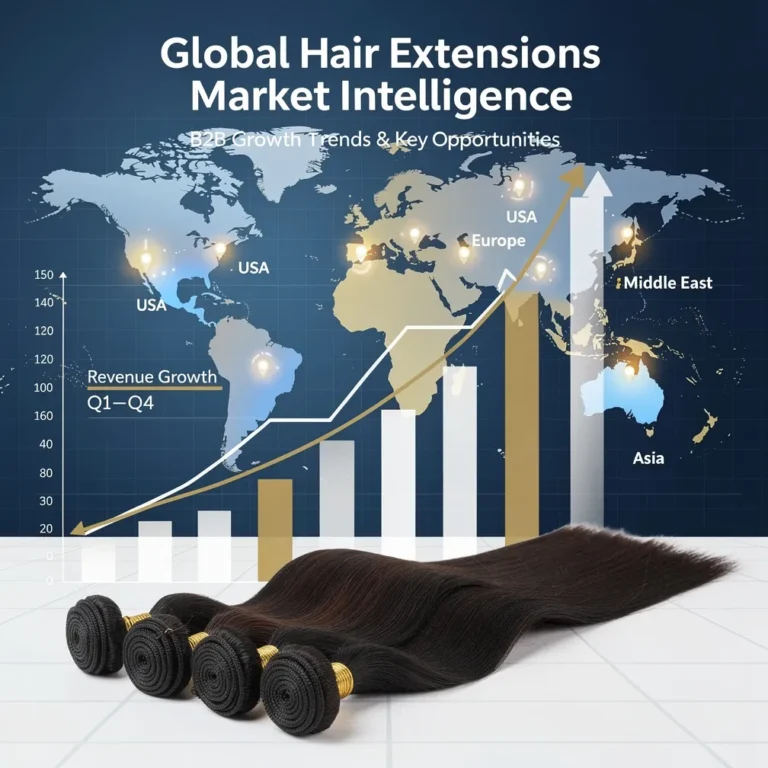
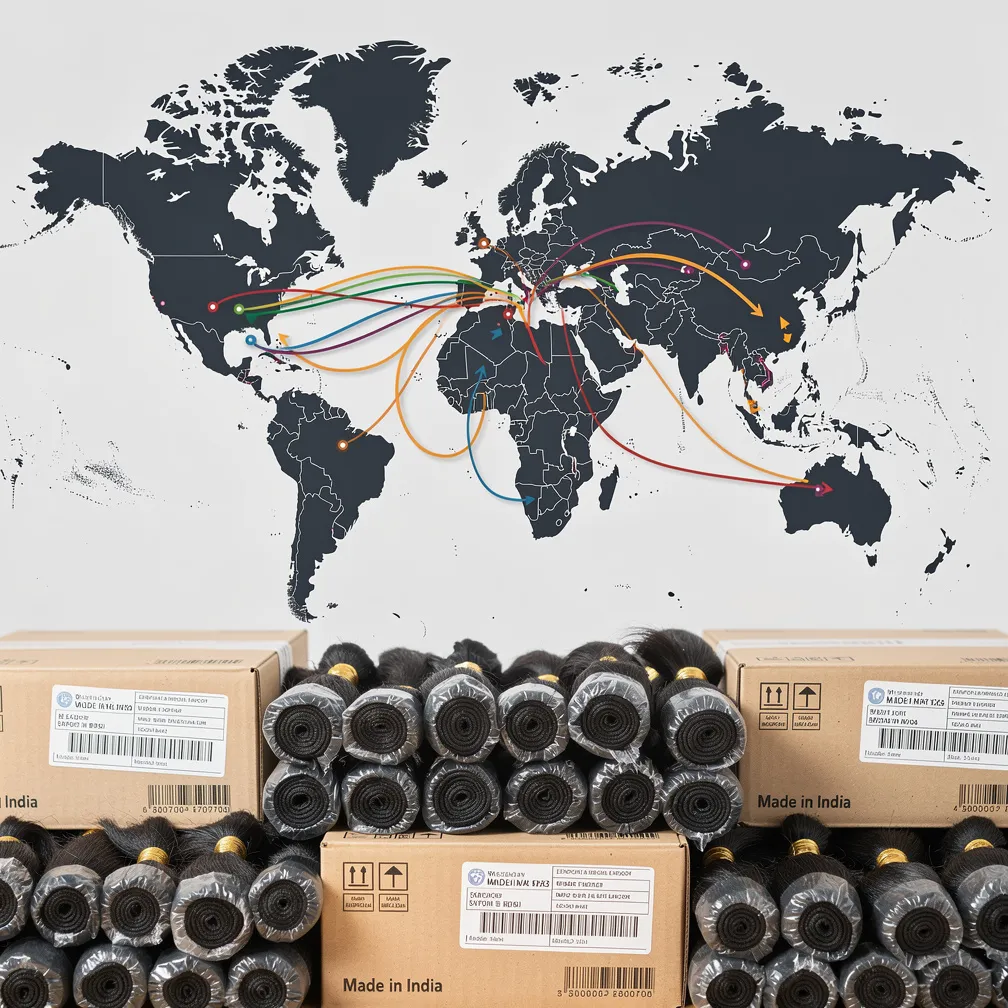
India’s hair extension export statistics confirm its position as the world’s dominant supplier: India exports over $400 million USD in human hair products annually and accounts for approximately 93% of global raw temple hair supply. The United States, European Union, and West African markets are the primary destinations, with China playing a dual role as both a processor and re-exporter. For distributors, brand owners, and salon groups evaluating their sourcing strategy, understanding the underlying trade data removes guesswork and confirms why Indian hair remains the global industry standard. For more details, see our guide on Hair Extension Trade Shows 2026. For more details, see our guide on Global Hair Extension Market Trends 2026.
This article compiles the most relevant 2026 market data for professional buyers — export volumes, top importing countries, HS codes, growth trends, and the structural reasons India’s position in the global hair supply chain is unlikely to change. All figures are drawn from publicly available trade databases, the Indian Commerce Ministry, and industry research. Hair Extensions By Nature manufactures and exports from Faridabad, Haryana, and works with buyers across more than 40 countries.
India’s Position in the Global Human Hair Market
No other country produces human hair at scale, quality, and consistency comparable to India. The structural advantages are geographic, cultural, and logistical. South Indian temples — particularly in Andhra Pradesh, Tamil Nadu, and Telangana — collect hair through a centuries-old tonsuring tradition in which devotees shave their heads as a religious offering. The Tirumala Tirupati Devasthanams (TTD) alone processes hair from approximately 12–18 million pilgrims annually, generating tens of thousands of kilograms of single-donor, cuticle-aligned hair per year.
This raw material quality advantage — single donor, unprocessed, naturally aligned cuticles — is impossible to replicate at industrial scale in any other country. China processes hair at higher volume, Vietnam has growing collection networks, and Brazil produces curly hair in smaller quantities, but none can match India’s combination of volume, raw quality, and export infrastructure.
India Human Hair Export Data — Key Statistics for 2026
| Metric | Data | Source / Notes |
|---|---|---|
| Annual export value (human hair products) | $400M–$450M USD | Indian Commerce Ministry data, 2024–2025 trend extrapolated |
| Share of global raw temple hair supply | ~93% | Industry consensus; no comparable raw source globally |
| Number of registered hair exporters | 1,000+ active exporters | DGFT (Directorate General of Foreign Trade) India |
| Primary export hubs | Chennai, Faridabad, Mumbai, Surat | Largest concentration of manufacturers and processors |
| Year-on-year export growth (5-year avg.) | 8–12% annually | Consistent growth driven by global salon industry expansion |
| Dominant HS code for hair exports | 6703 (raw/dressed human hair) | Also 6704 (wigs, hair extensions — finished products) |
| Top 3 export destinations (by value) | USA, China, Myanmar | USA for finished extensions; China/Myanmar for raw processing |
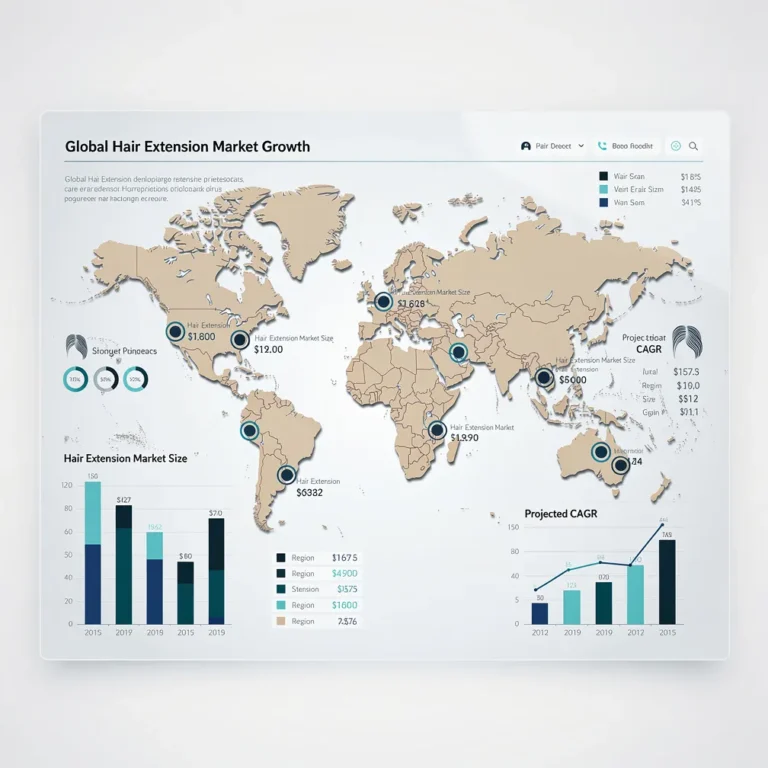
| Global hair extension market size (2026 est.) | $8.5B–$9.2B USD | Multiple industry research sources; CAGR ~8% |
| Projected global market size (2028) | $10B+ USD | Consistent with historical CAGR trajectory |
Top Importing Countries of Indian Human Hair
India’s human hair exports flow to two broad categories of buyers: processors who purchase raw or semi-processed hair to manufacture finished extensions (primarily China and Myanmar), and direct end-market buyers who purchase finished extensions for salon and retail distribution (primarily the USA, UK, Germany, UAE, Nigeria, and South Africa).
| Country / Region | Import Role | Primary Products Imported | Growth Trend |
|---|---|---|---|
| United States | End market (largest by value) | Finished extensions, wigs, toppers, clip-ins | Strong; African-American and mainstream salon demand growing |
| China | Processor / re-exporter | Raw bulk hair for processing into finished products | Stable; China adds chemical processing before re-export |
| Myanmar | Processor | Raw hair for sorting and semi-finishing | Steady; lower labor cost processing hub |
| United Kingdom | End market | Remy extensions, lace wigs, toppers | Growing; post-Brexit independent sourcing increasing |
| Germany / EU | End market | Premium Remy extensions, natural hair color demand | Moderate growth; premium segment outperforming |
| UAE / Middle East | Hub and end market | Bulk extensions, distributor stock for regional distribution | Strong; Dubai serves as re-distribution hub for Gulf and Africa |
| Nigeria | End market (largest in Africa) | Wigs, closures, bundles, lace frontals | Fastest growing market globally; high social media-driven demand |
| South Africa | End market | Remy bundles, wigs, lace closures | Growing steadily; professional salon segment expanding |
| France | End market | Premium extensions, Afro-texture wigs | Moderate; large diaspora market drives demand |
| Australia / Canada | End market | Full range of salon-grade extensions | Steady growth; salon direct buying increasing |
Sourcing direct from India and want to understand your import process? Contact us on WhatsApp — we have shipped to 40+ countries and can advise on customs documentation for your specific market.
HS Codes for Indian Hair Extension Exports
Understanding Harmonized System (HS) codes is essential for import planning. These codes determine duty rates, customs classification, and required documentation in your destination country.
| HS Code | Description | Typical Products | Notes |
|---|---|---|---|
| 6703.00 | Human hair, dressed, thinned, bleached or otherwise worked | Processed raw hair, bulk hair | Most common code for raw/semi-processed exports |
| 6704.11 | Wigs of synthetic textile materials | Synthetic wigs | Not applicable for human hair products |
| 6704.19 | Wigs of other materials (human hair) | Human hair wigs, toppers, hair pieces | Used for finished wig products |
| 6704.20 | Other articles of human hair | Wefts, extensions, clip-ins, tape-ins, fusion tips | Primary code for finished hair extensions |
| 0501.00 | Human hair, unworked | Unprocessed raw temple hair | Used for completely unprocessed bulk hair exports |
Import duties applied to these codes vary by destination country. The USA applies minimal duties (0–4%) on most hair extension categories under standard trade terms. The UK applies 0% duty on human hair under its Global Tariff schedule. The EU varies by member state but generally applies 2–4% for finished extensions. Nigeria and South Africa have higher duty structures (5–20%) that buyers should factor into landed cost calculations.
For a full sourcing process overview including customs documentation requirements, read our complete guide to sourcing hair extensions from India.
Market Growth Drivers — Why Indian Hair Exports Keep Growing
Several structural forces are accelerating demand for Indian hair extensions globally, making the market attractive for distributors and brand builders entering now.
Social Media and Content Creator Economy
Hair extension tutorials, transformation videos, and lifestyle content on platforms including Instagram, TikTok, and YouTube have dramatically expanded consumer awareness of hair extensions beyond their traditional salon context. A transformation video from a professional salon can reach millions of viewers and generate immediate product demand. This has expanded the market from high-income salon clients to a broad consumer base across income levels — increasing overall volume and creating new distribution channels that require consistent wholesale supply.
Professional Salon Growth in Emerging Markets
The professional salon industry in Nigeria, South Africa, Kenya, and other Sub-Saharan African markets is growing rapidly, driven by expanding middle-class incomes, urbanization, and a cultural shift toward professional beauty services. These markets are importing directly from India in increasing volumes, bypassing European and Chinese intermediaries to access better pricing.
Medical Hair Loss Market
Hair toppers and medical-grade wigs for alopecia and chemotherapy patients represent one of the fastest-growing segments within hair extensions. This segment is particularly strong in the USA, UK, and Germany, where professional suppliers to trichologists and medical practices require consistent, high-quality human hair products. Indian manufacturers are increasingly a primary supplier for this segment.
Private Label and Brand Building
The democratization of e-commerce has enabled hundreds of entrepreneurs across the USA, UK, and Nigeria to launch hair extension brands without significant upfront capital. These businesses typically source from Indian manufacturers under private label arrangements, adding branding and packaging to factory-produced products. The growth in private label demand has increased the volume of direct-from-India sourcing significantly over the past five years.
Interested in building a private label hair extension brand? Message us on WhatsApp — we offer full private label manufacturing from our Faridabad factory.
What the Trade Data Means for Buyers in 2026
The market intelligence has clear practical implications for wholesale buyers making sourcing decisions this year.
Indian manufacturing capacity is more than sufficient for new buyers. With 1,000+ active exporters and a well-established supply chain infrastructure, there is no shortage of production capacity. The challenge for buyers is not availability — it is identifying the right manufacturing partner from a fragmented supply base.
Direct sourcing continues to outperform intermediary-based buying on margin. As Indian manufacturers have become more sophisticated in international trade — better English communication, established payment systems, professional export documentation, and reliable logistics partnerships — the traditional role of intermediaries (Chinese traders, UK distributors) as quality and logistics guarantors has weakened. Buyers who source directly now access the same or better quality at 20–40% lower landed costs.
The African market is the fastest-growing opportunity for distributors. Nigeria, South Africa, and East Africa are importing at growing rates, but the professional distribution infrastructure is less developed than in Europe or North America. Distributors with existing networks in these markets can establish significant competitive advantages by securing direct manufacturer relationships now, before the market becomes as competitive as the US and UK.
Quality differentiation is accelerating. As the market grows, the gap between commodity-grade and premium-grade Indian hair is becoming more commercially significant. Buyers who understand the difference between raw temple hair, virgin hair, and Remy hair — and who can communicate that quality story to their customers — command better margins than those competing purely on price.
Frequently Asked Questions
How much does India export in human hair annually?
India exports over $400 million USD in human hair products annually, with consistent 8–12% annual growth. India accounts for approximately 93% of global raw temple hair supply.
Which countries import the most Indian hair?
The top importers are the USA (largest end market), China and Myanmar (as processing hubs), followed by the UK, Germany, UAE, Nigeria, and South Africa. The US and African markets are growing fastest.
What HS code is used for hair extensions?
Finished hair extensions use HS code 6704.20. Wigs and toppers fall under 6704.19. Raw processed hair uses 6703.00. Confirm the correct classification with your customs broker before importing.
Are import duties high on hair extensions?
The USA applies 0–4%, the UK applies 0%, the EU generally 2–4%, and Nigeria/South Africa have higher rates of 5–20%. Always calculate total landed cost including duties before comparing factory prices.
Source Your Supply from India’s Growing Export Base
The trade data confirms what experienced buyers already know: India is the most reliable, highest-quality, and most cost-effective source for human hair extensions globally. Hair Extensions By Nature manufactures the full range of Remy human hair products — from raw temple hair to finished clip-ins, tape-ins, wigs, and toppers — from our factory in Faridabad, Haryana.
For a comprehensive overview of the sourcing process, supplier verification, and quality standards, read our complete guide to sourcing hair extensions from India.
Ready to add a direct Indian manufacturer to your supply chain? Contact us on WhatsApp or email info@hairextensionsbynature.com for current pricing, MOQ, and export documentation.
Hair Extensions By Nature
Booth No 71, Sector 16 Huda Market, Faridabad, Haryana, India – 121002
Phone/WhatsApp: +91 9289358222