Indian Hair vs Vietnamese Hair
Indian hair and Vietnamese hair are the two most widely sourced raw and Remy hair extension origins in the global wholesale market, with Indian hair typically finer in texture and sourced from documented South Indian temple donations, and Vietnamese hair slightly thicker in strand diameter and sourced primarily from Northern Vietnam — both available at comparable wholesale prices of $80–$200 per 100g bundle depending on grade, length, and processing, and both representing premium quality that is substantially superior to most processed alternatives. For salon owners, extension brands, and wholesale buyers deciding which origin to build their product range around, the choice is rarely about one being universally better than the other — it is about which texture profile, supply chain characteristics, and market positioning best fit their customer base. This guide provides an honest, detailed comparison of both origins across every dimension that matters to wholesale buyers in 2026.
Hair Extensions By Nature manufactures and exports Indian raw and Remy hair extensions from our factory in Faridabad, Haryana, India. This comparison is written honestly — we sell Indian hair, but we will tell you when Vietnamese hair has genuine advantages for specific applications.
Origins and Supply Chain — A Fundamental Difference
The supply chain origin of Indian and Vietnamese hair is perhaps their most significant difference — not in quality, but in documentation, transparency, and ethical supply chain considerations.
Indian hair supply chain: The majority of premium Indian hair comes from South Indian Hindu temples, where devotees make a religious donation of their hair as an act of devotion. The largest and most famous of these is the Tirumala Tirupati temple in Andhra Pradesh, which auctions collected hair annually to processors and exporters under a transparent, documented process. This donation-based supply chain is unique in the global hair industry — the collection method is documented, the donors have given freely, and the volumes are substantial and consistent. The result is a supply chain that is more transparent and ethically documented than virtually any other hair source globally. Secondary Indian hair sources include market hair (collected from salon sweepings and combing waste) and direct purchase from individuals — the quality of these secondary sources is lower and should not be confused with temple hair.
Vietnamese hair supply chain: Vietnamese raw hair is collected primarily through direct purchase from individuals in Northern Vietnam, particularly rural communities where hair sale provides supplementary income. The supply chain is less institutionally documented than the Indian temple system but is well-established through decades of international trade. Reputable Vietnamese suppliers maintain relationships with consistent collection networks and can provide documentation of collection methods. However, buyers should conduct careful due diligence on Vietnamese suppliers, as the “Vietnamese hair” label is sometimes applied to hair collected in neighboring countries (Cambodia, Myanmar, Laos) and processed in Vietnam for export.
Texture and Physical Characteristics Comparison
| Characteristic | Indian Raw Temple Hair | Vietnamese Raw Hair |
|---|---|---|
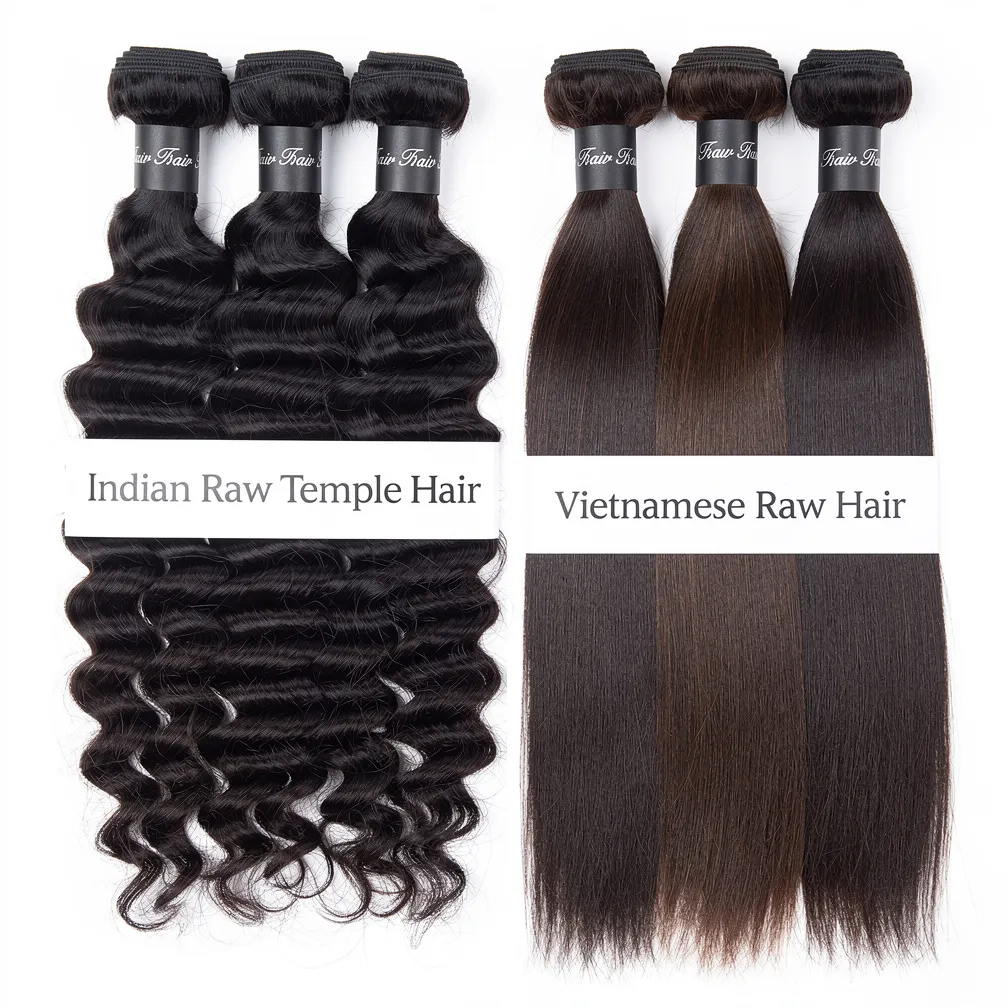
| Natural texture | Straight, wavy (slight to medium wave), lightly curly | Straight to slightly wavy; less natural wave variation |
| Strand diameter | Fine to medium — typically 60–80 microns | Medium — typically 70–85 microns; slightly thicker on average |
| Natural color | Dark brown to black (1B to 2); rare natural lighter shades | Dark brown to black; similar range to Indian |
| Natural luster | Natural — neither high gloss nor matte; healthy mid-sheen | Slightly higher natural luster in many grades |
| Cuticle condition (raw, unprocessed) | Intact; cuticle aligned in single-donor lots | Intact; cuticle aligned in single-donor lots |
| Elasticity | Excellent; healthy stretch and return | Excellent; comparable to Indian |
| Response to heat styling | Excellent; holds curl and straight styles well | Excellent; slightly easier to achieve pin-straight styles due to thickness |
| Response to color | Very good; natural virgin hair accepts color well | Very good; slightly more resistant to bleaching due to strand thickness |
| Blending with Black hair textures | Very good for wavy/curly clients; fine texture blends well | Good for straight styles; may require more processing for curly blending |
| Blending with Caucasian hair textures | Good — particularly wavy grades; fine texture is an advantage | Good — straight grades blend well with fine Caucasian hair |
Pricing Comparison — Wholesale Market Rates 2026
Wholesale price differences between Indian and Vietnamese hair are generally modest when comparing equivalent grades and lengths. The following price ranges reflect factory-direct wholesale prices for raw (unprocessed) hair in 100g bundles as of early 2026.
| Hair Length | Indian Raw Temple Hair (per 100g) | Vietnamese Raw Hair (per 100g) | Price Difference |
|---|---|---|---|
| 10–12 inches | $80–$110 | $70–$100 | Indian ~10–15% higher |
| 14–16 inches | $110–$145 | $95–$130 | Indian ~10–15% higher |
| 18–20 inches | $145–$180 | $130–$165 | Indian ~8–12% higher |
| 22–24 inches | $175–$220 | $155–$200 | Indian ~8–12% higher |
| 26–28 inches | $210–$270 | $185–$245 | Indian ~10% higher |
The slightly higher price of Indian temple hair at equivalent grades reflects the transparency and documentation of its supply chain (which commands a premium in markets where ethical sourcing is a brand value) and the consistency of the South Indian temple hair donation system as a supply source. However, the price differential is not dramatic, and either origin can support a profitable wholesale and retail business at comparable margin structures.
Want factory-direct pricing for Indian raw temple hair? Contact us on WhatsApp for our current price list and availability.
Processing and Product Range
Both Indian and Vietnamese raw hair can be processed into the same product range: raw (unprocessed), virgin Remy, and processed (colored, bleached, or chemically straightened). The choice between raw and processed depends on your target customer’s preferences and your margin structure.
Raw Indian temple hair has a natural advantage for wavy and curly extension products, as the natural wave pattern of South Indian hair means minimal processing is required to produce wavy and body wave wefts and extensions. Raw Vietnamese hair has an advantage for pin-straight, silky extension styles, as the natural texture of Vietnamese hair tends to be very straight and sleek.
In terms of processed products (colored hair, ombre/balayage, blonde extensions), both Indian and Vietnamese raw hair behave similarly when processed by an experienced team. The lower strand density of Indian fine hair means it can be bleached to lighter shades slightly more easily, while Vietnamese hair’s greater strand thickness provides excellent durability in heavily processed or bleached styles.
Availability and MOQ
Both Indian and Vietnamese hair are available in sufficient commercial quantities for wholesale orders. However, the Indian temple hair system’s institutionalized collection creates more predictable supply consistency for large volume orders. Annual temple hair auctions at Tirupati and other South Indian temples produce large, consistent supply volumes that manufacturers can plan around.
Vietnamese raw hair availability can be more variable — it depends on individual collection networks and is more susceptible to disruption from local economic changes (if alternative income sources reduce individual sellers’ willingness to sell hair). For very large-volume buyers, Indian hair’s supply chain predictability is a practical advantage.
MOQ for both origins is typically 5–10 bundles per specification from most Indian and Vietnamese manufacturers for standard products, with custom products requiring 20–50 unit minimums.
Market Positioning — Which Origin for Which Market
The texture profile and cultural associations of each origin influence which market segments they best serve. Indian hair’s fine-to-medium texture and natural wave variation make it the preferred choice for clients who want to match natural Black hair wave patterns, fine-textured Caucasian hair, or South Asian hair types. The ethical supply chain story of Indian temple hair also resonates strongly with brand-conscious buyers in the USA, UK, and Australia who are looking for hair with a transparent, documented origin story to support their brand values.
Vietnamese hair’s slightly thicker strand diameter, very straight natural texture, and high natural luster make it particularly popular in East Asian markets (Japan, South Korea, China, Vietnam itself) where straight, sleek styles are dominant, and with buyers who want the most naturally straight hair with minimal heat styling required. Vietnamese hair is also popular with buyers who want a slightly higher-volume appearance from each weft due to the thicker strand diameter adding bulk.
Need help choosing the right hair origin for your customer base? Message us on WhatsApp or email info@hairextensionsbynature.com — we can advise on which products best suit your market.
Which Origin Should You Choose for Wholesale in 2026?
Choose Indian temple hair if your customers value ethical supply chain transparency as a brand story; if you serve clients with fine to medium texture preferences or natural wave styling; if you supply markets in the USA, UK, Australia, or Europe where the temple hair story resonates; or if you want a highly consistent, institutionally documented supply chain for your wholesale business.
Choose Vietnamese hair (sourced from a verified, reputable supplier) if your customers prefer straight, sleek extension styles; if you serve East Asian markets where Vietnamese hair has strong brand recognition; or if price is the primary purchasing driver and the marginal cost saving justifies the supply chain complexity of sourcing from Vietnam versus India.
Many professional hair brands source both origins and position them as different product lines — Indian temple hair as the “ethical/spiritual origin” premium line, and Vietnamese hair as the “silky straight” line — capturing both market segments simultaneously.
Frequently Asked Questions
What is the main difference between Indian and Vietnamese hair?
Indian hair is finer, has natural wave variation, and comes from documented temple donations. Vietnamese hair is slightly thicker, more naturally straight/silky, and sourced through direct purchase networks in Northern Vietnam.
Which is better for natural wavy styles — Indian or Vietnamese?
Indian hair. The natural wave patterns of South Indian temple hair require minimal processing to produce wavy or body wave products, making it the superior choice for natural wave styling.
Which is better for straight, sleek styles?
Vietnamese hair has a slight natural advantage for pin-straight, silky styles due to its thicker, naturally very straight texture. It is the dominant choice in East Asian markets for this reason.
Order Wholesale Indian Raw Temple Hair from Our Factory
Hair Extensions By Nature exports raw Indian temple hair and virgin Remy hair from our factory in Faridabad, Haryana. We supply wholesale to brands and businesses worldwide with full supply chain documentation.
For the complete guide to Indian hair, read our raw Indian temple hair wholesale guide.
Request wholesale pricing for Indian raw hair: WhatsApp or email info@hairextensionsbynature.com.
Hair Extensions By Nature
Booth No 71, Sector 16 Huda Market, Faridabad, Haryana, India – 121002
Phone/WhatsApp: +91 9289358222
Start Your Hair Extensions Dropship Business
Zero inventory. Premium Indian Remy hair. Ship worldwide under your brand. MOQ as low as 5 pieces.