
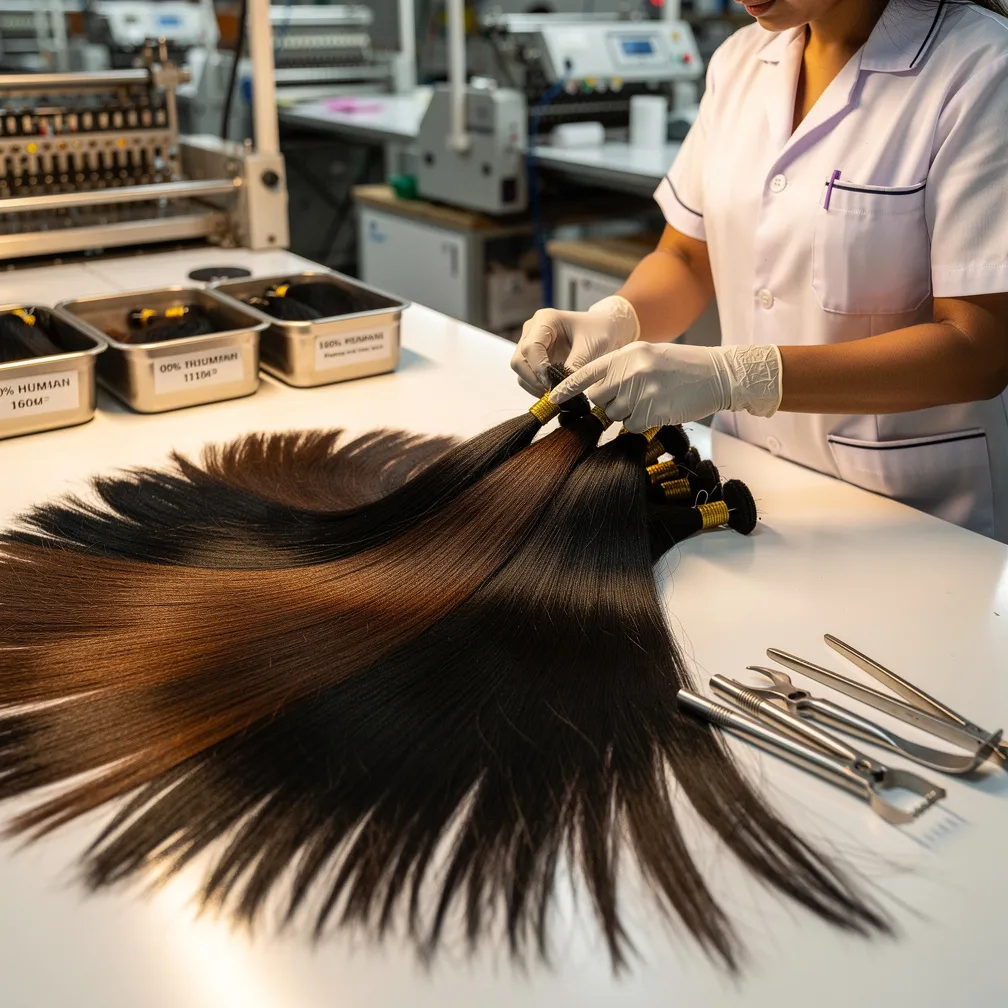
Hair Extension Density Guide — 130% to 200% Explained for Wholesale
Hair Extension Density Guide — 130% to 200% Explained for Wholesale
Hair extension density is the amount of hair per unit area of a weft or set, expressed as a percentage of a defined standard where 100% represents a natural, medium-full head of hair. For wholesale buyers, understanding density is essential because it directly determines the weight of each unit, the visual result for the end client, the raw material cost at the manufacturing stage, and the retail pricing tier the product justifies. The most common density tiers in the commercial wholesale market are 130%, 150%, 180%, and 200%, and each serves a distinct customer profile and market segment.
Why Density Matters More Than Length for Wholesale Buyers
Length is often the first specification wholesale buyers focus on. Density deserves equal or greater attention. Two sets of hair extensions at the same length can feel and look dramatically different depending on density. A 20-inch set at 130% density will have an airy, blendable quality that suits fine-hair clients. A 20-inch set at 200% density will be noticeably heavier, thicker at the ends, and dramatically more voluminous — suitable for clients with thick natural hair or those styling for special occasions requiring high visual impact.
Retail clients often do not understand density as a specification, but they respond to it instinctively. When a client holds up a set and says “this looks cheap and thin” or “this feels luxurious,” they are almost always responding to density. Getting density right for your specific market is one of the most important decisions you make at the wholesale sourcing stage — and one that many buyers only address after their first disappointing sales cycle.
Request density samples and wholesale pricing across all tiers from Hair Extensions By Nature.
Email: info@hairextensionsbynature.com | Phone: +91 9289358222
Density Comparison Table: 130% to 200%
| Density Level | Visual Appearance | Set Weight (7-piece, 18″) | Best Client Profile | Market Preference | Wholesale Cost Premium vs 130% | Retail Price Premium vs 130% |
|---|---|---|---|---|---|---|
| 130% (Light) | Natural, blendable, light body | 100 – 110 g | Fine, thin, or fragile hair | European, East Asian mainstream | Base | Base |
| 150% (Standard Full) | Full, volumized, salon-quality | 120 – 140 g | Normal to medium hair | North America, Europe, Australia | +12 – 16% | +20 – 30% |
| 180% (Glamour) | Thick, dramatic, high volume | 155 – 175 g | Thick natural hair, special events | Middle East, West Africa, bridal | +28 – 35% | +50 – 70% |
| 200% (Ultra Dense) | Maximum volume, heavy, bold | 185 – 220 g | Very thick hair, professional styling | West Africa, African diaspora markets | +40 – 50% | +80 – 110% |
130% Density: Natural Blend for Fine Hair Markets
The 130% density tier occupies the entry-level of the commercial wholesale range and serves a market that is often underserved: clients with fine, thin, or fragile hair. These clients cannot wear heavier extensions without experiencing discomfort or visible root stress at clip attachment points. For this demographic, 130% density is not a compromise — it is the correct product.
In the European market — particularly Northern and Western Europe where the predominant consumer base has naturally finer hair — 130% density is a top-three selling tier. Brands that stock exclusively 150% and above lose sales from fine-hair clients who try the product, find it too heavy, and return it. A clear “Natural Density” labeling tier for your 130% products communicates to this buyer profile exactly what the product does for them.
From a pricing perspective, 130% density allows wholesale buyers to offer an accessible entry price that captures first-time hair extension buyers. A 130% density set in a key color can serve as a loss-leader or introductory SKU that brings customers into the brand range, after which they graduate to higher density tiers as their hair extension experience grows.
150% Density: The Commercial Standard
One hundred and fifty percent density is the commercial standard for most global wholesale markets. It delivers a visibly fuller appearance than natural hair — which is what the majority of extension buyers want — without the weight penalty of higher densities. Most wholesale buyers who are unsure where to start should default to 150% as their primary density tier.
At 120 to 140 grams for a standard 18-inch seven-piece set, 150% density sits in a weight range that most clients tolerate comfortably for full-day wear. Clips can be standard alligator-style without needing reinforcement for longer-duration use. The set blends well across a wide range of natural hair textures from fine-medium to medium-thick.
The 150% tier also serves the professional salon market most broadly. Salons across the United States, Canada, the United Kingdom, Australia, and Western Europe have standardized on 150% as their default stock density, ordering 130% for fine-hair clients and 180% for clients requiring extra volume as needed. This tiered approach allows a salon to serve the full client range without maintaining an excessive SKU count.
180% Density: The Glamour Tier
One hundred and eighty percent density is where hair extensions make a bold statement. At 155 to 175 grams for a standard 18-inch set, 180% density creates the thick, flowing, high-volume look associated with luxury styling, editorial photography, and bridal applications. This tier is aspirational — clients who want it know exactly what they are seeking, and they are willing to pay significantly more for it.
The Middle Eastern market has extremely high demand for 180% density. Cultural and social occasions in the Gulf states involve glamorous styling events where maximum hair volume is a styling norm. Wholesale buyers serving Middle Eastern distributors should make 180% their primary density tier rather than treating it as a premium add-on.
West African and African diaspora markets also have strong demand for 180% density, where thicker hair is both a cultural aesthetic preference and a practical requirement for blending with the natural hair texture of many consumers. For these markets, 180% is often a minimum standard rather than a premium option.
Order density-specific wholesale hair extension sets for your target market. Contact Hair Extensions By Nature.
Factory: Booth No 71, Sector 16 Huda Market, Faridabad, Haryana, India – 121002
200% Density: Maximum Impact for Specialist Markets
Two hundred percent density represents the upper end of the standard wholesale range and is a specialist product rather than a general-purpose one. At 185 to 220 grams for an 18-inch set, 200% density extensions are substantially heavier than all other tiers. They should only be recommended for clients with naturally thick, dense hair — clients who use 200% density with fine or medium natural hair will experience visible weight stress at the roots, making the installation visibly uncomfortable and increasing the risk of traction-related scalp issues.
Despite these limitations, 200% density commands the highest wholesale and retail pricing of any standard density tier. Brands targeting the premium segment of the African-American, West African, or Afro-Caribbean market can justify stocking 200% density as their flagship tier with appropriate retail pricing and client education materials that explain the correct candidate profile for this density level.
Pricing Impact: How to Build a Tiered Density Range
A density-tiered wholesale assortment allows buyers to serve multiple market segments and price points without multiplying their SKU count across different product families. The most efficient approach is to pick one hero product family — a clip-in straight set, for example — and offer it across three density tiers (130%, 150%, and 180%) in your top-selling five colors. This gives you 15 core SKUs that cover the full market range rather than a fragmented catalog that is difficult to manage and communicate to retail buyers.
When pricing each tier, the retail markup should exceed the wholesale cost increase to maximize margin improvement at higher densities. If your 130% set costs $22 wholesale and retails at $65, your markup is 2.95x. Your 150% set at $26 wholesale should retail at $85 (3.27x markup). Your 180% set at $31 wholesale should retail at $115 (3.71x markup). This progressive markup structure is appropriate because the perceived value increase exceeds the cost increase at each tier step. Clients who want 180% density are generally less price-sensitive than those starting with 130%.
Communicating Density to Your Retail Buyers and End Clients
Density percentage is a manufacturing specification that means nothing to most retail customers without translation. Wholesale buyers who resell to salons or direct consumers should translate density into language that communicates the experience and result rather than the number. “Natural Blend,” “Full Volume,” and “Maximum Glamour” are more effective retail descriptors than 130%, 150%, and 180% respectively. Include the percentage in the technical product details for professional buyers who understand the specification, but lead with the experience label on packaging and marketing materials.
Request wholesale pricing and samples across all density tiers from Hair Extensions By Nature.
Email: info@hairextensionsbynature.com | Phone: +91 9289358222
Frequently Asked Questions
What does density mean in hair extensions?
Density expresses the amount of hair per unit area compared to a defined standard. 100% equals natural medium-full hair. 130% adds moderate volume, 150% creates a noticeably fuller look, 180% is glamour density, and 200% is ultra-thick for maximum volume.
What is the most popular density for wholesale hair extensions?
150% is the commercial standard and the most widely stocked density in professional wholesale markets globally.
Which markets prefer 180% or 200% density?
West African markets, African diaspora consumer segments, and Middle Eastern markets have the highest demand for 180% and 200% density. These regions prefer maximum volume as a standard aesthetic rather than a premium option.
Does higher density cost more at wholesale?
Yes. Moving from 130% to 150% adds approximately 12 to 16 percent to wholesale unit cost. Moving from 150% to 180% adds another 15 to 20 percent. Retail pricing premiums at each step should exceed the cost increase to expand margin.
What density is best for fine-hair clients?
130% density is recommended for fine-hair clients. The lower weight reduces scalp tension at clip attachment points and creates a proportionally natural result without the visible weight stress of higher density tiers.
![Hair Extension White Label Manufacturing India [2026 Guide]](https://hairextensionsbynature.com/wp-content/uploads/2026/04/11-hair-extension-white-label-manufacturing-india-hero-768x768.webp)
![Wholesale Closure Wigs (4×4, 5×5) from India — Manufacturer Guide [2026]](https://hairextensionsbynature.com/wp-content/uploads/2026/04/09-wholesale-closure-wigs-4x4-5x5-india-hero-768x768.webp)
![Indian Hair Extension Supplier for Turkey [2026 Market Guide]](https://hairextensionsbynature.com/wp-content/uploads/2026/04/32-indian-hair-extension-supplier-turkey-hero-768x768.webp)
![Hair Extension Inventory Management — Guide for Wholesale Distributors [2026]](https://hairextensionsbynature.com/wp-content/uploads/2026/04/10-hair-extension-inventory-management-wholesale-hero-768x768.webp)
![Receding Hairline Toppers — Wholesale Guide for Salons and Clinics [2026]](https://hairextensionsbynature.com/wp-content/uploads/2026/04/20-receding-hairline-toppers-wholesale-guide-hero-768x768.webp)