
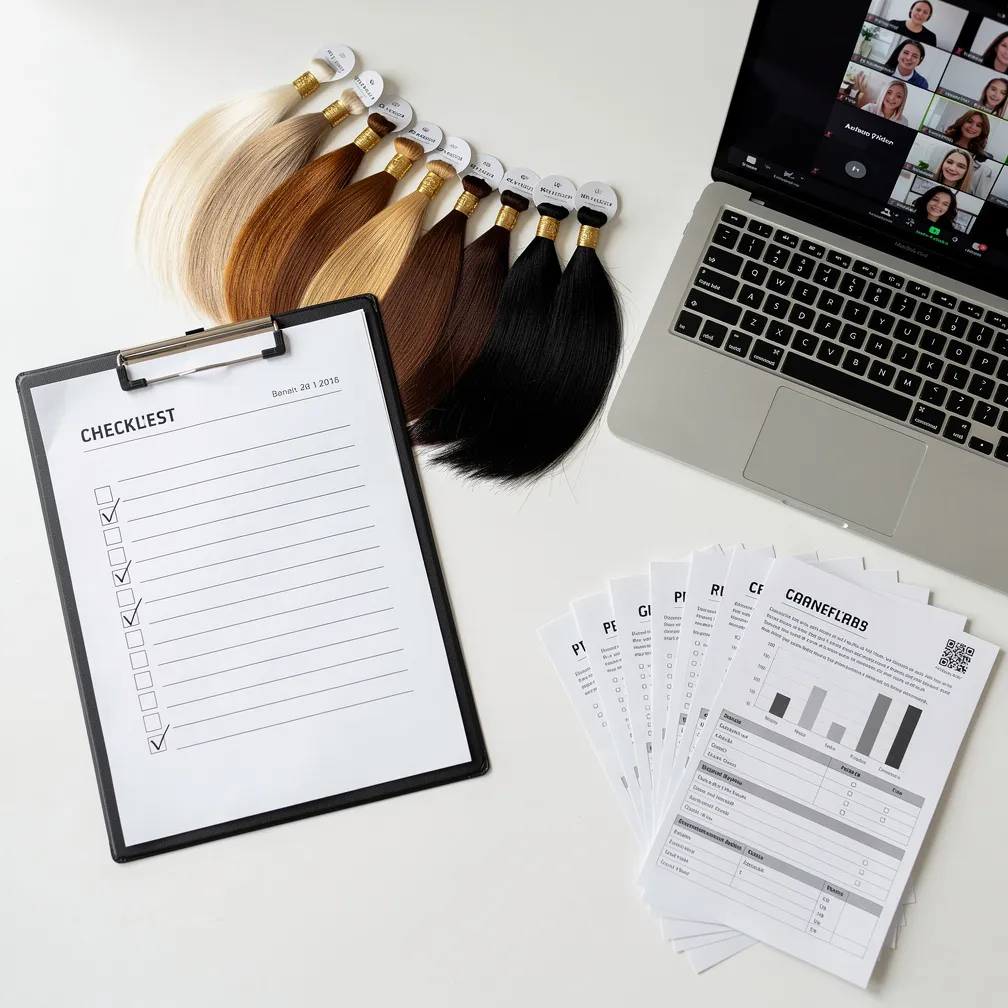
How to Find a Reliable Hair Extension Supplier — Red Flags and Green Flags [2026]
Finding a reliable hair extension supplier comes down to verifying 10 key green flags that distinguish genuine direct manufacturers from trading companies, resellers, and outright scams. The most important indicators are a verifiable factory address, willingness to conduct a live video call of the production facility, realistic pricing (not 50%+ below market rate), a clear sample policy, and proper export documentation. Conversely, the most dangerous red flags are no verifiable address, prices that seem impossibly cheap, refusal to show the factory on video, demands for 100% upfront payment, and pressure tactics around limited-time pricing. This guide gives you a complete checklist — 10 green flags and 10 red flags — to evaluate any hair extension supplier before placing a wholesale order. For more details, see our guide on Hair Extension Payment Methods. For more details, see our guide on Wholesale Men’s Hair Systems from India.
This guide is written for salon owners, brand builders, and distributors who are sourcing hair extensions wholesale for the first time or vetting a new supplier. The patterns described are drawn from documented industry experience with both reliable and unreliable suppliers.
The Supplier Landscape: Why Due Diligence Matters
The global hair extension wholesale market has thousands of suppliers across India, China, Vietnam, and beyond. The vast majority are legitimate businesses. But the market also has a significant number of trading companies that present themselves as manufacturers while actually sourcing from multiple small workshops — resulting in inconsistent quality — and a smaller but significant number of outright fraudulent operations that take payment and deliver nothing, or deliver poor-quality goods that do not match what was promised.
The good news is that reliable suppliers and problematic ones follow predictable patterns. A genuine direct manufacturer has nothing to hide — their factory is real, their pricing is transparent, their quality is consistent, and they actively welcome verification because it builds trust. Problem suppliers, by contrast, consistently exhibit the same evasion patterns. Learning to recognize both sides of this coin protects your investment and your business.
10 Green Flags: Signs of a Reliable Hair Extension Supplier
1. Verifiable Factory Address
A genuine manufacturer has a physical factory that can be verified on Google Maps, checked through business directories, or confirmed via a local contact. The address should correspond to an industrial or commercial zone, not a residential area. A verifiable address is the single most important initial filter — without it, there is no accountability.
2. Willingness for Video Factory Tour
Any legitimate manufacturer is proud of their facility and understands that international buyers cannot visit in person. They actively offer or readily agree to live video calls showing the production floor, machinery, in-process inventory, and quality control station. Seeing actual weft machines, sorting tables, and in-progress work orders during a live call (not edited promotional video) is strong evidence of genuine manufacturing capability.
3. Transparent, Market-Consistent Pricing
Reliable suppliers price within market range. Remy extensions have genuine cost floors based on raw material prices and manufacturing labor. If pricing is more than 25–30% below comparable market rates, be highly skeptical. Genuine manufacturers are competitive but not impossibly cheap — they have real costs to cover.
4. Sample Policy with Professional Execution
Reputable manufacturers actively encourage sample orders before bulk commitments. Samples typically cost $20–$50 per piece plus shipping, with many manufacturers applying the sample cost toward your first production order. When samples arrive, they come in professional packaging with proper labeling — not loose bundles in a plastic bag.
5. Export Documentation and Legal Registration
A legitimate Indian exporter holds an Import Export Code (IEC) issued by the Directorate General of Foreign Trade and GST registration. They can provide these documents on request. They issue proper commercial invoices, packing lists, and certificates of origin. The ability to produce these documents immediately is a strong indicator of an established export business.
6. Client References in Your Market
Established suppliers have existing clients in your target market who can speak to quality, reliability, and communication. A reputable manufacturer will offer to connect you with existing buyers (with permission) as part of their due diligence support. Be cautious of suppliers who cannot provide any references.
7. Clear Communication and Response Times
Reliable suppliers respond to inquiries within 24 hours, communicate clearly in English (or your language of business), provide specific answers to specific questions (pricing, MOQ, lead time, specifications), and proactively share information rather than being vague or evasive. Poor communication before an order is a reliable predictor of poor communication after payment.
8. Realistic Lead Times
Genuine manufacturers give accurate lead time estimates based on their current production schedule — typically 7–14 days for standard products and 14–21 days for custom orders. Be wary of suppliers who promise unrealistically fast production (2–3 days for large custom orders) or who are always vague about timelines.
9. Secure Payment Structure
Standard payment terms from reputable manufacturers are 30–50% advance via wire transfer, PayPal, or a secure business payment platform, with the balance due after quality inspection photos are shared before shipping. This structure protects both parties and is used by virtually all established manufacturers. 100% upfront payment on a first order with a new supplier is a risk that reputable manufacturers will not typically insist on.
10. Consistent Quality Across Samples
Order samples across at least 2–3 hair types and lengths. The quality should be consistent piece to piece — same density, same texture, same color accuracy. A supplier whose quality varies significantly between sample pieces will have the same problem at scale. Consistent samples are evidence of standardized production processes.
Contact Hair Extensions By Nature — We Welcome Verification and Sample Orders →
10 Red Flags: Warning Signs to Walk Away From
1. No Verifiable Factory Address
If a supplier cannot or will not provide a specific, verifiable factory address, or if the address leads to a residential building or empty lot on Google Maps, do not proceed. This is the most fundamental red flag in international wholesale sourcing.
2. Prices 50%+ Below Market Rate
There is a cost floor for genuine Remy human hair. If a supplier is offering Remy extensions at prices 50% or more below what other established manufacturers charge, the hair is almost certainly not what it is described as — it may be non-Remy collected hair, heavily processed low-grade hair, synthetic fiber, or a straightforward scam with no delivery intention.
3. Refusal to Do Live Video Calls
The most common excuse is a claimed inability to video call due to poor internet. In 2026, this is not credible for an established exporting business. Refusal to show the factory live — even when the buyer offers flexibility on timing and platform — almost always means there is no factory to show.
4. No Sample Policy or Sample Quality Mismatch
Some suppliers refuse samples entirely and pressure buyers to place bulk orders based on catalog photos. Others provide high-quality samples but deliver different, lower-quality hair in bulk production. A reputable manufacturer maintains the same quality standards from sample to production. If bulk delivery quality is significantly worse than samples, walk away and do not reorder.
5. Demand for 100% Upfront Payment
Demanding full payment before production begins, with no payment security mechanism, is a significant risk indicator. Established manufacturers do not need 100% upfront — they have working capital and a track record that makes partial advance entirely workable. The 100% upfront demand, especially combined with other red flags, is frequently associated with fraudulent operations.
6. Vague or Inconsistent Product Specifications
Reliable suppliers answer product specification questions precisely: strand weight per piece, hair grade, processing method, donor source, application method specifics. If answers to detailed product questions are consistently vague (“best quality,” “100% human hair”) without supporting specifics, the supplier may not actually know what they are selling because they are a trading company sourcing from multiple unknown workshops.
7. No Export Documentation Capability
Suppliers who cannot produce proper commercial invoices, packing lists, certificates of origin, or who suggest shipping without proper documentation are either informal traders or attempting to misrepresent goods. Proper documentation protects you as the importer and is standard for any legitimate exporter.
8. Pressure Tactics and Limited-Time Offers
High-pressure sales tactics — “this price is only available today,” “we have 10 other buyers waiting for this stock,” “you must decide now” — are sales manipulation, not the communication style of a manufacturing business with consistent supply capability. Reputable manufacturers do not use artificial urgency.
9. Poor or Absent Social Proof
Established manufacturers have a track record: testimonials from international buyers, a professional website, active social media showing actual products and factory operations, and trade show participation. A supplier with zero social proof, only a WhatsApp number, and no verifiable online presence presents significant risk.
10. Inability to Handle Returns or Disputes
Ask prospective suppliers directly: what is your policy if the goods delivered do not match the sample? A reliable manufacturer has a clear answer: replacement, credit, or refund on the affected portion. Evasive responses, claims that returns are impossible, or sudden communication drops after this question are disqualifying behaviors.
Green Flag vs Red Flag Comparison Checklist
| Evaluation Area | Green Flag (Reliable Supplier) | Red Flag (Problematic Supplier) |
|---|---|---|
| Factory address | Specific, verifiable on Google Maps | Vague, residential, or non-existent |
| Factory tour | Actively offers live video call | Refuses or always deflects |
| Pricing | Within 25–30% of market range | 50%+ below market rate |
| Samples | Available, professionally packaged | Unavailable or mismatches bulk |
| Export documents | IEC, GST, commercial invoice ready | Cannot produce or avoids discussion |
| Client references | Available in your target market | Unavailable or unverifiable |
| Communication | Specific, responsive, within 24 hrs | Vague, slow, or disappears post-payment |
| Lead times | Realistic, schedule-based estimates | Unrealistically fast or always unclear |
| Payment terms | 30–50% advance, balance pre-shipment | 100% upfront, no security mechanism |
| Dispute resolution | Clear replacement/credit policy | Evasive or non-responsive |
Verify Hair Extensions By Nature — Schedule a Video Factory Tour →
How to Conduct Supplier Due Diligence Step by Step
Step 1: Initial search and shortlist. Identify 3–5 potential suppliers through industry trade shows, B2B directories (IndiaMART, TradeIndia), referrals, or direct Google searches. Avoid relying solely on Alibaba for Indian suppliers.
Step 2: Address and registration check. Verify the factory address on Google Maps satellite view. For Indian suppliers, ask for their IEC (Import Export Code) and verify it on the DGFT portal (dgft.gov.in). This is a free, publicly searchable database.
Step 3: Initial communication quality assessment. Send a detailed product inquiry including specifications, target quantities, and timeline. Evaluate response speed and specificity. A reliable supplier responds within 24 hours with specific, accurate answers.
Step 4: Video call and factory tour. Request a live video call walk-through of the production facility. Confirm you want to see the factory floor, machinery, and in-process inventory. Observe the professionalism and preparation of the call.
Step 5: Sample order. Place a sample order across your target product range. Evaluate quality, packaging, shipping speed, and accuracy against specification. Perform the cuticle test, wash test, and burn test on samples.
Step 6: Reference check. Ask for references from existing buyers in your market. Contact them and ask about quality consistency, communication, and any issues encountered.
Step 7: Trial production order. Place a small production order (25–50 pieces) before committing to large volumes. Verify that quality, lead time, and communication match expectations from the sample stage.
For the complete sourcing process in detail, see our Complete Guide to Sourcing Hair Extensions from India.
Frequently Asked Questions
How do I know if a hair extension supplier is a manufacturer or a trading company?
Ask to see the factory on a live video call. A genuine manufacturer can show you production machinery, workers, and in-process orders immediately. A trading company cannot. Also ask about customization capability — genuine manufacturers can modify specifications; traders generally cannot because they buy finished goods from third-party workshops.
What documents should a legitimate Indian hair extension exporter provide?
A legitimate Indian exporter should provide: Import Export Code (IEC), GST registration certificate, commercial invoice, packing list, certificate of origin, and for processed hair going to regulated markets, REACH compliance declarations (for EU) or equivalent chemical compliance documentation.
Is it safe to pay by wire transfer to an Indian supplier?
Wire transfer (T/T) is the standard payment method for international B2B transactions and is safe when used with the 30–50% advance structure. Never wire 100% upfront to a new supplier. Use PayPal for smaller orders where buyer protection is valuable. Consider escrow services for very large first orders with new suppliers.
What should I do if a supplier delivers hair that is different from the sample?
Document the discrepancy immediately with photos and video. Contact the supplier within 48 hours of receipt. Reliable suppliers will offer replacement or credit. If the supplier becomes unresponsive, dispute the payment through your bank or PayPal as appropriate. Always pay only 30–50% upfront to protect the balance in these situations.
How many suppliers should I shortlist before choosing one?
Shortlist 3–5 suppliers and take at least 2–3 through the sample order process before selecting a primary supplier. Having a backup supplier relationship is good business practice regardless of how satisfied you are with your primary supplier, as supply chain disruptions can occur for legitimate reasons.
Evaluate Hair Extensions By Nature Against This Checklist
We meet every green flag described in this guide: our factory is at Booth No 71, Sector 16 Huda Market, Faridabad, Haryana, India — verifiable on Google Maps. We offer live video factory tours, maintain transparent pricing, ship professional samples within 48 hours, hold full IEC and GST registration, and structure payments at 50% advance with balance before shipping. We actively encourage due diligence because it builds the trust that long-term wholesale relationships require.
Message Us on WhatsApp to Start Your Verification Process →
Email: info@hairextensionsbynature.com
Hair Extensions By Nature — Manufacturer and Exporter of Remy Indian Human Hair Extensions. Factory: Booth No 71, Sector 16 Huda Market, Faridabad, Haryana, India – 121002. Phone/WhatsApp: +91 9289358222.
![Hair Extension Distributor Partnership India — Agreements & Margins [2026]](https://hairextensionsbynature.com/wp-content/uploads/2026/04/05-hair-extension-distributor-partnership-india-hero-768x768.webp)
![How to Order Hair Extension Samples from India — First-Time Buyer Guide [2026]](https://hairextensionsbynature.com/wp-content/uploads/2026/04/49-hair-extension-sample-ordering-guide-hero-768x768.webp)
![Indian Hair Extension Factory Direct Buying — Guide for European Buyers [2026]](https://hairextensionsbynature.com/wp-content/uploads/2026/04/03-indian-hair-extension-factory-direct-hero-768x768.webp)
![Best Wholesale Hair Extensions Manufacturer in India [2026 Guide]](https://hairextensionsbynature.com/wp-content/uploads/2026/03/02-wholesale-hair-extensions-manufacturer-india-hero-768x768.webp)
One Comment