
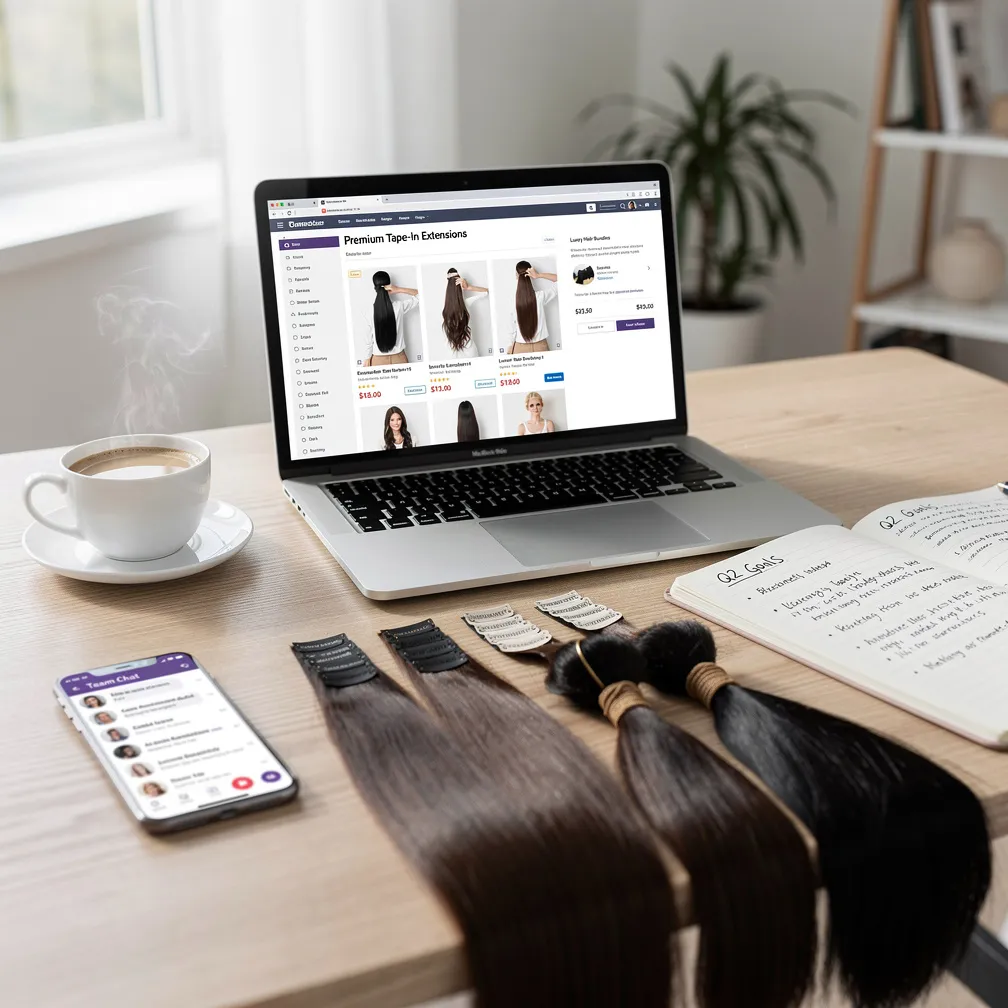
How to Start a Hair Extension Business in 2026 — Step-by-Step Guide
How to Start a Hair Extension Business in 2026 — Step-by-Step Guide
To start a hair extension business in 2026, define your business model and target market, source product from a verified Indian manufacturer with a pilot order, build your brand identity, establish your sales channels, and scale from there based on real market feedback. The hair extension market continues to grow at an estimated 8-10% CAGR through 2028, driven by increasing consumer demand across North America, Europe, Africa, and Southeast Asia. With Indian manufacturers offering factory-direct pricing at the lowest entry points globally, the startup capital requirement for a focused pilot launch is achievable at USD 3,000-8,000 — significantly lower than most product-based businesses. This 10-step guide covers everything a first-time hair extension business founder needs to go from idea to operational, with realistic cost benchmarks and supplier criteria that apply in 2026. For more details, see our guide on Hair Extension Dropshipping from India.
Ready to source your first order? Hair Extensions By Nature supports new hair extension businesses with pilot-friendly MOQs, private label capability, and a dedicated export team. Contact us to discuss your launch requirements.
Step 1: Choose Your Business Model
The first decision is which of the three primary hair extension business models you are entering. Each has different capital requirements, margin structures, and operational demands.
Online Retail Brand: You source wholesale from an Indian manufacturer, apply your own branding, and sell directly to end consumers through an e-commerce store (Shopify, WooCommerce), social media, or marketplace (Amazon, Etsy). Highest retail margins; highest marketing investment; most competitive channel.
Salon Supply / Distributor: You build relationships with salons, hair stylists, and beauty businesses and supply them at wholesale-to-professional pricing. Lower individual transaction margins than direct-to-consumer, but higher volume, more predictable reorders, and lower customer acquisition cost.
Regional Wholesale Distribution: You import from India in larger volumes and redistribute to smaller retailers, salons, and beauty supply stores in your region. Requires more capital and logistics capability, but delivers the strongest margin per kilogram and positions you as a supply chain player rather than a retailer.
For a new business, starting with online retail or salon supply and building toward regional distribution as volume grows is the most capital-efficient approach.
Step 2: Define Your Niche and Target Customer
The hair extension market is extremely broad. Attempting to serve every customer type with every product type is a reliable path to undifferentiated failure. The most successful new hair extension businesses in 2026 occupy a specific and defensible niche.
Niche examples that have demonstrated commercial traction: premium raw temple hair for natural hair enthusiasts; tape-in extensions specifically for fine European hair types; kinky curl and coil textures for natural hair communities; alopecia-friendly toppers and wigs positioned around medical needs; men’s hair systems for the growing professional male hair replacement market; or a geographic focus (supplying a specific city’s salon market where you have existing relationships).
Your niche determines your product range, your pricing, your marketing language, and which manufacturer capabilities matter most to your business.
Step 3: Research Your Market and Competitors
Before placing any orders, spend time on competitive research. Identify the top 5-10 brands in your chosen niche and analyze their product range, pricing, and positioning. Look for gaps — product grades they don’t cover, lengths they consistently stock out of, underserved customer types, or geographies with less established supply. Your business entry strategy should target at least one identifiable gap, not just attempt to replicate what already exists at a lower price.
Step 4: Find and Evaluate Your Manufacturer
Your manufacturer relationship is the most important business relationship in the hair extension supply chain. Use the 15-point evaluation checklist in our wholesale hair extensions manufacturer guide to qualify any prospective supplier. For new businesses, the critical requirements are: verified factory (not a trading company), sample program availability, MOQ at or below your pilot order budget, and clear communication from an experienced export team.
India is the optimal sourcing origin for new businesses for two reasons: factory-direct pricing provides the best product-cost foundation for margin, and Indian manufacturers have extensive experience supporting international new-brand launches with private label, packaging, and export documentation.
For the full context on sourcing from India, see our Complete Guide to Sourcing Hair Extensions from India.
Step 5: Order and Test Samples
Before any branded or bulk order, request and pay for samples of every SKU you intend to carry. Apply the quality tests from our hair extension quality verification guide: burn test, finger-slide test, wash and tangle test, weight check, and shedding test. Test against your intended market’s quality expectations, not just your own assessment.
The sample investment is typically USD 100-300 and is the best protection against a costly first-order quality failure.
Start with samples before committing to stock. Hair Extensions By Nature ships sample packs to new business founders. Verify quality before your first bulk order. Contact us on WhatsApp to arrange a sample pack.
Request a Sample Pack on WhatsApp
Step 6: Build Your Brand Identity
Your brand is how customers perceive and remember your business. At minimum, a new hair extension brand needs: a business name, logo, and consistent visual identity; professional product photography (either from your manufacturer or shot after receipt of samples); a brand story that is honest and specific about what makes your product the right choice for your target customer; and packaging that reflects your quality positioning.
Avoid generic brand names and packaging that is indistinguishable from dozens of competitors. The cost difference between mediocre and genuinely distinctive brand design is typically USD 300-1,500 for a logo and packaging system — well within a sensible startup budget and recoverable within the first 20-30 sales.
Step 7: Establish Your Sales Channel
For online retail, a Shopify or WooCommerce store is the standard platform. For salon supply, direct outreach and relationship building in your target salon community is the channel. For both, Instagram and TikTok are the most effective content and discovery channels for hair extension businesses in 2026.
Do not attempt to sell on every channel simultaneously as a new business. Focus on one primary channel, achieve consistent sales, then expand. Multi-channel launches without established operations behind them create fulfillment and customer service problems that damage brand reputation early.
Step 8: Place Your Pilot Order
Your first wholesale order should be a pilot — focused on 3-5 core SKUs, at MOQ quantities, specifically to validate market demand before committing to larger inventory. The purpose of the pilot is not to maximize margin; it is to test the full customer experience: ordering, receiving, quality checking, selling, and getting real feedback from end customers or salon clients.
A well-structured pilot order tells you which SKUs move fastest, what quality feedback your customers have, what your actual sell-through rate is, and whether your pricing is positioned correctly for your market.
Step 9: Handle Logistics and Customs Correctly
International importing requires correct documentation, HS code declarations, and in most countries, a registered business address for customs. Review our complete shipping and logistics guide for detailed information on carriers, transit times, duty rates, and the documentation your manufacturer should provide with every shipment.
For new importers, DHL or FedEx express courier for your first 3-5 orders is the simplest approach — door-to-door with tracking, no freight forwarder required for orders under 30 kg.
Step 10: Scale Based on Real Data
Growth decisions in a hair extension business should be driven by sell-through data, not enthusiasm. Before scaling inventory investment, confirm: your top 3-5 performing SKUs, your average order value and reorder rate, your customer acquisition cost, and your gross margin after product cost, shipping, duties, and returns.
A business that has proven these metrics at pilot scale has a clear, defensible basis for increasing order volumes, expanding SKU range, or investing in brand marketing. A business that scales before validating these numbers is building on assumptions, not evidence.
Startup Cost Breakdown by Business Model
| Cost Category | Online Retail Brand | Salon Supply Business | Regional Distributor |
|---|---|---|---|
| Pilot inventory (3-5 SKUs) | USD 1,500 – 3,500 | USD 2,000 – 5,000 | USD 8,000 – 20,000 |
| Samples (pre-order testing) | USD 100 – 300 | USD 150 – 400 | USD 300 – 800 |
| Branding (logo, design) | USD 300 – 1,200 | USD 200 – 800 | USD 500 – 1,500 |
| Private label packaging | USD 300 – 800 | USD 200 – 600 | USD 500 – 2,000 |
| E-commerce platform / website | USD 300 – 1,000 | USD 200 – 600 | USD 500 – 1,500 |
| Product photography | USD 300 – 1,200 | USD 200 – 600 | USD 300 – 800 |
| Shipping and duties (first order) | USD 150 – 400 | USD 200 – 600 | USD 800 – 2,500 |
| Business registration | USD 50 – 500 | USD 50 – 500 | USD 100 – 1,000 |
| Initial marketing budget | USD 500 – 2,000 | USD 200 – 1,000 | USD 500 – 2,000 |
| Total Estimated Range | USD 3,500 – 10,900 | USD 3,400 – 10,100 | USD 11,500 – 32,100 |
Note: These are estimated pilot-launch costs for 2026. Actual costs vary by country, product mix, and the specific business decisions made. The ranges represent a realistic spectrum from minimal to professionally positioned launch.
Common Mistakes New Hair Extension Businesses Make
Over-stocking the wrong SKUs: Buying 20 different SKUs on a first order before knowing what your market wants. Start with 3-5 core products, validate, then expand.
Choosing the cheapest supplier: In the hair extension market, the cheapest supplier is almost always supplying the lowest quality. Customer complaints about quality kill hair extension brands faster than any other factor.
No quality testing before retail: Every new business should test every SKU against the quality tests in our verification guide before selling a single unit. Your brand reputation depends on consistent product quality.
Undefined target customer: Marketing to “everyone who wants hair extensions” produces marketing that resonates with no one. Define your customer specifically and build everything — product, packaging, content, pricing — around that customer.
Skipping the sample stage: Never place a bulk order with a new supplier without first testing samples. The cost of a failed bulk order exceeds the sample cost by a factor of 10-50x.
Hair Extensions By Nature supports new business launches. We offer pilot-friendly MOQs, private label packaging from 100 pieces, dedicated export guidance, and sample programs. Email info@hairextensionsbynature.com or WhatsApp +91 9289358222 to discuss your launch plan.
Start Your Business Conversation on WhatsApp
Frequently Asked Questions
How much money do I need to start a hair extension business?
A focused pilot launch for an online retail hair extension brand requires approximately USD 3,500-11,000 including inventory, branding, packaging, website, product photography, and first-order shipping and duties. A salon supply business has a similar startup range of USD 3,400-10,000. A regional wholesale distribution business requires USD 11,500-32,000 for a properly funded launch. The low end of these ranges is achievable by keeping the initial SKU count to 3-5 products and using cost-effective branding and e-commerce tools.
Where should I source hair extensions for a new business?
India is the most cost-effective sourcing origin for new hair extension businesses due to factory-direct pricing 25-40% lower than equivalent Chinese distributor or Brazilian-marketed product. Indian manufacturers have extensive experience supporting international new-brand launches with sample programs, private label packaging, and export documentation. Verify any prospective supplier using the 15-point manufacturer evaluation checklist before placing an order.
Is the hair extension business profitable in 2026?
The hair extension market continues to grow at an estimated 8-10% CAGR through 2028. Profitability at the individual business level depends on product-cost management, niche positioning, and customer retention. Businesses sourcing factory-direct from India typically achieve gross margins of 50-70% on retail, and 25-40% on wholesale-to-salon supply. The most profitable hair extension businesses have strong reorder rates driven by consistent product quality and focused niche positioning.
Do I need a business license to sell hair extensions?
Requirements vary by country and business model. In the US, most states require a basic business license or seller’s permit for commercial activity. In the UK, registering as a sole trader or limited company is standard for commercial importing and retail. In Australia, an ABN is required for business activity. For importing commercial quantities from India, most countries require the importer to be a registered business entity for customs purposes. Consult a business advisor or accountant in your country for the correct structure.
What types of hair extensions sell best for new businesses?
Tape-in extensions and clip-in sets are the easiest entry products for new hair extension businesses due to their accessibility, consistent demand, and wide customer base. Weft bundles are ideal for businesses targeting salon professionals and African hair markets. Raw temple hair bundles command premium retail prices and suit businesses positioning around quality and authenticity. Wigs and toppers are higher-value products but require more customer education and styling support. Start with 2-3 products in the category best suited to your target customer before expanding.
How do I market a new hair extension brand?
Instagram and TikTok are the primary discovery channels for hair extension brands in 2026, with short-form video content demonstrating installation, texture, and results driving the highest engagement. For salon supply businesses, direct LinkedIn outreach and attendance at professional beauty trade shows generates qualified B2B leads. Influencer partnerships with hairstylists and educators who serve your target customer are highly effective when the partnership is authentic and the influencer uses the product professionally.
![Hair Extension MOQ Guide — What First-Time Wholesale Buyers Should Know [2026]](https://hairextensionsbynature.com/wp-content/uploads/2026/03/12-hair-extension-moq-guide-first-time-buyers-hero-768x768.webp)
![Best Indian Hair for Salons Wholesale — Texture, Color & Buying Guide [2026]](https://hairextensionsbynature.com/wp-content/uploads/2026/04/02-best-indian-hair-salons-wholesale-hero-768x768.webp)
![Hair Extension Salon Menu — How to Price Extensions for Maximum Profit [2026]](https://hairextensionsbynature.com/wp-content/uploads/2026/04/41-hair-extension-salon-menu-pricing-guide-hero-768x768.webp)

![Hair Extension Dropshipping from India — Can It Work for Your Business? [2026]](https://hairextensionsbynature.com/wp-content/uploads/2026/04/44-hair-extension-dropshipping-from-india-hero-768x768.webp)