
How to Verify Indian Hair Extension Quality Before Buying Wholesale
How to Verify Indian Hair Extension Quality Before Buying Wholesale
To verify Indian hair extension quality before buying wholesale, perform the burn test to confirm 100% human hair content, the finger-slide test to check cuticle alignment, the alkaline soak test to assess chemical processing damage, and the tangle test after wetting to evaluate longevity under real conditions. These tests require no specialist equipment and can be applied to any sample received from an Indian manufacturer before a bulk order commitment. In 2026, with online sourcing making supplier verification more difficult, these physical tests remain the most reliable due-diligence tools available to wholesale buyers. For more details, see our guide on Cuticle Aligned Hair Extensions.
Hair Extensions By Nature, a Faridabad-based manufacturer, encourages all prospective buyers to request samples and apply these tests before placing wholesale orders. Genuine quality withstands scrutiny — and we provide full transparency throughout the evaluation process.
Request a sample pack before committing to wholesale. Hair Extensions By Nature ships samples to qualified wholesale buyers. Verify our quality with the tests below before placing your first bulk order.
WhatsApp Us for Sample Information
Why Quality Verification Matters for Wholesale Buyers
The Indian hair extension market spans a wide quality spectrum, from unprocessed raw temple hair to heavily acid-washed, synthetic-blended product sold under misleading grade labels. For wholesale buyers — whether supplying salon chains, beauty distributors, or retail networks — receiving substandard product is not just a financial loss. It creates downstream customer complaints, return requests, and reputational damage that can take years to recover from.
Understanding how to assess quality independently, before and after delivery, gives buyers negotiating leverage, helps establish quality benchmarks with suppliers, and creates an audit trail that supports dispute resolution when product fails to meet specification.
For broader sourcing context, read our Complete Guide to Sourcing Hair Extensions from India, which covers supplier evaluation alongside quality verification.
Quality Grade Comparison Table
Before running individual tests, understand how the market grades hair. The following table defines the main quality tiers used by Indian manufacturers and what each grade means for wholesale buyers.
| Grade | Description | Cuticle Status | Processing | Lifespan (Typical) | Best Market Fit |
|---|---|---|---|---|---|
| Raw Temple Hair | Unprocessed, collected from temple donations | Fully intact, aligned | None | 2-4 years | Premium retail, luxury salons |
| Remy Double Drawn | Cuticle-aligned; short hairs removed | Intact, aligned | Minimal (wash, condition) | 12-18 months | Mid-high retail, salon chains |
| Remy Single Drawn | Cuticle-aligned; natural length variation | Intact, aligned | Minimal | 9-14 months | Mid-market retail, wholesale bundles |
| Non-Remy (Virgin) | Unprocessed but cuticles not aligned | Intact, mixed direction | None | 6-12 months | Value retail, budget distributors |
| Acid-Washed Non-Remy | Cuticles stripped; silicone coated | Removed | Heavy chemical | 3-6 months | Entry-level, disposable market |
| Synthetic Blend | Human hair mixed with synthetic fiber | Mixed | Variable | 1-3 months | Fashion, costume, events |
The 10 Quality Tests Every Wholesale Buyer Should Perform
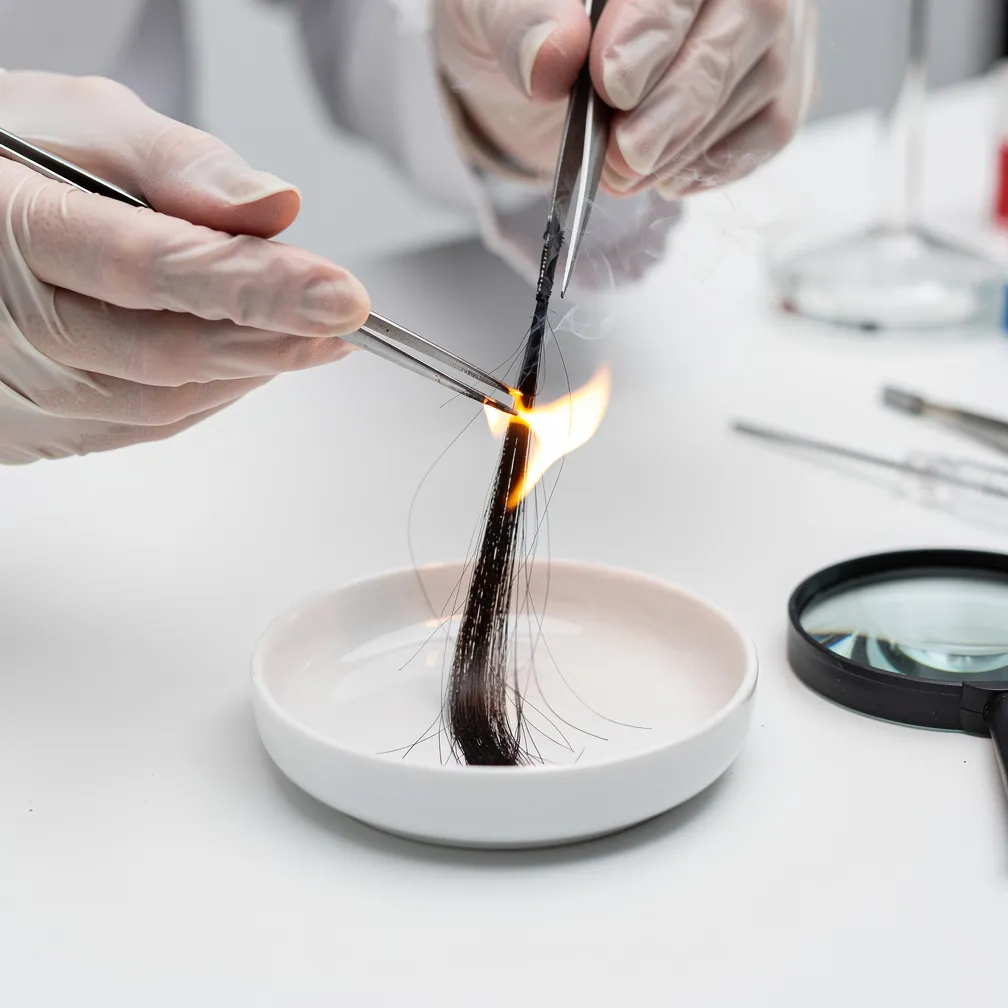
Test 1: The Burn Test
What it reveals: Whether the hair is 100% human or contains synthetic fiber.
How to perform: Take 5-10 strands from the sample. Hold one end with tweezers or fingers and bring the other end close to a lighter flame. Observe the burn behavior and smell.
What to expect from genuine human hair: Burns slowly, curls away from the flame, produces a soft ash that crumbles, and smells like burning protein (similar to singed skin or fingernails).
Fail indicators: Melts into a hard ball (synthetic fiber), burns rapidly with a chemical smell, or produces black plastic-like residue. Any melting indicates synthetic content.
Test 2: The Finger-Slide (Cuticle Alignment) Test
What it reveals: Whether cuticles are aligned root-to-tip (Remy quality). For more details, see our guide on Remy vs Virgin Hair.
How to perform: Take a small bundle of 20-30 strands. Slide your fingers from root to tip — this should feel smooth. Then slide from tip toward root (against the cuticle direction).
What to expect from Remy hair: Smooth downward, slightly resistant upward. The resistance going against the grain confirms cuticle scales are present and aligned.
Fail indicators: Equally smooth in both directions means cuticles have been acid-washed off. Excessive friction in both directions may indicate silicone coating masking damaged hair.
Test 3: The Tangle Test (Wet)
What it reveals: Real-world performance under moisture — the most honest durability indicator.
How to perform: Soak the sample in warm water for 5 minutes without any conditioner. Remove, gently squeeze excess water, and attempt to finger-detangle starting from the tips.
What to expect from quality hair: Minor tangles at the tips that detangle easily. The bundle should maintain its weft structure and not felt or mat together.
Fail indicators: Severe matting, tangling that cannot be resolved with fingers alone, or shedding of more than 5-8 strands during detangling. This indicates either non-aligned cuticles or silicone that has washed out revealing damaged hair underneath.
Test 4: The Alkaline / Bleach Lift Test
What it reveals: Whether the hair has been pre-processed or artificially colored, and how it responds to chemical services.
How to perform: Mix a small amount of bleach powder with developer (20 or 30 vol). Apply to a small section of sample hair on foil. Process for 30-45 minutes and observe the lift.
What to expect from quality virgin/raw hair: Lifts evenly from dark brown to orange-gold within 30-45 minutes without patchiness or banding.
Fail indicators: Patchy or uneven lift indicates previously processed or highlighted hair. No lift at all may indicate resistant synthetic content. Over-porous hair that lifts too fast indicates prior chemical damage.
Test 5: The Weight Accuracy Test
What it reveals: Whether bundles meet stated gram weights — a common area of fraud.
How to perform: Use a precise digital kitchen or jewelry scale. Weigh each bundle or set individually after removing any packaging material. Record and compare to the stated weight on the label or invoice.
Acceptable tolerance: Plus or minus 3-5% is acceptable in the industry. Variance above 10% is grounds for a formal complaint.
Fail indicators: Consistent under-weight bundles — even by 5-10 grams per piece — represent significant financial loss at scale. A 100-piece order of tape-in sets under-weighted by 10% effectively gives you 90 sets of product for the price of 100.
Test 6: The Strand Count / Double-Draw Test
What it reveals: Whether a bundle is genuinely double-drawn (full from root to tip) or single-drawn with natural taper.
How to perform: Take a weft or bundle and fold it in half at the midpoint. The hair at the fold point (mid-length) should be approximately 80-90% as dense as the root end for double-drawn hair.
Fail indicators: If the mid-point is significantly thinner — less than 60% of root density — the bundle is single-drawn or mislabeled. Inspect the tips: excessive shortfall at the tip indicates short hair was not removed in processing.
Test 7: The Shedding Test
What it reveals: Weft construction quality and whether the machine-sewn or hand-tied weft is secure.
How to perform: Hold a 10 cm section of weft at either end. Pull gently but firmly with both hands across the width. Repeat 3-4 times. Run your fingers through the hair from the weft downward.
Acceptable shedding: 2-5 strands across the entire sample. This is normal in any sewn weft.
Fail indicators: Shedding of 10+ strands per pull suggests poor weft construction, weak thread, or hair that was not properly knotted. Heavy shedding dramatically shortens product lifespan and generates immediate customer complaints.
Test 8: The Color Consistency Test
What it reveals: Whether the stated hair color is consistent throughout the bundle and matches the batch.
How to perform: Spread the bundle or set out under consistent natural daylight. Check the root section, the mid-length, and the tips. Compare all pieces in the order against each other.
What to expect from quality colored hair: The stated color should be consistent within 1 shade throughout the length. Natural hair may show slight natural variation, but processed color should be uniform.
Fail indicators: Visible banding, roots that are significantly lighter or darker than the tips (indicating grown-out color), or significant shade variation between pieces in the same batch.
Test 9: The Silicone Detection Test
What it reveals: Whether the hair has been coated with silicone to simulate softness and shine in hair that is otherwise damaged or non-cuticle-aligned.
How to perform: Wash a small section of the sample with a clarifying or sulfate-based shampoo 3-4 times. Allow to dry without conditioner. Assess texture and appearance after washing.
What to expect from quality hair: Genuine Remy hair retains softness, manageable texture, and natural sheen after multiple clarifying washes.
Fail indicators: Hair that becomes dry, rough, or significantly more prone to tangling after clarifying washes had its softness temporarily provided by silicone coating. This is the most common quality fraud technique in the market.
Our hair passes every test on this list. Hair Extensions By Nature supplies cuticle-aligned Remy and raw temple hair that is free from silicone coating, acid-washing, and synthetic blending. Request your sample pack today.
Request a Wholesale Sample Pack
Test 10: The Longevity / Wash-Cycle Test
What it reveals: How the hair performs across multiple wash and style cycles — the ultimate real-world quality indicator.
How to perform: Wash the sample hair 8-10 times using standard sulfate-free shampoo and conditioner. Blow-dry and style between washes. Assess after cycles 3, 6, and 10 for changes in texture, manageability, shedding, and shine.
What to expect from quality hair: Minimal change in texture through cycles 1-6. Slight natural drying of tips by cycle 10, which responds well to conditioning. No significant shedding or matting increase.
Fail indicators: Rapid texture degradation by wash cycle 3-4, progressive tangling that becomes unmanageable, or heavy shedding from weft. These indicate either silicone-coated non-Remy or heavily processed hair that was concealed by conditioning treatments before shipping.
Quick Reference: Test Results Summary
| Test | Pass Result | Fail Result | Time Required |
|---|---|---|---|
| Burn Test | Slow burn, protein smell, crumble ash | Melts, plastic smell, hard bead | 2 minutes |
| Finger-Slide Test | Smooth down, resistant upward | Same texture both directions | 1 minute |
| Tangle Test (Wet) | Minor tangles, easy detangle | Matting, heavy tangling | 10 minutes |
| Alkaline Lift Test | Even lift to orange-gold | Patchy, banded, or no lift | 45 minutes |
| Weight Accuracy | Within 5% of stated weight | More than 10% under stated weight | 5 minutes |
| Double-Draw Test | 80-90% density at mid-length | Less than 60% density mid-length | 5 minutes |
| Shedding Test | 2-5 strands per pull | 10+ strands per pull | 5 minutes |
| Color Consistency | Uniform shade, root to tip | Banding, patchiness, variance | 5 minutes |
| Silicone Detection | Retains softness after clarifying wash | Rough and tangled post-clarifying | 2 hours |
| Longevity Test | Manageable through 10 wash cycles | Significant degradation by cycle 3-4 | 1-2 weeks |
How to Communicate Quality Failures to Your Supplier
When sample testing reveals quality issues, the response from the supplier is itself a quality signal. Document your findings in writing with photographs or video evidence. Share this documentation via email to create a paper trail. A legitimate manufacturer will engage with specific technical feedback and offer to send revised samples or explain the variation.
Suppliers who deflect, minimize findings, or refuse to engage with documented quality evidence without placing a compensating order are signaling exactly how future disputes will be handled. Use this interaction to qualify or disqualify the supplier before any bulk commitment is made.
For wholesale buyers working through sourcing agents or import managers, this documentation also serves as a professional quality brief that can be handed to the manufacturer to set standards for ongoing production runs.
Hair Extensions By Nature welcomes quality scrutiny. We provide pre-shipment quality reports, weight-verified bundles, and open video walkthroughs of our production process. Contact our export team to discuss your quality requirements in detail.
Discuss Quality Standards on WhatsApp
Frequently Asked Questions
What is the most reliable test for verifying human hair extensions?
The burn test is the most reliable first-pass test for verifying 100% human hair content. Genuine human hair burns slowly, smells like burning protein (similar to fingernails), and produces a soft ash that crumbles. Synthetic fiber or synthetic-blend hair melts into a hard plastic bead and produces a chemical or burning plastic smell. The silicone detection test combined with the tangle test provides the most accurate picture of long-term quality.
How do I test if hair extensions are Remy quality?
The finger-slide test is the primary test for Remy cuticle alignment. Slide your fingers from root to tip (smooth) and then from tip toward root (resistant). Genuine Remy hair will feel noticeably different in each direction because the cuticle scales create friction when brushed against their natural direction. Hair that feels equally smooth in both directions has had its cuticles acid-washed off and should not be sold as Remy.
What is the alkaline test for hair extensions?
The alkaline or bleach lift test involves applying a bleach and developer mixture to a small hair sample and observing how it lifts. Quality virgin or raw Remy hair lifts evenly from dark to orange-gold tones in 30-45 minutes. Patchy or banded lift indicates previously processed hair. No lift may indicate synthetic content or heavily resistant hair. Over-rapid lift indicates prior chemical damage and a porous cortex.
How much shedding is normal in a hair extension weft?
2-5 strands of shedding per pull across a 10 cm weft section is considered acceptable and normal in machine-sewn wefts. Shedding of 10 or more strands per pull indicates poor weft construction, inadequate knotting, or a structurally weak thread seam. Persistent heavy shedding across multiple pieces in an order indicates a manufacturing quality issue that should be raised with the supplier formally.
How can I tell if hair extensions have been coated with silicone?
Wash the sample 3-4 times with a clarifying or sulfate-based shampoo. If the hair becomes significantly rougher, drier, and more prone to tangling after clarifying washes, it was coated with silicone to simulate softness. Genuine cuticle-aligned Remy hair retains its natural softness and manageable texture after multiple clarifying washes because its quality comes from intact cuticle structure, not a coating.
What is double-drawn hair and how do I verify it?
Double-drawn hair has had the shorter hairs removed during production so the bundle is full and dense from root to tip. To verify, fold a bundle at its midpoint — the density at mid-length should be 80-90% of the density at the root. If mid-length density drops below 60% of root density, the bundle is single-drawn or mislabeled. Double-drawn hair commands a price premium and is the standard for premium salon and retail markets.
Should I always request samples before a wholesale hair extension order?
Yes — always request samples before any wholesale order, regardless of how well the supplier has been recommended or how convincing their product photographs appear. Samples allow you to verify claims against the 10 physical tests above, assess color accuracy, and check weight. The cost of a sample pack is a negligible investment compared to the risk of receiving a large non-conforming shipment. Reputable manufacturers will always accommodate pre-order sample requests.
![Hair Extension Return Policies — What Wholesale Buyers Should Negotiate [2026]](https://hairextensionsbynature.com/wp-content/uploads/2026/04/50-hair-extension-return-policy-wholesale-hero-768x768.webp)
![Best Wholesale Hair Extensions Manufacturer in India [2026 Guide]](https://hairextensionsbynature.com/wp-content/uploads/2026/03/02-wholesale-hair-extensions-manufacturer-india-hero-768x768.webp)
![Hair Extension Quality Grading System — What Grades Really Mean [2026]](https://hairextensionsbynature.com/wp-content/uploads/2026/04/07-hair-extension-quality-grading-system-hero-768x768.webp)
![Wholesale Hair Extensions for Brazil and South America — Sourcing Guide [2026]](https://hairextensionsbynature.com/wp-content/uploads/2026/04/42-wholesale-hair-extensions-south-america-brazil-hero-768x768.webp)
![How to Test Hair Extension Quality — Buyer’s 8-Test Lab Guide [2026]](https://hairextensionsbynature.com/wp-content/uploads/2026/04/40-how-to-test-hair-extension-quality-buyer-lab-hero-768x430.webp)
![Hair Extension MOQ Guide — What First-Time Wholesale Buyers Should Know [2026]](https://hairextensionsbynature.com/wp-content/uploads/2026/03/12-hair-extension-moq-guide-first-time-buyers-hero-768x768.webp)