Cuticle Aligned Hair Extensions — What It Means and Why It Matters [2026]
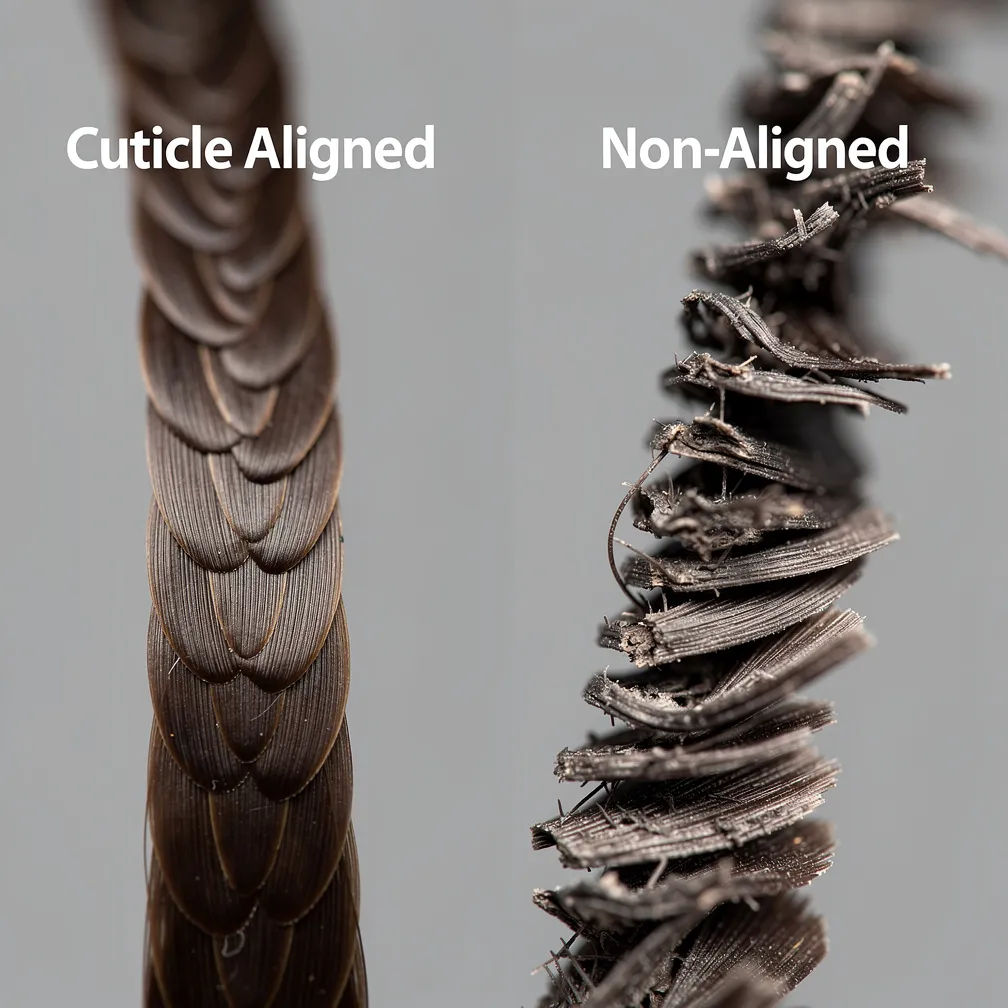
Cuticle aligned hair extensions are extensions in which every single strand of hair is oriented root-to-tip in the same direction, so that the microscopic overlapping scales covering each hair shaft — the cuticle — all face uniformly from the root toward the tip. This alignment prevents strands from interlocking with each other, which is the direct cause of tangling and matting. Cuticle alignment is the single most important structural quality factor in human hair extensions, and it is what separates an extension that performs beautifully for 12 to 18 months from one that begins matting within a few weeks of first wash.
For salon owners, distributors, and brand builders sourcing hair extensions at wholesale, understanding what cuticle alignment means at a technical level — and knowing how to verify it before committing to an order — is the difference between a product your clients love and a product that generates returns and complaints. This guide covers the science, the testing methods, the manufacturing implications, and the supplier red flags you need to know. For more details, see our guide on How to Verify Indian Hair Extension Quality Before Buying….
If you are newer to the sourcing process, our complete guide to sourcing hair extensions from India covers the broader supplier evaluation framework, of which cuticle alignment is one critical component.
Ready to request cuticle aligned wholesale samples? Message us directly:
WhatsApp: +91 9289358222
The Microscopic Science of Hair Cuticles
To understand why cuticle alignment matters so much, you need to understand the structure of a single human hair shaft. Each strand is composed of three concentric layers: the medulla (the innermost core), the cortex (which gives hair its strength and color), and the cuticle — the outermost protective layer that determines how a strand behaves in contact with other strands.
The cuticle is not a smooth surface. Under a scanning electron microscope, it looks like fish scales or roof shingles: flat, overlapping plates called cuticle cells, typically 0.2 to 0.5 micrometers thick, each one pointing away from the root toward the tip. On a healthy, undamaged hair strand, these scales lie flat and all point in the same direction. This is what makes healthy hair feel smooth when you run your fingers from root to tip, and slightly resistant when you run them tip to root — you are feeling the edge of those scales.
Now picture what happens when you mix strands oriented in opposite directions. The root-pointing scales of one strand catch on the tip-pointing scales of an adjacent strand. Under any kind of movement — wind, brushing, sleeping, washing — these opposing scales interlock progressively. The more they interlock, the tighter the knot becomes, until you have the irreversible mat that makes extensions unwearable. This is not a styling failure or a client care failure. It is a structural quality failure baked in at the manufacturing stage.
What “Aligned” Means in Practice at the Factory
At the hair collection and sorting stage, maintaining cuticle alignment requires deliberate process discipline. When raw hair is collected from a single donor — as is the case with Indian temple hair — all strands naturally share the same root-to-tip direction because they came from the same head in one cut. The manufacturer’s job is to preserve that orientation through every subsequent handling step: bundling, washing, sorting by length, drawing, and wefting or tip application.
The moment strands from different donors, or from brush collections (where root-and-tip directions are already randomized), are combined without re-sorting, alignment is lost. The only way to “fix” the appearance of misaligned hair is to strip the cuticle entirely with an acid bath — which is how the majority of mass-market extensions are produced.
Cuticle Aligned vs. Acid-Bath Processed Hair: The Full Comparison
The table below compares cuticle aligned hair (true Remy and raw virgin hair) against acid-bath processed hair (often marketed as “Remy-like,” “non-Remy,” or “machine-made Remy”) across the factors that matter most to professional wholesale buyers. For more details, see our guide on Remy vs Virgin Hair.
| Factor | Cuticle Aligned Hair | Acid-Bath Processed Hair |
|---|---|---|
| Cuticle status | Intact, all scales facing root-to-tip | Cuticle chemically dissolved or stripped |
| Initial appearance | Naturally lustrous, slightly matte on raw hair | High gloss due to silicone or polymer coating |
| Feel before first wash | Smooth, natural weight | Extremely silky (from coating) |
| Feel after 5 washes | Maintains smooth texture | Rough, tangled — coating washes off |
| Tangling rate | Minimal with correct care | High — begins within weeks of wearing |
| Typical lifespan | 12 to 18+ months with proper maintenance | 4 to 8 weeks before severe tangling |
| Can be colored? | Yes — cuticle intact accepts color evenly | Poor results — no cuticle to hold color |
| Can be heat styled? | Yes, repeatedly with heat protectant | Limited — further degrades the damaged cortex |
| Alkaline test result | Scales swell slightly; hair remains intact | Silicone dissolves; hair turns dry and brittle |
| Hair source | Single-donor (temple, village collections) | Mixed sources, brush hair, salon floor |
| Wholesale price per bundle | Higher (reflects quality and sourcing cost) | Lower (commodity pricing) |
| Client satisfaction rate | High — repeat purchase and referrals | Low — returns, complaints, chargebacks |
| Brand risk for resellers | Low | High — client trust damage after first wear |
The economic reality for wholesale buyers is clear: a lower unit cost on acid-bath processed hair is almost always offset by higher return rates, replacement costs, and the long-term cost of losing clients who had a bad experience with your brand.
Why Indian Temple Hair Is Naturally Cuticle Aligned
Indian temple hair has become the global benchmark for cuticle aligned raw hair for two structural reasons: how it is collected, and how little it is processed afterward.
Single-Donor Collection Through Temple Tonsuring
South Indian temples — particularly in Tamil Nadu, Andhra Pradesh, and Karnataka — collect hair through a ritual called tonsuring, where devotees shave their entire head as a religious offering. The tonsuring is performed by trained barbers who shave the head cleanly in a single session. This means:
- Every strand in that collection shares the same root-to-tip direction.
- The hair has never been chemically treated, bleached, or colored.
- The cuticle is completely intact, with scales flat and undamaged.
- There is no mixed-donor contamination from brush collections or salon floor sweepings.
Temple collections are then auctioned to licensed hair traders and manufacturers who sort, wash, and process the hair while maintaining the original directional orientation. When a manufacturer bundles and wefts this hair correctly — keeping all root ends together and all tip ends together — the resulting extension is naturally cuticle aligned without any special treatment required.
Minimal Processing Preserves Cuticle Integrity
Raw Indian temple hair is typically washed once with a mild sulfate-free shampoo to remove natural oils, then sorted by length and quality grade. No acid bath, no silicone coating, no synthetic polymer treatment. Because the cuticle was never damaged, it does not need to be masked. The result is a hair extension that behaves like natural growing hair — because structurally, it still is.
This is the fundamental reason why experienced buyers in the USA, UK, Germany, and Australia specify Indian temple hair when building premium extension product lines. It is not marketing positioning. It is structural and verifiable.
Interested in wholesale pricing for cuticle aligned Indian temple hair?
Contact us on WhatsApp: +91 9289358222 — we respond within 24 hours and ship samples worldwide.
How to Test for Cuticle Alignment: Two Methods Every Buyer Should Know
When evaluating a potential supplier’s samples, do not rely solely on their assurance that their hair is “100% cuticle aligned Remy.” Perform these two verification tests on every sample batch before committing to a purchase order.
Test 1: The Directional Feel Test
This is the simplest and most immediate test. Take a single strand or a small section of the extension and run your thumb and index finger along the strand in two directions:
- Root to tip — your fingers should glide smoothly with minimal resistance.
- Tip to root — you should feel slight but clear resistance as your fingers catch the upward edge of the cuticle scales.
If the strand feels equally smooth in both directions, the cuticle has been stripped and coated with silicone. If the strand feels rough in both directions, it is damaged or extremely low quality. True cuticle aligned hair will have this characteristic directional asymmetry — smooth one way, slightly resistant the other.
Perform this test on arrival and again after washing the sample three to five times. On cuticle aligned hair, the asymmetry remains consistent after washing. On silicone-coated hair, both directions become rough once the coating has washed out.
Test 2: The Alkaline Test (Sodium Hydroxide Test)
This is the gold-standard laboratory test used by professional buyers and quality auditors. It identifies whether hair has been coated with silicone or synthetic polymer to simulate the smoothness of a healthy cuticle.
Method:
- Prepare a 10% sodium hydroxide (NaOH) solution in a glass beaker. Sodium hydroxide is available at most chemical supply stores; handle with gloves and eye protection.
- Cut a 2 to 3 inch section of the extension sample and submerge it in the solution.
- Leave for 20 to 30 minutes at room temperature.
- Remove the sample and assess it while still wet, then again after drying.
How to read the results:
- Cuticle aligned real hair: The cuticle scales will swell slightly and the hair may become slightly tacky to the touch (because alkali causes the cuticle to open), but the strand remains structurally intact.
- Silicone-coated non-Remy hair: The silicone or polymer coating visibly dissolves in the alkaline solution. The solution may become slightly cloudy or oily. When you remove and dry the strand, it will feel dramatically rougher and significantly more prone to tangling than before the test.
A supplier confident in their cuticle aligned claim will have no objection to you performing this test on their samples. A supplier who discourages testing is giving you important information about the quality of their product.
Bonus Check: The Burn Test for Synthetic Content
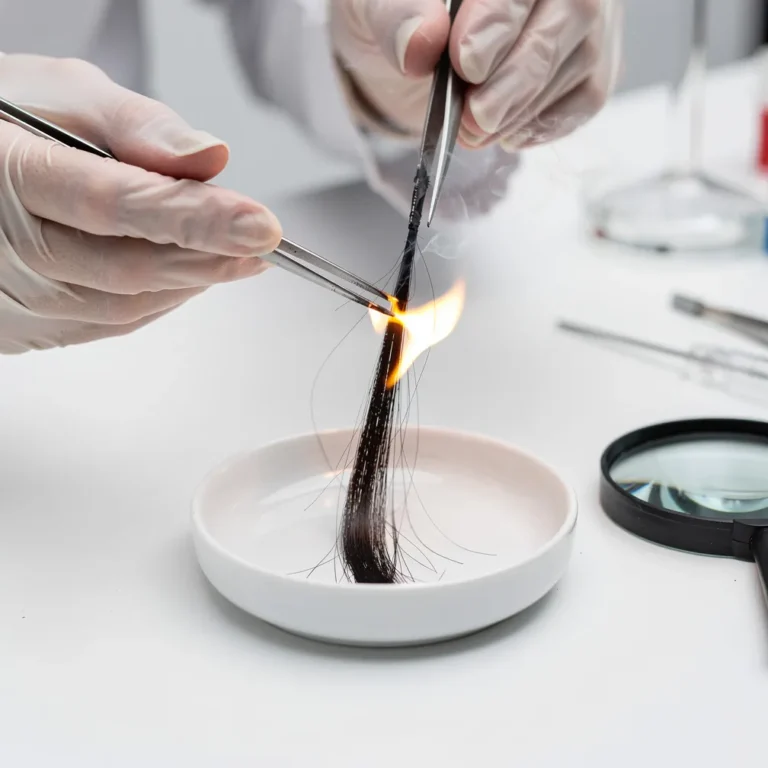
While not a cuticle test specifically, the burn test confirms that you are dealing with human hair rather than synthetic or blended fiber. Hold a small section above a flame briefly. Real human hair burns slowly, forms a crushable ash ball, and produces a smell similar to burning protein. Synthetic fiber melts, produces black smoke, and smells like burning plastic. Any supplier claiming cuticle aligned status for hair that fails the burn test is misrepresenting the product entirely.
The Business Economics of Cuticle Alignment for Wholesale Buyers
For buyers building a wholesale extension business — whether supplying salons, building a direct-to-consumer brand, or distributing across a region — the economics of cuticle aligned hair versus acid-bath processed hair play out over the lifetime of your client relationships, not just the initial invoice.
Consider a salon owner purchasing a batch of 50 weft bundles. If 20% of those bundles generate client complaints within the first month — returns, replacement services, negative reviews — the actual cost of that inventory is significantly higher than the invoice suggested. One cluster of negative reviews in a local market can suppress new client acquisition for months.
Contrast this with cuticle aligned Indian temple hair: clients who receive an excellent result at installation are statistically more likely to return for maintenance, purchase additional lengths, and refer friends. For a salon-focused distributor or brand owner, this repeat purchase behavior is the actual revenue engine — not the one-time margin on a single bundle.
Experienced B2B buyers in the USA and UK have largely moved away from competing on price with low-cost non-Remy suppliers. The market segment that purchases on price alone is not brand loyal and does not generate the referral economics that build sustainable businesses. Premium cuticle aligned hair attracts the client profile that does both.
The question is therefore not whether cuticle aligned hair costs more per unit. It does. The question is whether the total business outcome over 12 months is better with cuticle aligned hair at a higher unit price or with acid-bath processed hair at a lower unit price. For most professional buyers operating at any meaningful scale, the answer is consistent.
Get factory-direct pricing on cuticle aligned wholesale hair extensions.
WhatsApp us at +91 9289358222 or email info@hairextensionsbynature.com for a wholesale price list and sample kit information.
Supplier Red Flags: When “Cuticle Aligned” Is Just a Label
The terms “cuticle aligned” and “100% Remy” have become heavily misused in hair extension marketing. Here are the supplier behaviors and product characteristics that should prompt additional scrutiny before placing a purchase order.
- Extremely low pricing for claimed Remy or cuticle aligned hair. Genuine cuticle aligned, single-donor hair requires higher collection and sorting costs than bulk mixed hair. If the price seems inconsistent with that supply chain, it almost certainly is.
- Hair that smells strongly of chemicals on arrival. Cuticle aligned raw hair may have a mild natural scent. A strong chemical smell indicates acid bath processing, bleaching, or heavy silicone application.
- Unusually high shine on a dark, uncolored bundle. Raw or minimally processed cuticle aligned dark hair has a natural sheen, not a high-gloss lacquer finish. Excessive shine on uncolored hair is typically silicone.
- Supplier cannot confirm the collection source. A legitimate cuticle aligned hair manufacturer will tell you where the raw hair originates — which temples, which regions, which collection methods. Vague answers warrant follow-up questions.
- No sample program available. Any serious manufacturer of cuticle aligned hair will offer samples, because they are confident in what those samples will demonstrate. Resistance to sample requests is a meaningful warning sign.
- Texture inconsistency within a bundle. If the first few inches feel smooth and the lower half feels different, the hair may have mixed directional orientation within the bundle, or may be blended with lower-quality hair from a different source.
- No transparency about processing steps. A credible manufacturer will describe exactly what the hair has been through from collection to finished product. Refusal to discuss processing or vague descriptions of “minimal processing” without specifics warrants further investigation.
About Hair Extensions By Nature
Hair Extensions By Nature is a direct manufacturer and exporter of cuticle aligned Remy human hair extensions based in Faridabad, Haryana, India. We source raw temple hair directly from South Indian temple collections and manufacture finished extensions — wefts, I-tip, U-tip, tape-in, clip-in, and bulk hair — under one roof, supplying salons, distributors, and private label brands across the USA, UK, Europe, and 40+ countries worldwide.
Our facility operates quality control checks at every stage of production specifically to maintain cuticle alignment from raw material through finished product. We offer a sample program for first-time B2B buyers, flexible MOQ structures for initial orders, and full private label packaging capability for brands building their own extension lines.
To learn more about our manufacturing process and sourcing standards, visit our guide on sourcing hair extensions from India.
Factory address: Booth No 71, Sector 16 Huda Market, Faridabad, Haryana, India — 121002
Phone / WhatsApp: +91 9289358222
Email: info@hairextensionsbynature.com
Frequently Asked Questions About Cuticle Aligned Hair Extensions
What does cuticle aligned mean in hair extensions?
Cuticle aligned means that every strand of hair in the extension is oriented in the same direction — root to tip — so that the microscopic overlapping scales (cuticles) covering each strand all face the same way. This prevents strands from interlocking and tangling with each other during wear, and is the primary determinant of extension longevity.
What is the difference between cuticle aligned and non-cuticle aligned hair extensions?
Cuticle aligned hair has intact cuticles all pointing in the same direction, giving it natural longevity, minimal tangling, and the ability to be colored and heat styled repeatedly. Non-cuticle aligned hair has strands mixed in random directions, causing tangling. It is typically processed with an acid bath to strip the cuticle and then coated with silicone to simulate smoothness — a coating that washes off after a few weeks of wear, leaving rough, unusable hair.
How can I test if hair extensions are truly cuticle aligned?
Two reliable tests are: (1) The directional feel test — run your fingers from root to tip (should feel smooth) and then tip to root (should feel slightly resistant due to cuticle edges). If both directions feel equally smooth, the cuticle has likely been stripped and coated. (2) The alkaline test — submerge a sample in 10% sodium hydroxide solution for 20 to 30 minutes. Genuine cuticle aligned hair remains structurally intact; silicone-coated hair loses its smoothness as the coating dissolves in the solution.
Is Indian temple hair naturally cuticle aligned?
Yes. Indian temple hair collected through the ritual tonsuring process is naturally cuticle aligned because it comes from a single donor in one complete head shave. All strands share the same root-to-tip orientation at the point of collection. Provided the manufacturer handles and bundles the hair while maintaining that direction throughout sorting and production, no artificial alignment process is required.
Why do some hair extensions tangle quickly after a few washes?
The most common cause is that the cuticle has been stripped from the hair through acid bath processing and replaced with a silicone or polymer coating to simulate smoothness. Once the coating washes off after several shampoos, the underlying damaged hair — with no cuticle protection and no consistent directional alignment — begins to tangle and mat. This is a manufacturing quality issue, not a client care issue.
What is the lifespan difference between cuticle aligned and non-cuticle aligned hair extensions?
Cuticle aligned hair extensions, with proper washing and maintenance, typically last 12 to 18 months or longer. Acid-bath processed non-Remy extensions typically begin significant tangling within 4 to 8 weeks of first wear, and are usually unwearable within 3 months regardless of how well the client maintains them.
Can non-cuticle aligned hair be colored or heat styled?
Performance is poor on both counts. Without an intact cuticle, color molecules cannot be absorbed and held evenly by the hair shaft, leading to patchy or fast-fading color results. Heat styling further degrades the already-compromised cortex layer, causing breakage and increased frizz. Cuticle aligned hair, having an intact structure, accepts color and heat in the same way as natural growing hair.
What is the minimum order quantity for cuticle aligned hair extensions from Indian manufacturers?
MOQ varies by manufacturer and product type. At Hair Extensions By Nature, we work with first-time B2B buyers at MOQs starting from 25 to 50 pieces for most extension types, with a sample kit program available before any full purchase order. Contact us via WhatsApp at +91 9289358222 or email info@hairextensionsbynature.com for current MOQ and pricing details specific to your product requirements.
![Hair Extension Certifications — ISO, CE, and Quality Standards Explained [2026]](https://hairextensionsbynature.com/wp-content/uploads/2026/04/08-hair-extension-certifications-iso-quality-hero-768x768.webp)
![Hair Extension Return Policies — What Wholesale Buyers Should Negotiate [2026]](https://hairextensionsbynature.com/wp-content/uploads/2026/04/50-hair-extension-return-policy-wholesale-hero-768x768.webp)
![Wholesale Micro Ring Loop Extensions India — Salon Product Guide [2026]](https://hairextensionsbynature.com/wp-content/uploads/2026/04/21-wholesale-micro-ring-loop-extensions-india-hero-768x768.webp)
![Raw Indian Temple Hair Vendors — Complete Sourcing Guide [2026]](https://hairextensionsbynature.com/wp-content/uploads/2026/04/02-raw-indian-temple-hair-vendors-sourcing-guide-hero-768x430.webp)
One Comment