
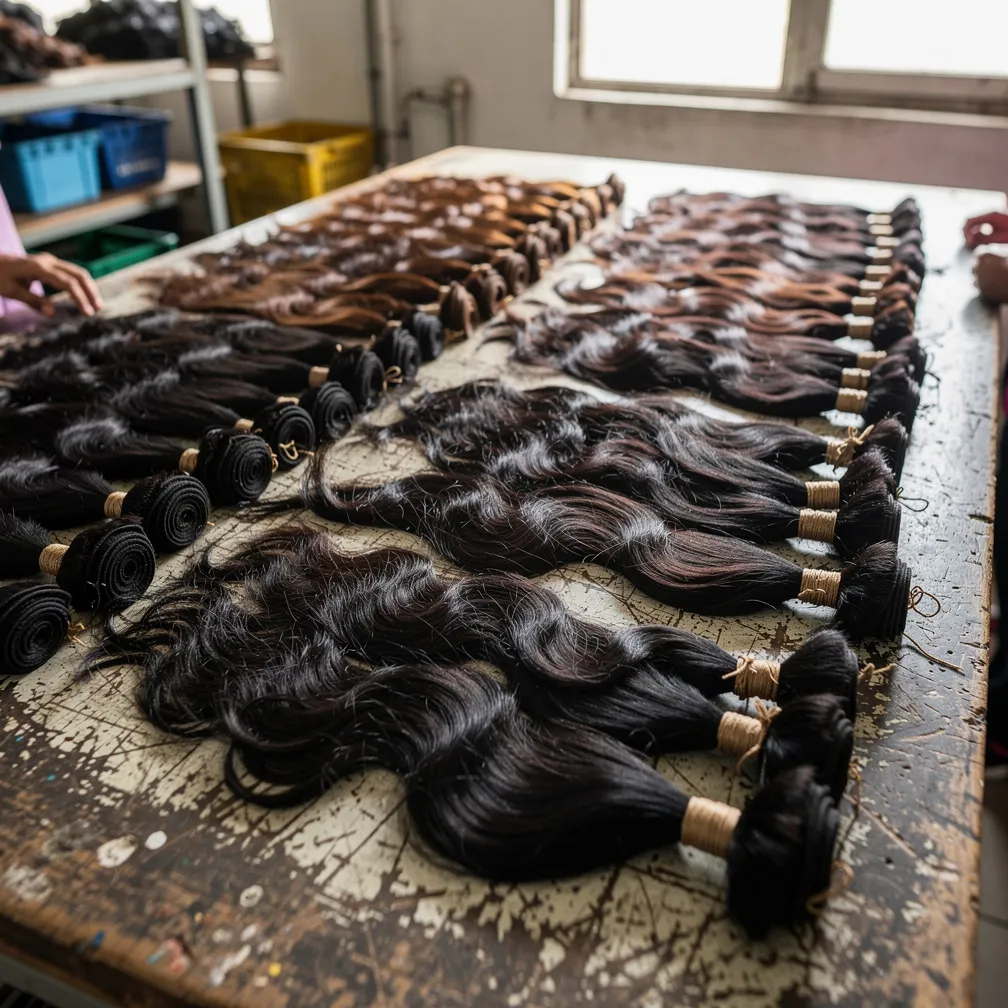
Raw Unprocessed Indian Hair Wholesale — Grades, Pricing & Bulk Guide [2026]
Raw Unprocessed Indian Hair Wholesale — Grades, Pricing, and Bulk Buying Guide [2026]
Raw unprocessed Indian hair is human hair that has not been chemically treated, dyed, bleached, permed, or coated with silicone — it arrives in its natural state exactly as collected, with cuticles intact and running in one direction. India is the world’s largest source of raw temple hair, with the Tirupati temple system in Andhra Pradesh alone collecting over 500 metric tons of hair annually through tonsuring ceremonies. For processors, traders, and wholesalers in Asia and the Middle East, Indian raw hair is the primary feedstock for finished extension products. Wholesale pricing ranges from $120 to $500+ per kilogram depending on length, grade, and cuticle quality, with MOQs starting at 1 kg from direct manufacturers.
This guide is designed for hair processors in China, Vietnam, and Southeast Asia, traders in the UAE and Japan, and bulk wholesalers who need to understand Indian raw hair grades, pricing structures, sourcing verification, and processing potential. Hair Extensions By Nature, a manufacturer based in Faridabad, Haryana, India, supplies raw unprocessed hair in bulk quantities to processors and traders across Asia, the Middle East, and beyond.
Need raw unprocessed Indian hair in bulk? Hair Extensions By Nature supplies temple-sourced raw hair from our Faridabad facility. Contact us for per-kg pricing and grade availability.
WhatsApp Us for Bulk Raw Hair Pricing
Understanding Raw Indian Hair Grades
Not all raw Indian hair is the same. The grading system reflects collection source, cuticle integrity, length consistency, and processing potential. Understanding these grades is essential for processors calculating yield and traders evaluating value.
| Grade | Source | Cuticle Integrity | Length Consistency | Processing Potential |
|---|---|---|---|---|
| Single Temple (Grade A) | Single temple donation, one donor | 100% intact, unidirectional | High — consistent root-to-tip | Excellent — accepts color, holds texture |
| Double Temple (Grade B) | Temple collection, sorted by length | 95-100% intact | Good — sorted within 2-inch range | Very good — suitable for most processing |
| Mixed Temple (Grade C) | Multiple temple collections, mixed | 85-95% intact | Moderate — wider length variance | Good — suitable for standard processing |
| Comb/Fallen Hair (Grade D) | Collected from combs and salons | 50-80% intact, mixed direction | Low — highly varied | Limited — requires acid bath, shorter life |
For processors producing finished Remy extensions, Grade A (single temple) and Grade B (double temple) are the only grades that deliver a finished product with long lifespan and minimal tangling. Grade C is acceptable for mid-range products sold in price-sensitive markets. Grade D (comb/fallen hair) is used for low-end products and synthetic blends — it should never be sold as Remy.
Per-Kg Pricing for Raw Indian Hair (2026)
Raw hair pricing is determined by three primary factors: grade, length, and market demand. The following table reflects current factory-direct pricing from Indian manufacturers. These prices fluctuate seasonally — temple collection peaks occur after major festivals, and pricing tends to increase during low-collection months (May-July).
| Length | Grade A (USD/kg) | Grade B (USD/kg) | Grade C (USD/kg) | Grade D (USD/kg) |
|---|---|---|---|---|
| 8-12 inches | $120 – $180 | $90 – $140 | $60 – $100 | $25 – $50 |
| 14-18 inches | $200 – $300 | $160 – $240 | $110 – $180 | $50 – $80 |
| 20-24 inches | $320 – $420 | $260 – $350 | $180 – $260 | $80 – $130 |
| 26-30 inches | $450 – $600 | $380 – $500 | $280 – $380 | $130 – $200 |
| 32+ inches | $600+ | $500+ | $380+ | Rarely available |
Volume discounts apply. Orders of 10 kg+ typically receive 5-10% discount; 50 kg+ orders can negotiate 10-15% below listed pricing. Seasonal contracts (quarterly or annual commitments) secure the best per-kg rates and guarantee supply during peak-demand months.
Temple Hair Collection and Ethical Sourcing
India’s raw hair supply chain begins at temples, primarily in South India. The tonsuring ceremony — where devotees shave their heads as an act of faith — produces ethically collected hair that no other country can replicate at scale. Tirupati (Tirumala Tirupati Devasthanams) is the single largest collection point, but hundreds of smaller temples across Tamil Nadu, Andhra Pradesh, and Karnataka also participate.
The ethical dimension matters increasingly to end consumers and regulatory bodies. Temple hair is voluntarily donated — no coercion, no exploitation. This is a verifiable supply chain: temple authorities auction collected hair to licensed buyers, who transport it to sorting facilities, where it is graded by length and quality before being sold to manufacturers and processors.
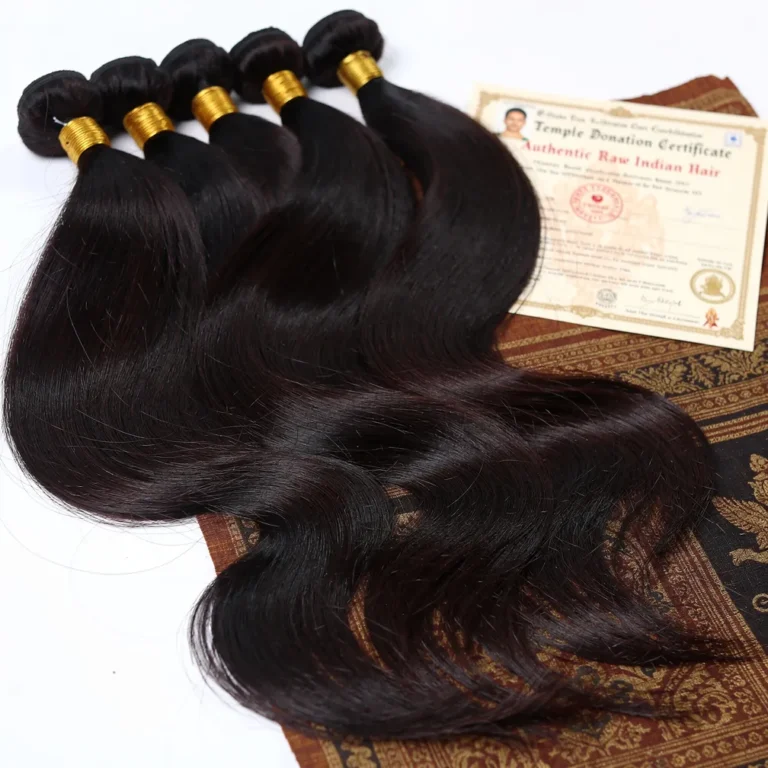
When buying raw hair, ask your supplier for traceability documentation. Legitimate suppliers can tell you which temple region the hair was collected from and provide auction receipts or purchase documentation. Hair Extensions By Nature maintains complete traceability from temple collection to export shipment.
Need traceability documentation for your raw hair purchase? Hair Extensions By Nature provides complete sourcing documentation including temple region of origin. Contact us for bulk pricing and availability.
WhatsApp Us for Raw Hair Sourcing
Processing Potential by Grade
For processors evaluating raw Indian hair as feedstock, understanding the yield and processing potential of each grade determines your finished product cost and quality ceiling.
Grade A — Single Temple
Yield after washing and conditioning: 85-92%. Accepts bleaching up to level 10 (lightest blonde) without significant structural damage. Holds permanent curling and straightening textures. Ideal for producing premium Remy wefts, tape-ins, keratin bonds, and wig construction. Processing waste is minimal. This is the grade used by manufacturers producing for European, US, and Japanese retail markets.
Grade B — Double Temple
Yield after washing and conditioning: 80-88%. Accepts bleaching up to level 8-9 with standard results. Suitable for all standard extension types including wefts, tape-ins, and clip-ins. Slight length variance within batches may require additional sorting during weft construction. This is the workhorse grade for most large-scale processors producing mid-to-high range finished products.
Grade C — Mixed Temple
Yield after washing and conditioning: 70-82%. Bleaching beyond level 6-7 risks damage. Best suited for natural color and dark-shade finished products. Higher sorting labor cost due to length and quality variance. Acceptable for bulk weft production targeting price-sensitive markets in Africa and Southeast Asia.
Grade D — Comb/Fallen Hair
Yield after processing: 50-65%. Requires acid bath to remove mixed cuticle directions, which shortens lifespan significantly. Suitable only for low-end products, practice hair for beauty schools, and synthetic blends. Not suitable for any product marketed as Remy.
Quality Verification for Raw Hair Purchases
Before committing to bulk raw hair orders, verify quality through these specific tests:
- Cuticle test: Run fingers from tip to root. Intact cuticles feel smooth tip-to-root and slightly resistant root-to-tip. Stripped or damaged cuticles feel rough in both directions
- Burn test: A single strand, when burned, should smell like burning protein (similar to burning feathers), curl into a ball, and crumble to ash. Synthetic or heavily silicone-coated hair melts and smells like burning plastic
- Water test: Submerge a small sample in water. Genuine raw human hair absorbs water and sinks within 30-60 seconds. Silicone-coated hair repels water and floats
- Bleach test: Apply a small amount of bleach to a test strand. Raw unprocessed hair should lighten evenly. Previously processed hair will lighten unevenly or become gummy
- Weight verification: Weigh your shipment immediately on receipt. Legitimate suppliers maintain +/- 2% weight accuracy. Consistent underweight is a sign of dishonest dealing
Bulk Ordering Logistics
Minimum Order Quantities
Most Indian raw hair suppliers accept MOQs starting at 1 kg for sample and trial orders. Production-scale orders typically start at 5-10 kg minimum. For processors running continuous production lines, monthly contracts of 50-200 kg are standard. Hair Extensions By Nature supplies raw hair from 1 kg upward with volume pricing breaks at 10 kg, 50 kg, and 100 kg thresholds.
Shipping for Bulk Raw Hair
Raw hair is lightweight relative to volume. A 10 kg shipment typically ships via DHL or FedEx air freight at a cost of $80-$150 to most Asian destinations. Larger shipments (50+ kg) may benefit from air cargo rates through freight forwarders, reducing per-kg shipping cost by 30-40%. Sea freight is rarely used for raw hair due to the risk of moisture damage during extended transit.
Payment Terms
Standard terms: 50% advance via wire transfer (T/T), balance before shipment. For established buyers with regular monthly orders, net 15 or net 30 terms may be available. Letters of credit are accepted for orders above $10,000.
Why Source From Hair Extensions By Nature?
Hair Extensions By Nature supplies raw unprocessed Indian hair to processors and traders across China, Japan, South Korea, Vietnam, UAE, and Thailand. Our advantages for bulk raw hair buyers include:
- Direct temple sourcing: We maintain purchasing relationships with temple hair auction networks across South India, ensuring consistent supply year-round
- All grades available: Grade A through Grade C, sorted by length with 2-inch accuracy
- Volume capacity: We can supply 100+ kg per month consistently to production-scale processors
- Traceability: Full documentation from temple region to export, supporting your downstream compliance requirements
- Competitive per-kg pricing: Factory-direct with volume breaks at 10, 50, and 100 kg thresholds
- Quality guarantee: Weight accuracy within +/- 2%, cuticle integrity verified, and replacement policy for quality discrepancies
- Flexible MOQ: Starting at 1 kg for trial orders, scaling to monthly contracts
Contact us at +91 9289358222 (WhatsApp) or info@hairextensionsbynature.com. Factory address: Booth No 71, Sector 16 Huda Market, Faridabad, Haryana, India – 121002.
Frequently Asked Questions
What is the price of raw unprocessed Indian hair per kg?
Raw unprocessed Indian hair pricing ranges from $120-$600+ per kg depending on grade and length. Grade A single temple hair in 14-18 inch lengths costs $200-$300 per kg, while 20-24 inch lengths cost $320-$420 per kg. Grade D comb hair is the cheapest at $25-$200 per kg. Volume discounts of 5-15% apply for orders of 10 kg and above.
What is the minimum order quantity for raw Indian hair?
Most Indian raw hair suppliers accept minimum orders starting at 1 kg for sample and trial purposes. Production-scale orders typically start at 5-10 kg. Monthly contracts for processors usually range from 50-200 kg. Volume pricing breaks are available at 10 kg, 50 kg, and 100 kg thresholds.
How is Indian temple hair collected?
Indian temple hair is collected through tonsuring ceremonies where devotees voluntarily shave their heads as an act of religious faith. The largest collection point is Tirupati temple in Andhra Pradesh, which collects over 500 metric tons annually. Temple authorities auction the collected hair to licensed buyers, who sort and grade it before selling to manufacturers and processors. This is an ethical, voluntary collection system with no coercion.
What is the difference between raw hair grades A, B, C, and D?
Grade A (single temple) comes from a single donor with 100% intact cuticles and the highest processing potential. Grade B (double temple) is temple-collected and sorted by length with 95-100% cuticle integrity. Grade C (mixed temple) combines multiple collections with 85-95% cuticle integrity. Grade D (comb/fallen hair) is collected from salons and combs with mixed cuticle direction, suitable only for low-end products.
Can raw Indian hair be bleached to blonde?
Grade A single temple raw hair can be bleached up to level 10 (lightest blonde) without significant structural damage. Grade B accepts bleaching to level 8-9. Grade C should not be bleached beyond level 6-7 without risking hair integrity. The key is starting with unprocessed hair that has intact cuticles — previously processed or chemically treated hair will not accept even bleaching.
How do I verify that raw Indian hair is genuinely unprocessed?
Perform four tests: (1) Cuticle finger-slide test — smooth tip-to-root, resistant root-to-tip. (2) Burn test — should smell like protein, not plastic. (3) Water test — raw hair absorbs water and sinks within 60 seconds; silicone-coated hair floats. (4) Bleach test — raw hair lightens evenly; previously processed hair lightens unevenly. Also request traceability documentation showing temple origin.
Ready to source raw Indian hair in bulk? Hair Extensions By Nature supplies temple-sourced raw hair in all grades and lengths from our Faridabad facility. Contact us for per-kg pricing, volume discounts, and monthly supply contracts.
Email: info@hairextensionsbynature.com
Visit: www.hairextensionsbynature.com/contact
![How Indian Temple Hair Is Processed — From Collection to Extensions [2026]](https://hairextensionsbynature.com/wp-content/uploads/2026/03/25-how-indian-temple-hair-is-processed-hero-768x768.webp)