
Best Wholesale Hair Extensions Manufacturer in India [2026 Guide]
Best Wholesale Hair Extensions Manufacturer in India [2026 Guide]
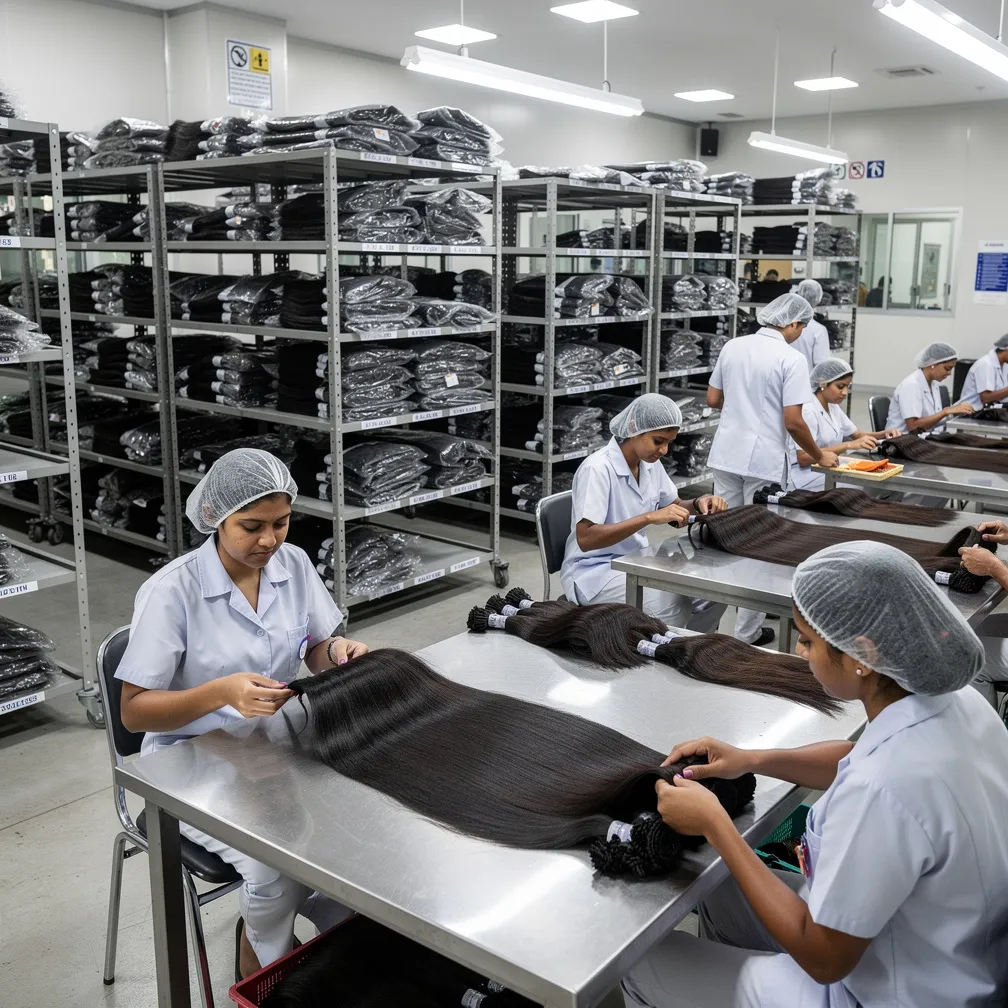
The best wholesale hair extensions manufacturer in India is a direct production facility — not a trading company or middleman — that holds a valid export license, maintains in-house quality control, and supplies verifiable Remy human hair with cuticle alignment intact. In 2026, India remains the world’s largest exporter of human hair, shipping over USD 450 million worth of product annually, but the wide variance in supplier quality makes manufacturer evaluation a non-negotiable step for any serious wholesale buyer. This guide gives procurement teams, distributors, and salon chain buyers the exact framework to identify, evaluate, and qualify an Indian hair extension manufacturer before committing to volume orders. For more details, see our guide on Hair Extension Payment Methods. For more details, see our guide on Wholesale Men’s Hair Systems from India.
Whether you are placing your first wholesale order or looking to switch from a current supplier, the criteria below are based on direct industry experience from Hair Extensions By Nature, a manufacturer based in Faridabad, Haryana — one of India’s primary hair extension export hubs.
Speak directly with our manufacturing team. Hair Extensions By Nature supplies verified Remy and raw Indian hair extensions to wholesale buyers across 30+ countries. WhatsApp us now to discuss MOQ, pricing, and sample availability.
WhatsApp Us for Wholesale Pricing
India’s Hair Extension Manufacturing Landscape in 2026
India’s human hair industry is concentrated in three geographic clusters: the temple hair collection and initial processing belt in Tamil Nadu (Chennai, Tirupati corridor), the finishing and export manufacturing hub in the National Capital Region (Faridabad, Delhi, Noida), and secondary processing units in Andhra Pradesh and Maharashtra. Each cluster plays a distinct role in the supply chain, and understanding this geography helps buyers ask better questions when evaluating a supplier’s claims.
Chennai-based units often focus on raw temple hair processing and initial sorting. Faridabad and the NCR region are where the majority of value-added manufacturing happens — cuticle alignment, coloring, chemical processing, clip-in and tape-in assembly, wig construction, and export packaging. When a supplier based outside these hubs claims to manufacture from scratch, that warrants additional verification.
For a broader overview of how India’s supply chain works from temple to export, read our Complete Guide to Sourcing Hair Extensions from India.
Factory vs. Trading Company: The Most Important Distinction
The single most impactful decision a wholesale buyer makes is whether they are purchasing from an actual manufacturer or from a trading company representing multiple factories. Neither model is inherently fraudulent, but the implications for pricing, quality control, lead times, and customization differ significantly.
| Criterion | Direct Manufacturer | Trading Company |
|---|---|---|
| Pricing | Factory-direct, no intermediary margin | 15-40% markup over factory price |
| Quality Control | Direct oversight at every production stage | Dependent on factory QC; inconsistent |
| Customization | Full OEM/private label capability | Limited; depends on factory agreement |
| Lead Times | 7-20 days; predictable and direct | Often longer; middle-party coordination |
| MOQ Flexibility | Often more flexible for established buyers | Fixed MOQs dictated by factory terms |
| Accountability | Single point of responsibility | Shared/diffused responsibility |
| Factory Audit | Can invite buyers for in-person or video audit | May resist audit or redirect to office |
| Export Documentation | Handles IEC, GST, and shipping in-house | May use third-party exporters |
A simple test: ask the supplier to share their IEC (Importer Exporter Code) number issued by India’s DGFT. Legitimate manufacturers will provide this without hesitation. You can verify it at the DGFT public portal. A trading company will often share an IEC that belongs to their logistics partner rather than their own entity.
15-Point Manufacturer Evaluation Checklist
Use this checklist as a structured due-diligence framework before placing any wholesale order. It applies whether you are conducting a remote evaluation or visiting the facility in person.
| # | Evaluation Point | What to Look For | Red Flag |
|---|---|---|---|
| 1 | IEC Registration | Valid DGFT-issued IEC code | Refusal to share or unverifiable code |
| 2 | GST Registration | Active GSTIN on invoices | No GST number or inconsistent entity name |
| 3 | Physical Factory Proof | Video walkthrough of production floor | Only shows a showroom or office |
| 4 | Sample Program | Willing to send paid samples pre-bulk | Refuses samples or requires bulk MOQ first |
| 5 | Quality Grading System | Clear definitions for Remy, double drawn, raw | Vague or inconsistent grade terminology |
| 6 | Export History | References from existing international buyers | No verifiable references or export portfolio |
| 7 | Communication Quality | Responsive within 24 hours; clear English | Slow responses; avoids direct questions |
| 8 | Payment Terms | 30-50% advance; balance before dispatch | 100% upfront demand; no receipt |
| 9 | Product Range | Manufactures multiple extension types in-house | Extremely narrow range suggesting re-selling |
| 10 | MOQ Transparency | Clear MOQ per SKU, per category | MOQs that change with every conversation |
| 11 | Packaging Capability | In-house custom packaging and labeling | No packaging options; ships loose |
| 12 | Defect Policy | Written policy for defective goods replacement | No policy; avoids the question |
| 13 | Certifications | ISO, SEDEX, or equivalent quality cert | Unverifiable or expired certificates |
| 14 | Shipping Partners | Works with DHL, FedEx, Aramex directly | Unknown couriers; no tracking capability |
| 15 | Social Proof | Active professional presence; real buyer reviews | Generic stock images; no verifiable presence |
Quality Markers Every Wholesale Buyer Must Verify
Price alone does not determine quality — and in the Indian hair extension market, low price almost always correlates with compromised hair grade. The following quality markers should be verified before any bulk purchase.
Cuticle Alignment
Genuine Remy hair has all cuticle layers running in the same direction from root to tip. This is the single most important quality indicator. Hair without cuticle alignment tangles after minimal use and has a significantly shorter lifespan. Request samples and perform the finger-slide test: run your fingers from tip toward the root; if resistance is high, the cuticles are likely not aligned or the hair has been acid-washed.
Double-Drawn vs. Single-Drawn Construction
Double-drawn hair has short hairs removed so that the weft or bundle is full from root to tip. Single-drawn hair contains a mix of lengths, resulting in a tapered appearance. For premium salon and retail markets, double-drawn construction commands higher prices and reduces customer complaints. Confirm this specification in writing before ordering.
Chemical Processing Transparency
Ask directly: has this hair been bleached, relaxed, or permed? Legitimate manufacturers will provide straightforward answers. Hair that has undergone heavy processing is more affordable but has a shorter lifecycle. For raw hair, confirm that it is truly unprocessed and sourced from temple donations — a practice Hair Extensions By Nature adheres to with full traceability documentation available on request.
Weight Accuracy
Bundles sold by weight must meet stated gram counts consistently. A common quality issue is bundles weighing 10-15% less than stated. Weigh your first shipment immediately upon receipt. Reputable manufacturers will replace or credit bundles that fall short of stated weight.
Ready to evaluate Hair Extensions By Nature as your manufacturer? We offer free video factory walkthroughs, sample programs, and a dedicated export team for international wholesale buyers. Contact us on WhatsApp to get started.
MOQ Expectations When Buying from Indian Manufacturers
Minimum order quantities vary significantly by manufacturer size, product type, and customization level. Understanding realistic MOQ ranges prevents wasted negotiation time and helps buyers plan procurement budgets accurately.
| Product Category | Typical MOQ (Standard) | MOQ with Private Label | Lead Time |
|---|---|---|---|
| Raw Hair Bundles (by weight) | 1 kg | 3 kg | 7-10 days |
| Weft Extensions | 50 pieces | 100 pieces | 10-15 days |
| Tape-In Extensions | 50 sets | 100 sets | 10-15 days |
| Clip-In Extensions | 50 sets | 100 sets | 10-15 days |
| I-Tip / U-Tip Bonds | 100 strands | 200 strands | 12-18 days |
| Full Lace Wigs | 10 pieces | 20 pieces | 15-25 days |
| Lace Front Wigs | 10 pieces | 20 pieces | 15-25 days |
| Men’s Hair Systems | 5 pieces | 10 pieces | 20-30 days |
Buyers purchasing across multiple SKUs in a single order often qualify for blended MOQ structures, where the total order value determines eligibility rather than per-SKU quantities. Discuss this option explicitly when negotiating with any manufacturer.
Certifications and Compliance Standards
India’s hair extension export market is largely unregulated at the product level, which means certification is a differentiator rather than a baseline requirement. However, international buyers — particularly those serving European and Australian markets — increasingly require documented quality management systems.
The key certifications to look for include ISO 9001 (quality management systems), SEDEX or SMETA audit compliance (ethical supply chain), and REACH compliance documentation for extension adhesives and colorants sold into EU markets. Manufacturers exporting to the United States should be aware of FDA labeling requirements for any products containing chemical adhesives or treatments.
Always request copies of certificates and verify their validity dates and issuing body. A certificate dated more than three years ago without renewal is not current and cannot be relied upon.
Communication and Business Conduct Standards
The quality of communication before the first order is the most predictive indicator of how disputes will be handled after shipment. Evaluate prospective manufacturers on the following:
- Response time: wholesale buyers should expect replies within 24 hours during the manufacturer’s working week
- Documentation quality: professional invoices, clear product specifications, and written order confirmations
- Language capability: a dedicated export team with strong English communication, not just a sales agent who routes messages
- Problem resolution: ask directly how they handle incorrect shipments, quality complaints, and customs delays — legitimate manufacturers have documented procedures
- Transparency: willingness to discuss limitations, lead time risks, and product grades honestly rather than over-promising
Hair Extensions By Nature maintains a dedicated WhatsApp export line (+91 9289358222) and email (info@hairextensionsbynature.com) staffed by an experienced export team. Our factory is located at Booth No 71, Sector 16 Huda Market, Faridabad, Haryana, India – 121002, and we welcome buyer visits by appointment.
Start your supplier evaluation today. Hair Extensions By Nature provides IEC documentation, factory video walkthroughs, and paid sample programs for qualified wholesale buyers. Use the link below to contact our export team directly.
Frequently Asked Questions
What is the difference between a hair extension manufacturer and a trading company in India?
A manufacturer owns and operates a production facility where hair is processed, assembled, and quality-checked in-house. A trading company sources finished products from multiple factories and resells them, adding a margin without adding production value. Manufacturers offer better pricing, customization capability, and direct quality accountability. Key tests include requesting an IEC code, a factory video, and references from international buyers.
What is the minimum order quantity for wholesale hair extensions from India?
MOQs vary by product type. Raw hair bundles typically start at 1 kg, while finished products like tape-in sets, weft bundles, and clip-in sets generally have MOQs of 50 pieces for standard orders. Private label and custom branded orders typically require double the standard MOQ. Manufacturers may offer blended MOQ structures for buyers ordering across multiple product categories in a single shipment.
How do I verify that an Indian hair extension manufacturer is legitimate?
Request and verify their IEC (Importer Exporter Code) through India’s DGFT portal. Ask for a live or recorded video walkthrough of the production facility. Request a paid sample before committing to bulk orders. Check for active GSTIN on their invoices, ask for references from existing international buyers, and verify any certifications through the issuing body directly.
Which cities in India are the main hair extension manufacturing hubs?
The primary manufacturing and export hubs are Faridabad and the broader National Capital Region (Delhi, Noida, Gurugram) for value-added manufacturing and export. Chennai and the Tamil Nadu belt (including the Tirupati corridor) are the primary raw hair processing centers. Andhra Pradesh and Maharashtra have secondary processing operations. Most large-scale export manufacturers are concentrated in the NCR region.
What certifications should a reputable Indian hair extension manufacturer hold?
Key certifications to look for include ISO 9001 (quality management), SEDEX or SMETA audit compliance (ethical supply chain), and REACH compliance for products containing adhesives or chemical colorants sold into EU markets. Always verify that certificates are current, not expired, and issued by a recognized certification body. Buyers serving regulated markets like the EU and Australia should specifically request compliance documentation.
What payment terms are standard when ordering from Indian hair extension manufacturers?
Standard payment terms for first-time wholesale orders are typically 30-50% advance payment upon order confirmation, with the remaining balance due before dispatch. For established buyer relationships, some manufacturers offer 30-day credit terms or letter of credit arrangements. Wire transfer (T/T) and PayPal are common payment methods. Be cautious of suppliers demanding 100% upfront payment with no paper trail.
How long do Indian hair extension manufacturers take to fulfill wholesale orders?
Standard wholesale orders with no customization typically ship within 7-15 business days. Custom color, private label packaging, and bespoke wigs or hair systems extend lead times to 15-30 days. Raw hair bulk orders may ship faster if stock is held. Always confirm production capacity and lead times in writing at the time of order placement, especially for seasonal peak periods.
![How to Order Hair Extension Samples from India — First-Time Buyer Guide [2026]](https://hairextensionsbynature.com/wp-content/uploads/2026/04/49-hair-extension-sample-ordering-guide-hero-768x768.webp)
![Indian Hair Extension Factory Direct Buying — Guide for European Buyers [2026]](https://hairextensionsbynature.com/wp-content/uploads/2026/04/03-indian-hair-extension-factory-direct-hero-768x768.webp)
![Hair Extension MOQ Guide — What First-Time Wholesale Buyers Should Know [2026]](https://hairextensionsbynature.com/wp-content/uploads/2026/03/12-hair-extension-moq-guide-first-time-buyers-hero-768x768.webp)
![Hair Extension Distributor Partnership India — Agreements & Margins [2026]](https://hairextensionsbynature.com/wp-content/uploads/2026/04/05-hair-extension-distributor-partnership-india-hero-768x768.webp)