
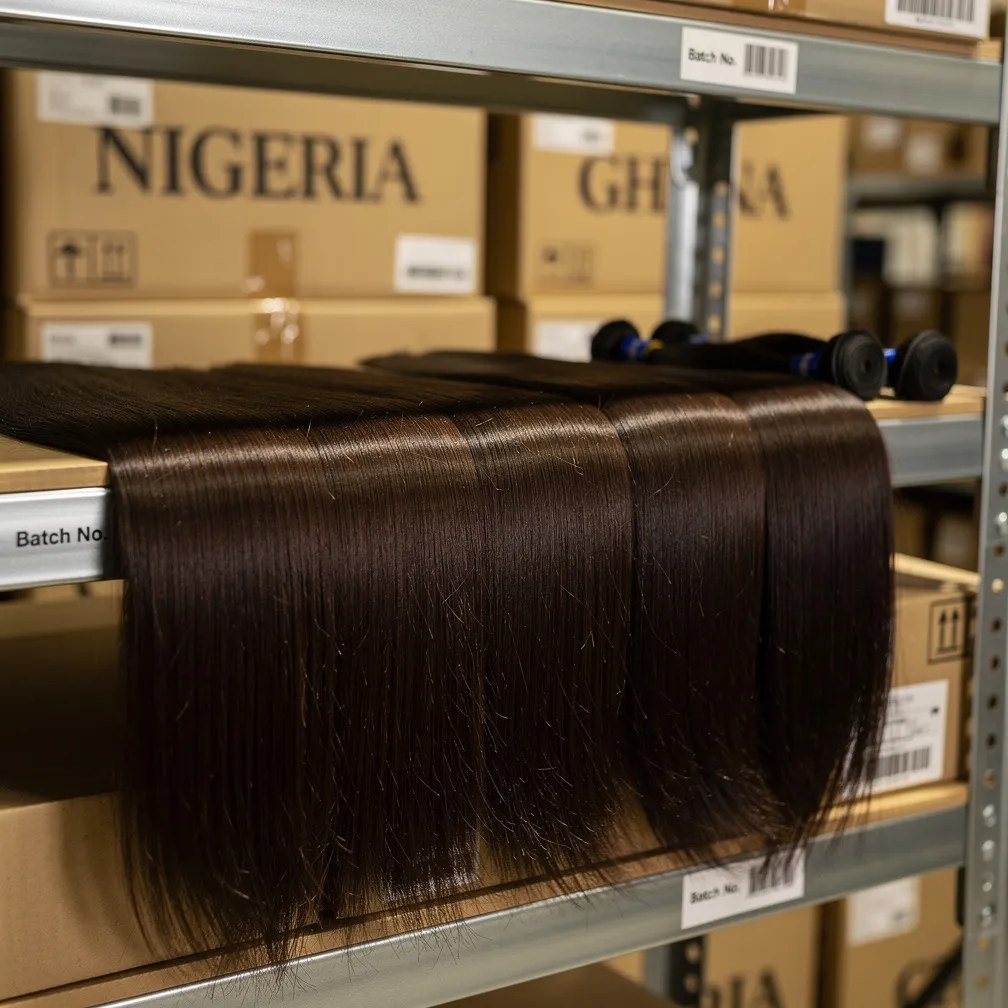
Wholesale Indian Hair Extensions for Nigeria and Africa — Sourcing Guide [2026]
Wholesale Indian hair extensions for Nigeria and Africa offer distributors and salon owners across the continent access to the world’s highest-quality human hair at prices that support strong retail margins. India’s factory-direct wholesale pricing for Remy bundles, closures, and frontals typically ranges from $15 to $60 per unit depending on length and type — significantly lower than the prices African buyers pay when purchasing through intermediaries in Dubai, China, or the United Kingdom. This guide covers everything African wholesale buyers need to know, from selecting the right Indian manufacturer to navigating import duties, shipping costs, and payment logistics for markets in Lagos, Accra, Nairobi, and Johannesburg. For more details, see our guide on complete guide to sourcing hair extensions from India. For more details, see our guide on Wholesale Indian Hair for Southeast Asia.
At Hair Extensions By Nature, we have shipped wholesale orders to distributors across West Africa, East Africa, and Southern Africa for years. The African market is one of our most important export destinations, and we understand the specific product preferences, logistics challenges, and business practices that matter most to buyers in Nigeria, Ghana, Kenya, South Africa, Tanzania, and beyond.
Why African Distributors Prefer Indian Hair Over Chinese Hair
The distinction between Indian and Chinese hair is well understood by experienced African distributors, even if it is not always communicated clearly to end consumers. Indian temple hair is single-donor hair collected with cuticles running in one direction — a property known as Remy alignment. This means the hair behaves like natural hair: it remains tangle-free after washing, holds color well, and lasts significantly longer than processed alternatives.
Chinese-manufactured hair, by contrast, is predominantly sourced from mixed origins — brush collections, salon floor sweepings, and short clippings that are then acid-bathed to strip and realign cuticles before coating with silicone. This process creates hair that feels luxurious in the packet but begins to tangle, shed, and dull after a few washes as the silicone coating breaks down.
For African distributors, this quality difference directly affects customer loyalty and repeat business. A retailer whose clients return complaining about tangling and shedding after two weeks loses that client’s business. A retailer selling genuine Indian Remy hair builds a repeat customer base. The price premium of Indian hair over the lowest-tier Chinese alternatives is typically 30–50%, but the repeat purchase rate and brand reputation returns far exceed that premium.
Indian Hair vs. Chinese Hair — What African Buyers Should Know
| Factor | Indian Temple Hair | Chinese-Processed Hair |
|---|---|---|
| Hair source | Single-donor temple collections | Mixed sources, brush/salon collections |
| Cuticle condition | Naturally aligned, intact | Acid-stripped, silicone-coated |
| Lifespan (with care) | 12–24 months | 2–6 months |
| Post-wash behavior | Smooth, minimal tangle | Tangles increase after each wash |
| Color retention | Excellent — absorbs dye evenly | Uneven — stripped cuticles resist dye |
| Wholesale price (per bundle, 18″) | $20–$40 | $10–$20 |
| Retail margin potential | High — premium positioning | Low — commodity market pricing |
| Customer complaint rate | Low with genuine Remy quality | High with low-grade product |
Most Popular Products in African Hair Markets
Product preferences vary across African regions, but the core categories with the strongest demand are consistent across Nigeria, Ghana, Kenya, and South Africa.
Bundles
Bundle deals — typically sold in sets of three (16″+18″+20″ or 18″+20″+22″) — are the core product across all African markets. Nigerian buyers tend to favor body wave and deep wave textures, while East African buyers in Kenya and Tanzania more commonly purchase straight and loose wave. South African buyers purchase a wider range of textures including kinky straight and natural wave. Wholesale bundle pricing from India ranges from $15 to $55 per 100g bundle depending on length and texture, with double drawn bundles commanding a 30–50% premium over single drawn.
Closures and Frontals
The wig-making industry across Nigeria, Ghana, and South Africa has grown dramatically over the past five years, driving strong wholesale demand for lace closures (4×4, 5×5) and frontals (13×4, 13×6). Lagos and Accra both have active wig-making communities supplying both local retail and diaspora markets. Wholesale closures from India range from $18 to $45 and frontals from $35 to $80 depending on lace type and hair grade.
Wigs and Wig Caps
Ready-to-wear wigs are increasingly in demand, particularly in South Africa and Kenya where the formal retail hair market is more developed. Many African distributors purchase bulk bundles and closures from India and have wigs assembled locally, which creates local employment while still accessing the quality advantage of Indian hair.
Contact Us on WhatsApp for Africa-Specific Wholesale Pricing →
Shipping Indian Hair Extensions to African Countries
Shipping from India to African markets involves more complexity than shipping to the USA or UK, but well-established freight routes exist to all major African commercial cities. The key variables are transit time, cost, and the reliability of local customs clearance.
Shipping Options from India to Africa
Air courier services (DHL, FedEx, Aramex) provide the fastest and most reliable service for small and medium wholesale orders under 50 kg. Aramex in particular has strong delivery networks across West Africa, East Africa, and Southern Africa. For larger orders above 100 kg, air freight consolidation services offer significant cost savings. Sea freight is feasible for container-load orders exceeding 500 kg but is rarely practical for hair extension wholesalers at the distributor level.
Shipping Cost and Transit Time by African Country
| Country | Destination City | Air Courier Transit | Approx. Shipping Cost (per kg) | Import Duty on Human Hair | Notes |
|---|---|---|---|---|---|
| Nigeria | Lagos (LOS) | 5–8 business days | $12–$18 | ~20% | Aramex and DHL most reliable |
| Ghana | Accra (ACC) | 5–8 business days | $11–$16 | ~20% | Consistent clearance at Kotoka Airport |
| Kenya | Nairobi (NBO) | 4–7 business days | $10–$15 | ~25% | Strong Aramex coverage |
| South Africa | Johannesburg (JNB) | 4–6 business days | $9–$14 | ~20% | Most straightforward customs process |
| Tanzania | Dar es Salaam | 6–9 business days | $11–$16 | ~25% | Allow extra clearance time |
| Ethiopia | Addis Ababa (ADD) | 4–6 business days | $10–$14 | ~15% | Ethiopian Airlines cargo option available |
| Senegal | Dakar (DKR) | 7–10 business days | $13–$18 | ~20% | DHL recommended |
| Cameroon | Douala | 7–10 business days | $13–$19 | ~30% | Allow additional clearance time |
Note: Shipping costs and duties are approximate and subject to change. Always confirm current rates with your freight agent and customs broker. Import duties are calculated on the declared value of the shipment — accurate invoicing is essential for smooth clearance.
Navigating Import Duties and Customs in Africa
Import duties are one of the most significant costs for African buyers sourcing from India, and they require careful planning to protect margins.
Human hair and hair extension products are classified under HS code 6703 (hair, dressed, thinned, bleached, or otherwise worked) in most African customs tariff systems. Some countries also classify finished extensions under 6704 (wigs and the like). The applicable duty rate varies by country and by the level of processing — raw hair typically attracts lower duties than finished wigs in some jurisdictions.
Documentation required for smooth customs clearance in most African countries includes a commercial invoice with declared value in USD, a packing list with weight and dimensions, a certificate of origin (Form A or GSP certificate from India), and in some cases a fumigation certificate. Work with a customs broker in your country for your first several shipments — the cost of professional broker services ($50–$200 per shipment) is far less than the cost of delays, demurrage, or penalty fees from clearance errors.
Payment Methods for Buying from Indian Manufacturers
Payment logistics are a genuine challenge for many African buyers, and understanding the available options helps you structure purchases efficiently.
Wire Transfer (T/T)
Bank-to-bank wire transfer is the preferred method for large wholesale orders. Most established Indian manufacturers accept wire transfer in USD. Nigerian buyers should be aware that Central Bank of Nigeria forex restrictions can create delays for USD international transfers — work with your bank in advance to understand the process and timeline. South African buyers typically face fewer restrictions on international transfers.
Western Union
Western Union remains widely used across West Africa for transactions under $2,000–$3,000. It is fast (funds available within minutes), widely accessible, and does not require a bank account for the sender. The main disadvantage is the transfer fee (typically 2–5% of the transaction amount) and per-transaction limits that may require multiple transfers for larger orders.
PayPal and Other Digital Options
PayPal availability is limited in many African countries. Some Nigerian and South African buyers use PayPal linked to Domiciliary accounts, but access is inconsistent. Newer platforms including Flutterwave and Paystack offer cross-border USD payment capabilities that are worth exploring as they mature.
A practical approach for first-time buyers: pay a 30% deposit via Western Union to initiate production, then pay the 70% balance via wire transfer before shipping. This reduces risk on both sides and allows you to confirm production quality through photos and video before final payment.
WhatsApp Us to Discuss Payment Options and Pricing →
Working With a Reliable Indian Manufacturer as an African Buyer
Many African buyers have experienced challenges sourcing from India — receiving misrepresented products, dealing with shipping delays, or losing advance payments to fraudulent traders. These problems are avoidable with the right verification approach.
Verifying a Genuine Indian Manufacturer
Request a video call and factory tour before placing your first order. A real manufacturer will show you the production floor, sorting stations, and quality control processes. Ask to see their export documentation — an IEC (Import Export Code) certificate and GST registration are standard for legitimate Indian exporters. Ask for references from existing African buyers if possible — manufacturers with established export relationships to your region will have these readily available.
Order samples before committing to bulk. A sample order of 3–5 bundles or closures costs $60–$150 including shipping — consider this an investment in quality verification. Test the samples: wash them, check for shedding, run your fingers both ways along the hair shaft to test cuticle alignment, and assess whether the texture matches what was promised.
Red Flags to Avoid
Avoid suppliers who cannot provide a verifiable factory address, who offer prices dramatically lower than the market range, who request 100% payment upfront before any samples, or who use only WhatsApp with no verifiable business identity. Legitimate manufacturers will be transparent about their process, comfortable with video calls, and willing to ship samples before large orders.
Building a Long-Term Sourcing Relationship
The most successful African distributors treat their Indian manufacturer as a long-term business partner rather than a one-time transaction. Building a relationship means consistent communication, timely payments, clear product specifications, and honest feedback about quality and market preferences.
As your order volume grows, so does your negotiating position. Distributors placing monthly orders of 100+ pieces can typically negotiate 15–25% below standard wholesale pricing, priority production scheduling, and extended payment terms. Some manufacturers will also develop exclusive product configurations or textures for high-volume regional distributors — giving you a differentiation advantage in your market.
For African distributors interested in private label — putting your own brand on the products — Indian manufacturers offer full custom packaging with MOQs as low as 100 pieces. This is particularly relevant for the growing number of Nigerian and South African entrepreneurs building regional hair brands. See our guide to hair extension custom packaging and private label for full details on this process.
Frequently Asked Questions
Why do Nigerian hair distributors prefer Indian hair over Chinese hair?
Indian temple hair features naturally cuticle-aligned Remy construction from single donors, resulting in significantly longer lifespan and better performance after washing compared to Chinese-processed hair, which is often acid-stripped and silicone-coated. The longer lifespan generates better customer satisfaction and repeat business for retailers.
How long does shipping from India to Lagos take?
Air courier services (DHL, Aramex) deliver from India to Lagos in approximately 5–8 business days. Customs clearance in Nigeria typically adds 1–3 additional days. Total delivery time from order confirmation to receipt is typically 10–16 days including production time.
What is the import duty on hair extensions in Nigeria?
Nigeria applies an import duty of approximately 20% on human hair products classified under HS code 6703. Additional VAT and port handling fees may apply. Work with a customs broker in Lagos for accurate duty calculation based on your specific shipment.
What is the minimum order for wholesale hair extensions from India to Africa?
Most Indian manufacturers accept first orders from African buyers starting at 10–25 pieces (bundles, closures, or frontals). Volume discounts begin at orders of 50+ pieces and increase at 100+, 200+, and 500+ piece thresholds.
Can I pay by Western Union when buying from an Indian manufacturer?
Yes. Western Union is a widely accepted payment method for orders under $3,000 with established Indian hair manufacturers. For larger orders, wire transfer (T/T) is preferred. A common arrangement is 30% deposit via Western Union and 70% balance via wire transfer before shipping.
What products are most popular for African hair markets?
Bundle deals (sets of 3 in body wave, deep wave, and straight textures), 4×4 and 5×5 closures, and 13×4 frontals are the highest-demand products across Nigerian, Ghanaian, Kenyan, and South African wholesale markets. Ready-to-wear wigs are growing in demand, particularly in South Africa and Kenya.
Does India export to Kenya and South Africa as well as Nigeria?
Yes. India exports hair extensions to distributors across all major African markets including Nigeria, Ghana, Kenya, South Africa, Tanzania, Ethiopia, and Senegal. Shipping routes are well-established, and air courier services including Aramex and DHL provide reliable delivery to all major African commercial cities.
Ready to Source Wholesale Indian Hair for Your African Market?
Hair Extensions By Nature ships factory-direct to distributors across Nigeria, Ghana, Kenya, South Africa, Tanzania, and beyond. Whether you are placing your first wholesale order or looking to consolidate your sourcing relationship with a reliable Indian manufacturer, we provide transparent pricing, quality samples, and export documentation to support smooth import clearance in your country.
Message Us on WhatsApp for Africa Wholesale Pricing →
Email: info@hairextensionsbynature.com
Hair Extensions By Nature — Manufacturer and Exporter of Remy Indian Human Hair Extensions. Factory: Booth No 71, Sector 16 Huda Market, Faridabad, Haryana, India – 121002. Phone/WhatsApp: +91 9289358222.
![Indian Hair Extension Supplier for USA Salons — Direct from Manufacturer [2026]](https://hairextensionsbynature.com/wp-content/uploads/2026/03/14-wholesale-hair-extensions-supplier-usa-salons-hero-768x768.webp)
![Wholesale Hair Extensions for Australia and Canada — Indian Supplier Guide [2026]](https://hairextensionsbynature.com/wp-content/uploads/2026/04/40-wholesale-hair-extensions-australia-canada-hero-768x768.webp)
![Wholesale Hair Extensions for UAE and Middle East — Indian Supplier Guide [2026]](https://hairextensionsbynature.com/wp-content/uploads/2026/03/23-wholesale-hair-extensions-uae-middle-east-hero-768x768.webp)
![Wholesale Indian Hair Extensions for UK Buyers — Supplier Guide [2026]](https://hairextensionsbynature.com/wp-content/uploads/2026/03/21-wholesale-hair-extensions-uk-buyers-guide-hero-768x768.webp)
![Wholesale Indian Hair for Southeast Asia — Vietnam, Thailand, Indonesia [2026]](https://hairextensionsbynature.com/wp-content/uploads/2026/04/47-wholesale-hair-extensions-southeast-asia-hero-768x768.webp)
![Wholesale Hair Extensions for Brazil and South America — Sourcing Guide [2026]](https://hairextensionsbynature.com/wp-content/uploads/2026/04/42-wholesale-hair-extensions-south-america-brazil-hero-768x768.webp)