
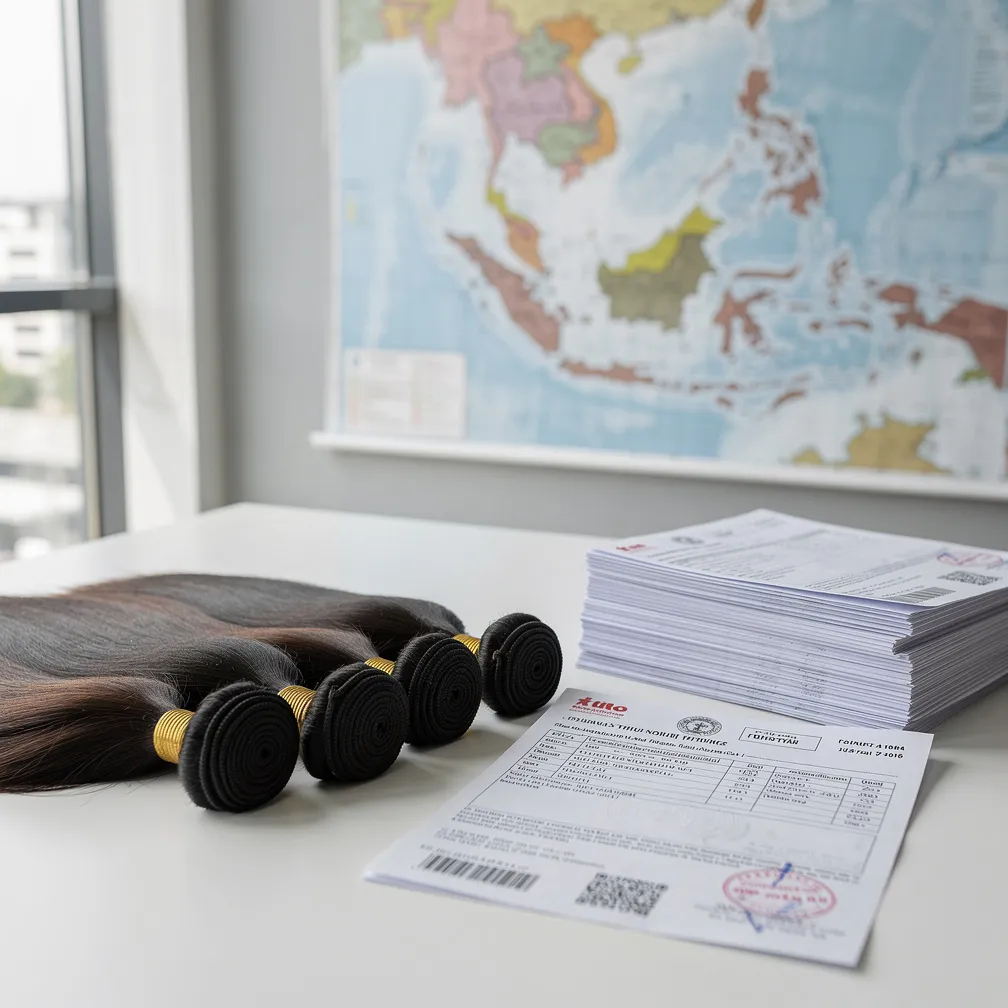
Wholesale Indian Hair for Southeast Asia — Vietnam, Thailand, Indonesia [2026]
Wholesale Indian hair for Southeast Asia operates across two distinct market roles: India as a raw material supplier to major Southeast Asian processing hubs (primarily Vietnam and Thailand), and India as a direct manufacturer of finished extensions for the growing domestic consumer markets in Indonesia, the Philippines, and Malaysia. Understanding which role applies to your business — and what the specific market dynamics are in each country — is essential for buyers, processors, and distributors operating in the region. This guide covers Southeast Asia’s hair extension landscape country by country, with India’s specific role in each market clearly defined. For more details, see our guide on Wholesale Hair Extensions for Brazil and South America. For more details, see our guide on Wholesale Hair Extensions for Australia and Canada.
At Hair Extensions By Nature, we export raw temple hair and finished Remy extensions to buyers across Southeast Asia. Our buyers range from Vietnamese processors importing raw material to Indonesian distributors stocking finished extensions for their local salon market. This guide reflects that firsthand export experience.
India’s Role in the Southeast Asian Hair Supply Chain
To understand Southeast Asia’s hair extension market, it is essential to understand the global supply chain flow. India is the world’s primary source of raw human hair — collecting single-donor virgin hair from South Indian temples and supplying it to manufacturers and processors globally. A significant portion of that raw hair flows to Southeast Asian processing hubs, particularly Vietnam, where it is processed, textured, and distributed as “Vietnamese hair” to global markets.
This creates a somewhat paradoxical situation: much of the hair marketed globally as “Vietnamese hair” or “Asian processed hair” is actually Indian raw hair that has been processed in Vietnam. Vietnamese manufacturers are skilled processors who add value through chemical processing, quality sorting, and professional packaging, but the underlying raw material in many cases originates in India.
For buyers in Southeast Asia, this creates two viable sourcing strategies: import Indian raw hair and process it locally, or import finished extensions from India and sell directly to the domestic market. Which strategy suits your business depends on your manufacturing capability, your target market, and your volume requirements.
Vietnam — The Region’s Processing Hub
Market Overview
Vietnam is the second-largest hair extension exporter in the world after China, with annual export value estimated at $300–$400 million. Vietnam’s hair industry is concentrated in Hanoi and the northern provinces, with hundreds of small to medium-sized processing factories that import raw hair from India, Cambodia, and domestic Vietnamese collectors.
Indian raw temple hair is highly valued by Vietnamese processors for its cuticle alignment, texture consistency, and length availability. Vietnamese processors use Indian raw hair to produce I-tip, U-tip, flat tip, tape-in, weft, and wig products that are then exported globally, particularly to the US, European, and Australian markets.
India’s Role in Vietnam’s Hair Industry
India exports significant volumes of raw human hair and partially processed hair to Vietnam. Vietnamese manufacturers prefer Indian raw hair for high-end product lines because the temple-sourced provenance and intact cuticle alignment produce a superior finished product compared to hair collected from brush combing or salon floor sweeping.
For buyers in Vietnam who are manufacturers or processors, importing Indian raw temple hair directly from an Indian supplier like Hair Extensions By Nature provides access to the highest-quality raw material at competitive pricing. For Vietnamese distributors serving the domestic market, finished Indian extensions offer an alternative to locally processed product.
Shipping from India to Vietnam
Air freight from India (Delhi or Chennai) to Hanoi (HAN) or Ho Chi Minh City (SGN) takes 3–5 business days. Sea freight transit time is 12–18 days from Indian ports to Vietnamese ports. For raw hair shipments, which tend to be larger in volume and lower in per-unit urgency, sea freight is commonly used. For finished extension samples and trial orders, air freight is standard.
Thailand — Processing Hub and Growing Consumer Market
Market Overview
Thailand’s hair extension industry serves dual roles: as a regional processing and distribution hub (Bangkok has a significant hair extension manufacturing and wholesale sector) and as a domestic consumer market for professional salon extensions. Thailand’s domestic beauty industry is large and sophisticated, with a strong professional salon culture in Bangkok and major tourist centers.
Thailand imports both Indian raw hair for processing and finished extensions for domestic distribution. The domestic consumer market in Thailand favors silky straight and natural wave textures, with bone straight gaining rapid popularity following Korean and Japanese beauty influence trends.
Import Process in Thailand
Thailand’s import process for hair extensions is relatively straightforward compared to markets like Brazil. Thailand has free trade agreements with several regional partners and maintains moderate import duties on hair products. Working with a Thai customs broker is recommended for first shipments but the process is manageable for most importers.
Contact Hair Extensions By Nature to discuss wholesale options for Southeast Asian buyers →
Indonesia — Southeast Asia’s Fastest-Growing Consumer Market
Market Overview
Indonesia represents arguably the most exciting emerging opportunity in Southeast Asia for hair extension distributors. With a population of over 270 million people, a large and growing urban middle class, and a rapidly professionalizing salon industry, Indonesia’s hair extension market is expanding quickly.
Unlike Vietnam and Thailand, which function primarily as processing and export hubs, Indonesia is predominantly a consumer market. Indonesian distributors import finished extensions — primarily from China, India, and Vietnamese processors — to supply the domestic salon and beauty retail network.
Jakarta, Surabaya, and Bali are the key urban centers, each with a growing professional salon culture that is increasing demand for premium human hair extensions. The Indonesian market primarily demands natural wave, body wave, and straight textures in natural black and off-black colors — products that Indian manufacturers supply directly at competitive price points.
Sourcing for the Indonesian Market
For buyers building distribution in Indonesia, direct sourcing from Indian manufacturers offers a cost advantage over sourcing through Vietnamese or Chinese intermediaries. Indian Remy finished extensions can be imported directly to Jakarta or Surabaya by air in 5–7 business days, and by sea in 20–28 days from Indian west coast ports.
Indonesia’s import regulations require correct HS code classification, commercial invoice, and certificate of origin. Working with an Indonesian customs broker (PPJK) is essential for regular importers. Import duties on hair extension products typically range from 5–15% depending on product classification.
Malaysia, Philippines, and Singapore — Additional Market Context
Malaysia has a sophisticated urban salon market in Kuala Lumpur and Penang, with demand for both straight textures (dominant in the Chinese-Malaysian community) and curly/natural wave textures (popular in the Malay and Indian-Malaysian communities). Indian hair blends particularly well with Malaysian consumers’ hair types, creating a natural market fit.
The Philippines has a rapidly growing salon industry with strong demand for bone straight and body wave extensions among Filipino consumers. The Philippine market is price-sensitive but growing rapidly in professional salon penetration, creating ongoing wholesale demand growth.
Singapore is a premium market that demands high-quality finished extensions with professional packaging. Singapore-based distributors often serve as regional distributors for premium brands across Southeast Asia. Indian manufacturers who can supply consistent quality with professional packaging find Singapore a strong entry point into the regional premium segment.
Southeast Asian Market Overview by Country
| Country | Market Role | Primary Demand | Popular Textures | Import Complexity | Air Freight from India |
|---|---|---|---|---|---|
| Vietnam | Processing hub + exporter | Raw hair for processing | N/A (raw input) | Low-Medium | 3–5 days |
| Thailand | Processing + consumer | Raw hair + finished | Bone straight, natural wave | Low-Medium | 4–6 days |
| Indonesia | Consumer market | Finished extensions | Natural wave, body wave, straight | Medium | 5–7 days |
| Malaysia | Consumer market | Finished extensions | Silky straight, body wave | Low | 4–6 days |
| Philippines | Consumer market | Finished extensions | Bone straight, body wave | Medium | 5–7 days |
| Singapore | Premium consumer + regional hub | Premium finished + private label | Silky straight, body wave, tape-in | Very Low | 4–5 days |
Pricing — Indian Hair Extensions for Southeast Asian Buyers
Indian manufacturers offer Southeast Asian buyers competitive pricing that compares favorably with Vietnamese-processed alternatives, particularly for buyers who do not require the specific texturing and processing that Vietnamese manufacturers specialize in.
Raw Indian temple hair (100g per bundle) wholesale pricing ranges from $20–$50 per bundle depending on length (12–24 inches) and quality grade. Finished Indian Remy bundles in standard textures (body wave, natural wave, straight) wholesale between $18–$60 per bundle. Vietnamese-processed hair of equivalent quality typically prices 20–40% higher than equivalent Indian finished goods, reflecting Vietnam’s processing value-add and higher labor costs relative to India.
For Southeast Asian buyers who are purchasing to supply domestic consumers (rather than for further processing), Indian finished extensions at Indian manufacturing price points provide strong margin potential in markets like Indonesia, Malaysia, and the Philippines.
Request wholesale pricing for Southeast Asian markets from our export team →
Shipping and Logistics from India to Southeast Asia
India is geographically well-positioned to serve Southeast Asia. The proximity compared to India-to-Europe or India-to-Americas routes means competitive shipping costs and faster transit times.
For air freight, the primary Indian departure airports for Southeast Asian cargo are Delhi (DEL), Mumbai (BOM), and Chennai (MAA). Chennai is particularly well-positioned for Southeast Asian destinations given its location on India’s east coast. DHL, FedEx, and Singapore Airlines Cargo are the primary carriers for express air freight on this route.
For sea freight, Indian ports at Chennai, JNPT Mumbai, and Nhava Sheva serve Singapore, Port Klang (Malaysia), Tanjung Priok (Jakarta), and Vietnamese ports via relatively short sea routes compared to trans-oceanic shipping. Transit times of 12–25 days (depending on port pairs) make sea freight practical for regular bulk restocking orders.
For a comprehensive guide to the full sourcing process from Indian manufacturers, including documentation requirements, payment terms, and quality verification, visit our complete India sourcing guide.
Contact Hair Extensions By Nature
We export raw temple hair and finished Remy extensions to buyers across Southeast Asia and are experienced with regional shipping, documentation, and customs requirements.
- WhatsApp / Phone: +91 9289358222
- Email: info@hairextensionsbynature.com
- Factory: Booth No 71, Sector 16 Huda Market, Faridabad, Haryana, India – 121002
Frequently Asked Questions — Wholesale Hair Extensions for Southeast Asia
Connect with Hair Extensions By Nature for Southeast Asian wholesale and raw hair supply →
![Wholesale Indian Hair Extensions for UK Buyers — Supplier Guide [2026]](https://hairextensionsbynature.com/wp-content/uploads/2026/03/21-wholesale-hair-extensions-uk-buyers-guide-hero-768x768.webp)
![Wholesale Hair Extensions for Australia and Canada — Indian Supplier Guide [2026]](https://hairextensionsbynature.com/wp-content/uploads/2026/04/40-wholesale-hair-extensions-australia-canada-hero-768x768.webp)
![Indian Hair Extension Supplier for Europe — Germany, France, Italy Guide [2026]](https://hairextensionsbynature.com/wp-content/uploads/2026/04/32-hair-extension-supplier-europe-germany-hero-768x768.webp)
![Wholesale Indian Hair Extensions for Nigeria and Africa — Sourcing Guide [2026]](https://hairextensionsbynature.com/wp-content/uploads/2026/03/22-wholesale-hair-extensions-nigeria-africa-hero-768x768.webp)
![Wholesale Hair Extensions for UAE and Middle East — Indian Supplier Guide [2026]](https://hairextensionsbynature.com/wp-content/uploads/2026/03/23-wholesale-hair-extensions-uae-middle-east-hero-768x768.webp)
![Wholesale Hair Extensions for Brazil and South America — Sourcing Guide [2026]](https://hairextensionsbynature.com/wp-content/uploads/2026/04/42-wholesale-hair-extensions-south-america-brazil-hero-768x768.webp)
One Comment