
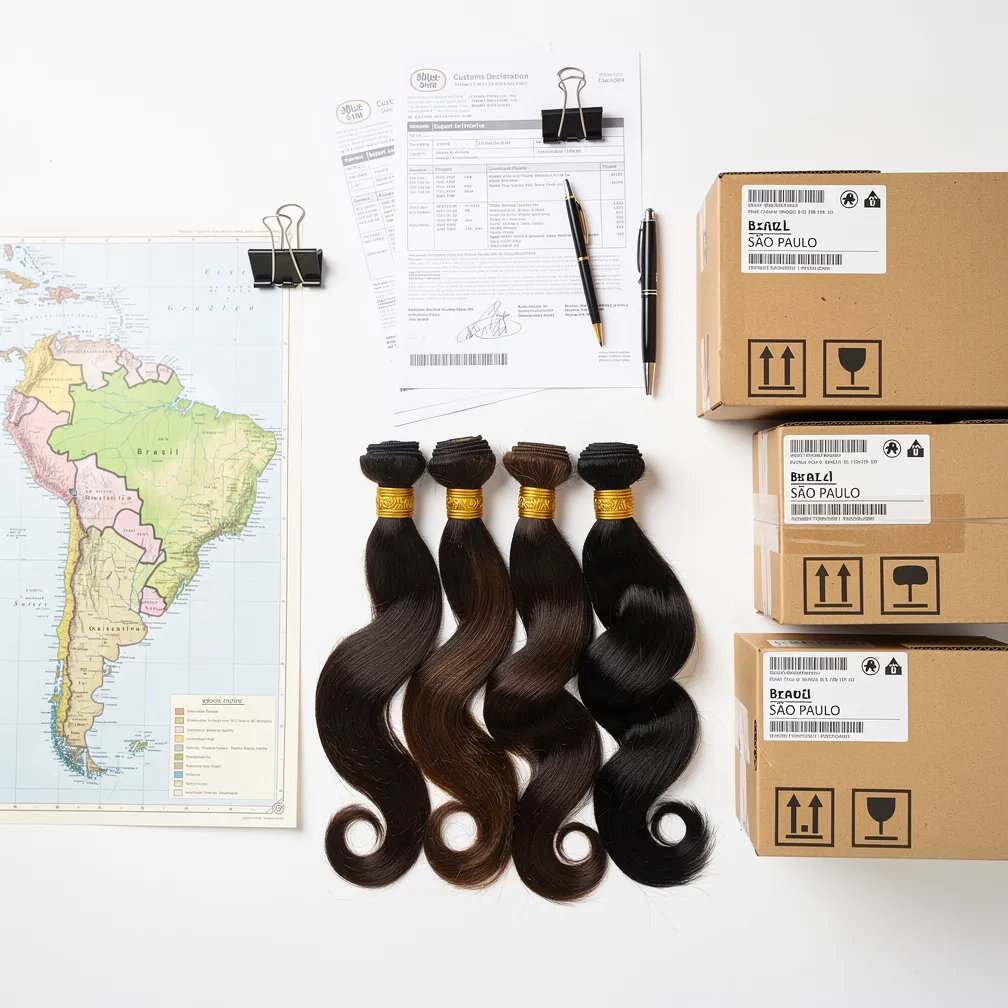
Wholesale Hair Extensions for Brazil and South America — Sourcing Guide [2026]
Wholesale hair extensions for Brazil and South America present one of the most compelling B2B opportunities in the global hair industry. Brazil ranks among the top three consumer markets for hair products worldwide, supported by a deeply embedded cultural relationship with hair styling, a growing middle class of over 200 million people, and an already-established domestic hair industry that has created substantial buyer sophistication. For Indian manufacturers and international distributors looking to enter or expand in this region, understanding the market dynamics, import regulatory framework, and sourcing logistics is essential before placing a first order. For more details, see our guide on Wholesale Indian Hair for Southeast Asia. For more details, see our guide on Wholesale Hair Extensions for Australia and Canada.
At Hair Extensions By Nature, we manufacture and export Remy human hair extensions from our facility in Faridabad, Haryana, India, and we regularly work with buyers from Latin America who are building distribution networks or private label brands across Brazil, Colombia, Argentina, Chile, and Peru. This guide is built from that firsthand export experience, combined with market data on South American hair extension demand.
The South American Hair Extension Market — By the Numbers
South America’s hair extension market is dominated by Brazil, which accounts for an estimated 60–65% of regional demand. The Brazilian hair and beauty industry generates over $30 billion annually, making it the second-largest beauty market in the world after the United States. Hair extensions, wigs, and hair toppers represent a growing segment within that total, driven by rising disposable incomes and increasing access to professional salon services in Tier 2 and Tier 3 cities.
Beyond Brazil, Colombia has emerged as a significant secondary market, particularly for clip-in and tape-in extensions targeting urban consumers in Bogota and Medellín. Argentina’s market is price-sensitive but volume-driven, while Chile and Peru have smaller but growing professional salon segments that import premium extensions for high-end clientele.
| Country | Market Size (Estimate) | Primary Extension Type | Key Import Channel | Price Sensitivity |
|---|---|---|---|---|
| Brazil | $800M+ hair products annually | Weft, clip-in, keratin tip | Direct import + local distributors | Medium — quality-conscious |
| Colombia | $150M+ hair products annually | Clip-in, tape-in | Via USA or direct | Medium-high |
| Argentina | $100M+ (volatile currency impact) | Clip-in, weft | Gray market + formal import | High — price-driven |
| Chile | $80M+ hair products annually | Tape-in, I-tip | Direct import, EU-style compliance | Low — premium-oriented |
| Peru | $60M+ hair products annually | Weft, full wigs | Via Lima distributors | Medium |
Indian Hair vs. Brazilian Hair — What Wholesale Buyers Need to Know
One of the most common questions from buyers entering the South American market is how Indian hair compares to Brazilian hair — a term that is widely misunderstood in the global hair industry.
The term “Brazilian hair” as used in global wholesale markets almost never refers to hair actually grown or collected in Brazil. Instead, it refers to a texture profile — typically a medium-weight, slightly wavy to body wave texture — that was popularized by Brazilian Blowout treatments and Brazilian-style hair marketing. The hair sold as “Brazilian” by most global wholesalers is actually Indian or Vietnamese hair, processed and labeled for the Brazilian hair style market.
Actual raw hair sourced from within Brazil exists but is limited in commercial scale. Brazil’s domestic hair collection infrastructure is not developed at industrial volume, making Indian temple hair the preferred raw material for manufacturers who supply the South American market.
Indian Hair Advantages for South American Buyers
Indian Remy hair — particularly temple-sourced hair from South India — offers consistent cuticle alignment, natural texture versatility, and a density profile that blends well with the hair types common across South America. Brazilian consumers, in particular, tend to have naturally wavy to curly hair, and Indian hair processed to body wave or natural wave textures integrates exceptionally well.
From a wholesale cost perspective, Indian hair prices at source are significantly lower than domestically produced alternatives in Brazil. Wholesale bundle prices from Indian manufacturers range from $15 to $80 per bundle depending on length, texture, and grade, compared to $50–$150 for equivalent bundles retailing under Brazilian-origin claims in the local market.
Importing Hair Extensions into Brazil — Regulatory Framework
Brazil operates one of the most complex import regulatory environments in the world. Buyers planning to import hair extensions from India into Brazil need to understand the layered tax and documentation requirements before placing orders.
Brazilian Import Tax Structure
Hair extensions imported into Brazil fall under NCM (Nomenclatura Comum do Mercosul) codes, most commonly 6703.00.00 (human hair, dressed, thinned, bleached or otherwise worked) or 6704 (wigs, false beards, eyebrows, eyelashes, switches and the like). Each NCM code carries specific tax rates, and the total import cost in Brazil is not just the customs duty — it is a stack of multiple taxes:
- II (Imposto de Importação): The base import duty, typically 10–20% for hair extension products
- IPI (Imposto sobre Produtos Industrializados): An industrial products tax, often 5–10%
- PIS/COFINS: Federal social contribution taxes, approximately 9.25% combined
- ICMS (Imposto sobre Circulação de Mercadorias e Serviços): State-level circulation tax, varies by state from 12–18%
- AFRMM (Additional Freight Charge for Merchant Marine Renewal): Applies to sea freight shipments
The combined effective tax burden on imported hair extensions in Brazil can range from 60–100% of the CIF (cost, insurance, freight) value, depending on the specific product classification and destination state. This is why many Brazilian importers price Indian hair products significantly higher than what they pay at source — the landed cost calculation is substantially higher than the factory price.
Documentation Required for Brazilian Customs
Importers shipping to Brazil should ensure their Indian supplier can provide: commercial invoice with correct NCM classification, packing list, certificate of origin (Form A or general certificate), bill of lading or airway bill, and a product description in Portuguese where required by the customs broker. Working with a licensed Brazilian customs broker (despachante aduaneiro) is strongly recommended for first-time importers.
Mercosur Considerations for Hair Extension Trade
Mercosur (Mercado Comum do Sul) is the South American trade bloc comprising Brazil, Argentina, Uruguay, and Paraguay, with associate members including Bolivia, Chile, Colombia, Ecuador, and Peru. Mercosur’s common external tariff (TEC) applies to imports from non-member countries, including India.
Importantly, Mercosur does not have a free trade agreement with India as of 2026, meaning Indian hair extensions enter Mercosur countries subject to full external tariff rates. India and Mercosur have been in trade agreement negotiations, but no comprehensive agreement is in force at time of publication. Buyers should verify current tariff classifications with their customs broker before placing large orders.
For distribution strategies that span multiple South American countries, Colombia, Chile, and Peru may offer slightly more straightforward import environments than Brazil. These countries have more streamlined customs processes and, in Chile’s case, active free trade agreements with major trading partners that create a more trade-friendly environment generally.
| Import Factor | Brazil | Colombia | Argentina | Chile |
|---|---|---|---|---|
| Base import duty (hair extensions) | 10–20% | 5–15% | 10–25% | 0–6% |
| Total effective tax burden | 60–100% | 25–40% | 40–60% | 10–20% |
| Customs complexity | High | Medium | High | Low |
| Customs broker recommended | Essential | Recommended | Essential | Optional |
| Typical clearance time | 2–4 weeks | 1–2 weeks | 2–6 weeks | 3–7 days |
Shipping Logistics from India to South America
Shipping from India to South America involves greater distances than trans-Atlantic or trans-Pacific routes, and buyers should plan accordingly for lead times and freight costs.
Air Freight
Air freight from major Indian cargo hubs (Delhi, Mumbai, Chennai) to Sao Paulo (GRU), Bogota (BOG), or Santiago (SCL) typically takes 5–8 business days via connecting routes. Direct flights are limited, and most air freight routes connect through Dubai, Amsterdam, or Miami. Air freight costs for a standard 10–20 kg hair extension shipment typically range from $8–$15 per kilogram for economy air service, making it viable for smaller high-value orders.
Sea Freight
For larger bulk orders — typically above 50 kg — sea freight becomes economically preferable. Transit time from Indian ports (JNPT Mumbai or Chennai) to Brazilian ports (Santos, Rio de Janeiro) ranges from 25–35 days depending on routing and transshipment points. LCL (less-than-container-load) consolidation services are available for buyers who cannot fill a full 20-foot container. Sea freight to South America is significantly more economical per kilogram than air, but requires longer lead time planning.
Recommended Shipping Strategy for New Importers
New buyers entering the South American market should use air freight for their first 3–5 sample and trial orders, establishing quality consistency before committing to larger sea freight volumes. Once quality and regulatory processes are confirmed, transitioning to quarterly sea freight shipments reduces per-unit logistics costs substantially.
Discuss shipping options and wholesale pricing for South America with our export team →
What Products Sell Best in the South American Hair Extension Market
Product selection matters enormously when entering any new regional market. South American consumers and salon professionals have distinct preferences shaped by local hair culture, climate, and styling traditions.
In Brazil, the most in-demand extension types among professional buyers are machine weft (bulk bundles for sew-in installations), keratin-tipped (U-tip and I-tip) extensions popular in urban salon markets, and clip-in sets for retail. Wigs and full lace units are growing rapidly in Brazil’s northern and northeastern states, where Afro-textured hair markets are strongest.
Texture preferences in South America skew toward body wave, natural wave, and deep wave — textures that blend well with the naturally wavy to curly hair types common across the region. Bone straight and silky straight textures are popular in higher-income urban markets, particularly among consumers seeking the “Brazilian blowout” look without chemical processing.
For buyers building a South American wholesale catalog, the following products represent the highest-demand entry points: 16–24 inch body wave bundles in 100g weights, natural black and off-black color options (not pre-colored), I-tip and U-tip extensions in natural wave texture, and full lace wigs in 18–22 inch length range.
Building a Distribution Strategy for Brazil and South America
The most successful wholesale buyers in South America operate as importers-distributors who take stock locally and sell to salons, stylists, and retail stores within their country. Attempting to direct-ship to end consumers from India is not practical given the import complexity and delivery timeline expectations.
A viable distribution model involves importing in container quantities (minimum 50–100 kg per shipment) every 60–90 days, establishing a local warehouse or fulfillment point, selling to professional salons and beauty supply stores on local credit terms, and building brand recognition through social media targeting the professional salon market.
For distributors new to the hair extension category, Hair Extensions By Nature supports buyers with private label packaging in Portuguese, product specification documentation, and samples for market testing before committing to full import volumes. See also: Complete Guide to Sourcing Hair Extensions from India for the full supplier verification and ordering process.
Contact Hair Extensions By Nature
Hair Extensions By Nature is an Indian hair extension manufacturer exporting to distributors, salons, and brand owners across South America and globally.
- WhatsApp / Phone: +91 9289358222
- Email: info@hairextensionsbynature.com
- Factory: Booth No 71, Sector 16 Huda Market, Faridabad, Haryana, India – 121002
![Wholesale Hair Extensions for Australia and Canada — Indian Supplier Guide [2026]](https://hairextensionsbynature.com/wp-content/uploads/2026/04/40-wholesale-hair-extensions-australia-canada-hero-768x768.webp)
![Wholesale Indian Hair for Southeast Asia — Vietnam, Thailand, Indonesia [2026]](https://hairextensionsbynature.com/wp-content/uploads/2026/04/47-wholesale-hair-extensions-southeast-asia-hero-768x768.webp)
![Indian Hair Extension Supplier for USA Salons — Direct from Manufacturer [2026]](https://hairextensionsbynature.com/wp-content/uploads/2026/03/14-wholesale-hair-extensions-supplier-usa-salons-hero-768x768.webp)
![Wholesale Indian Hair Extensions for UK Buyers — Supplier Guide [2026]](https://hairextensionsbynature.com/wp-content/uploads/2026/03/21-wholesale-hair-extensions-uk-buyers-guide-hero-768x768.webp)
![Indian Hair Extension Supplier for Europe — Germany, France, Italy Guide [2026]](https://hairextensionsbynature.com/wp-content/uploads/2026/04/32-hair-extension-supplier-europe-germany-hero-768x768.webp)
![Best Wholesale Hair Extensions Manufacturer in India [2026 Guide]](https://hairextensionsbynature.com/wp-content/uploads/2026/03/02-wholesale-hair-extensions-manufacturer-india-hero-768x768.webp)