Machine Weft vs Hand-Tied Weft Extensions
Machine weft and hand-tied weft hair extensions differ fundamentally in their construction method, performance characteristics, price point, and the client profile they serve. Machine weft extensions are produced on industrial sewing machines, creating a thick, durable stitched track that is cost-efficient to manufacture and highly durable for everyday wear. Hand-tied weft extensions are constructed entirely by hand, with each small hair section individually knotted onto a fine thread base — a process that takes significantly longer per piece and produces a dramatically thinner, more flexible weft that lies nearly flat against the scalp. For wholesale buyers sourcing either product from India, understanding these differences determines which product fits your salon segment, your retail brand positioning, and your target price point. For more details, see our guide on Indian Hair vs Chinese Hair. For more details, see our guide on Indian Hair vs Brazilian Hair.
How Machine Weft Extensions Are Manufactured
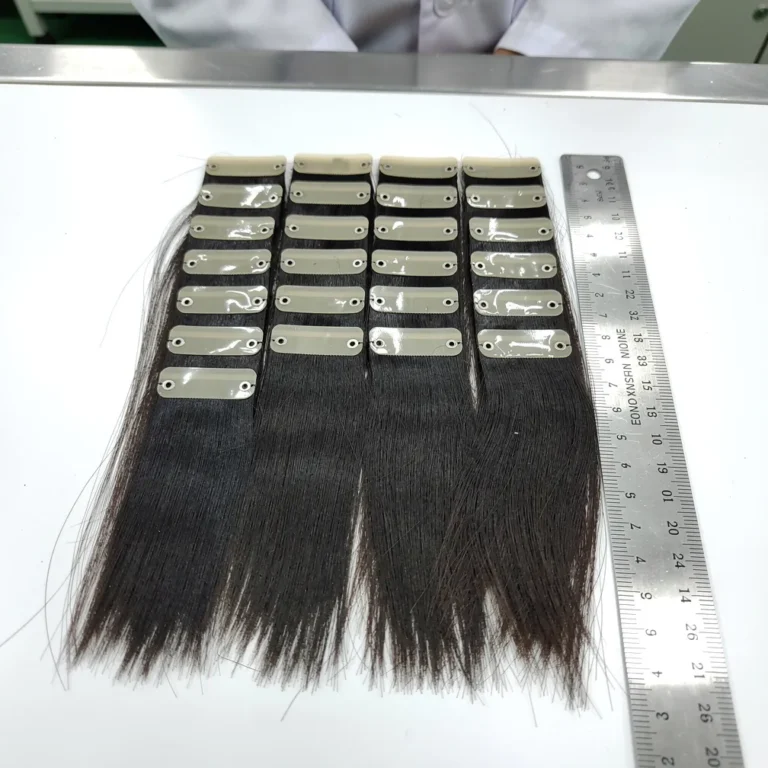
Machine weft production is one of the most efficient processes in hair extension manufacturing. Sorted and prepared hair bundles are aligned and fed into a specialized industrial weft-sewing machine. The machine stitches a continuous thread track across the top of the hair bundle at high speed, securing all strands in a single pass. A standard machine weft measuring 100cm in width can be produced in a matter of minutes once the hair preparation is complete.
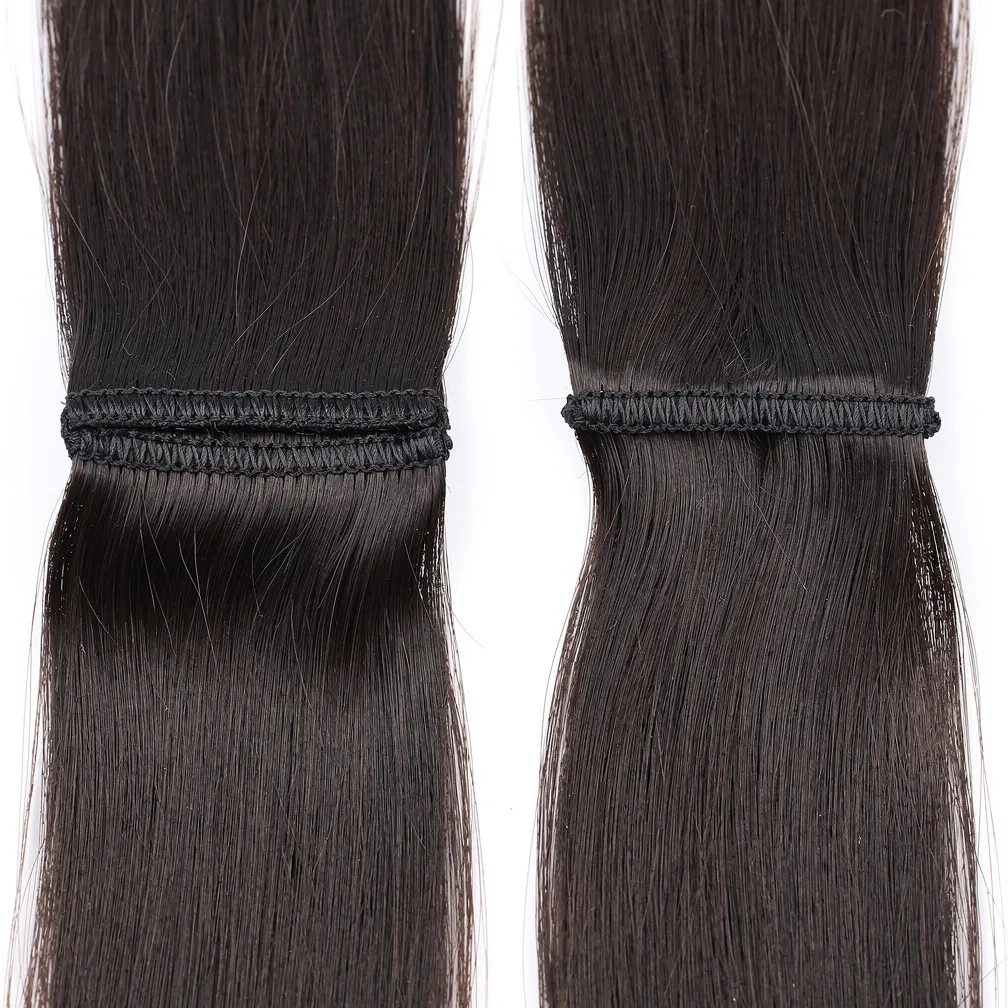
The resulting weft has a visible stitched track at the top — typically 6–8mm thick — and produces a dense, even curtain of hair below. Machine wefts are strong, highly resistant to shedding (when quality-made), and can be cut to any width the stylist requires without special treatment. This cuttability is one of the practical advantages of machine weft that hairdressers value: rows can be customized to fit any head size or application area.
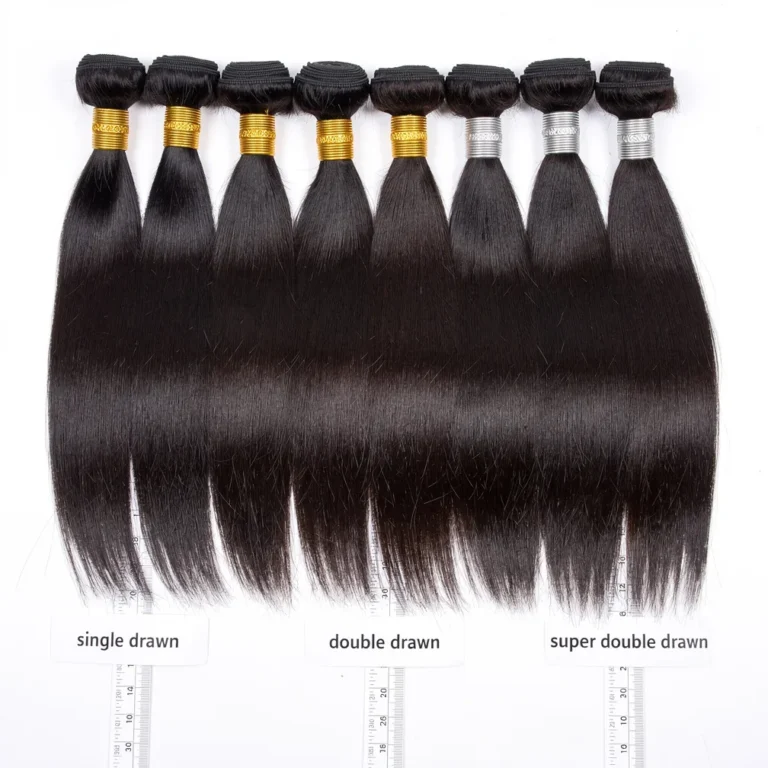
The industrial efficiency of machine weft production translates directly to lower wholesale prices. A machine weft bundle of 100g in 18″ Remy Indian hair typically wholesales for $15–$35 from an Indian manufacturer, depending on hair grade and whether it is single drawn or double drawn.
How Hand-Tied Weft Extensions Are Manufactured
Hand-tied weft production is an entirely different process — one that requires skilled artisans and considerably more production time per unit. Small sections of prepared hair (typically 1–2cm wide sections) are individually knotted by hand onto a fine nylon or silk thread foundation. Each section is secured with a series of hand-tied knots before the next section begins. A single standard-width hand-tied weft (100cm) takes an experienced weft maker several hours to complete, compared to minutes for machine weft.
The result is a weft with an extremely thin base — typically 1–3mm — that is lightweight, flexible, and lies nearly flat against the scalp when installed. The hand-tied construction distributes the weight of the extensions across many small attachment points rather than a single thick track, which reduces tension on the scalp and creates a more comfortable experience for the client.
Hand-tied wefts are not cuttable without unraveling — a key practical distinction. If a stylist cuts a hand-tied weft without securing the cut ends, the hand-tied knots will release and the weft will shed. This requires either purchasing pre-sized wefts or using a specialized heat-seal method to cut without unraveling.
Request Machine Weft and Hand-Tied Weft Samples on WhatsApp →
Side-by-Side Comparison: Machine Weft vs Hand-Tied Weft
| Factor | Machine Weft | Hand-Tied Weft |
|---|---|---|
| Manufacturing method | Industrial sewing machine | Hand-knotted by artisans |
| Production time per piece | Minutes | Several hours |
| Weft base thickness | 6–8mm | 1–3mm |
| Weight on scalp | Heavier, concentrated track | Light, distributed weight |
| Cuttability | Yes — cut to any width | No — requires heat sealing |
| Shedding risk | Low with quality construction | Very low — individual knot construction |
| Installation method | Sew-in beaded rows, glue, weave | Beaded rows, hand-tied method |
| Scalp comfort | Good | Excellent — nearly flat lie |
| Natural appearance | Good with proper installation | Excellent — weft virtually invisible |
| Ideal for | Volume, length, cost efficiency | Fine hair, seamless result, premium segment |
| Wholesale price per 100g (India) | $15–$35 | $30–$70 |
| Retail price benchmark | $40–$90 per piece | $80–$180 per piece |
| Recommended hair grade | Remy or double drawn works well | Best with double drawn for fullness |
Which Salons Buy Machine Weft vs Hand-Tied Weft
Understanding which salon segment buys which product helps wholesale buyers and distributors stock appropriately for their target market.
Machine Weft Buyers
Machine weft is the workhorse product for the vast majority of hair extension salons globally. High-volume extension salons, salons with a diverse price-point range, and salons serving clients who prioritize length and volume over the premium seamless look predominantly purchase machine weft. The ability to cut machine weft to fit makes it practical and versatile for stylists doing multiple applications per day.
Machine weft is also the standard product for wholesale distributors supplying general beauty supply stores, online retailers, and brand owners at the mid-market price point. For retail brands targeting the $50–$120 retail price range, machine weft double drawn bundles from India provide the quality-to-price ratio that makes margin targets achievable.
Hand-Tied Weft Buyers
Hand-tied weft is the preferred product for premium salons offering high-end extension services, salons specializing in extension work for clients with fine or thin hair, and salons where the stylist’s reputation is built on seamless, undetectable results. The flat lie of hand-tied weft against the scalp makes it particularly well-suited for clients with fine hair who cannot conceal a thick machine weft track.
Hand-tied weft is also gaining popularity in the USA and UK among extension specialist salons that have trained in specific installation methods (like the Hotheads or Remy Cachet systems) that use hand-tied weft as their signature product. Premium salon brands selling extension services at $800–$2,000+ per full installation typically use hand-tied weft exclusively.
Pricing Gap and Margin Analysis
The wholesale price difference between machine weft and hand-tied weft from India is consistently 40–80%, driven entirely by the labor cost differential in production. A machine weft that wholesales at $20 for 100g of 18″ double drawn Remy will have a hand-tied equivalent at $32–$36. At 24″, the same comparison might be $35 machine vs. $55–$65 hand-tied.
Retail price differences are typically larger than the wholesale gap, because salons and brands that offer hand-tied weft position it in a premium segment that supports a higher markup. The retail margin percentage on hand-tied weft can be higher than on machine weft even though the absolute cost is higher — premium positioning enables premium pricing beyond a simple cost-plus formula.
For wholesale buyers stocking both, the practical guidance is: maintain a broader SKU range in machine weft (your volume product) and a focused, quality-led range in hand-tied weft (your premium offering). Avoid stocking hand-tied weft in too many lengths and textures until you understand your market’s demand for each specific configuration.
Discuss Weft Wholesale Pricing and MOQ on WhatsApp →
Quality Factors to Evaluate When Ordering Wefts
Whether purchasing machine or hand-tied weft, several quality indicators should be evaluated on samples before committing to bulk orders.
For Machine Weft
Examine the stitching track closely. Quality machine wefts have tight, consistent stitching with no loose threads or gaps. The stitching should run straight and parallel to the top edge of the weft. Check for shedding by running your fingers through the weft and gripping firmly — some hair fall is normal, but excessive shedding from the track indicates poor construction. Verify that the hair density is consistent from one end of the weft to the other; unevenness indicates poor quality control during production.
For Hand-Tied Weft
Examine the individual knots under good lighting. Each knot should be tight and uniform. The thread base should be fine — visible from a distance on a flat white surface, it should appear almost like a single fine line with hair flowing from it. Gently pull the weft laterally — a well-constructed hand-tied weft will stretch slightly with the knots holding firm. Check for knots that are loose or missing, which will cause unraveling during wear.
For both product types, perform a cuticle alignment test (run fingers root-to-tip vs. tip-to-root) and a burn test (real human hair smells like burning protein, not plastic) as described in our complete guide to sourcing hair extensions from India.
MOQ and Lead Times for Weft Orders
Machine weft is a high-volume production item and Indian manufacturers typically hold ready stock in standard specifications (natural black, dark brown, straight and body wave, 16″–24″). This means lead times for standard machine weft orders are often 3–7 days. Custom color, texture, or double drawn specifications may require 7–14 days.
Hand-tied weft requires more production time due to the labor-intensive construction. Lead times are typically 10–21 days from order confirmation. MOQs for hand-tied weft are generally lower per style than machine weft because unit prices are higher — most manufacturers will produce from 10–20 pieces per specification for hand-tied orders, while machine weft MOQs start at 20–50 pieces.
Frequently Asked Questions
What is the main difference between machine weft and hand-tied weft?
Machine weft is made on an industrial sewing machine with a thick stitched track; hand-tied weft is made by hand with individual knots on a fine thread base. Hand-tied weft is thinner (1–3mm vs. 6–8mm), flatter against the scalp, and costs 40–80% more wholesale.
Can machine weft be cut to size?
Yes. Machine weft can be cut to any width without unraveling. Hand-tied weft cannot be cut without unraveling unless the cut end is heat-sealed first.
Which is better for fine hair clients?
Hand-tied weft is significantly better for clients with fine or thin hair because the ultra-thin base lies flat against the scalp and is far easier to conceal. Machine weft tracks can be visible and uncomfortable for clients with very fine hair.
What is the wholesale price difference between machine and hand-tied weft from India?
Hand-tied weft wholesale prices are typically 40–80% higher than equivalent machine weft. For example, 18″ double drawn Remy machine weft might wholesale at $20–$30 per 100g, while hand-tied equivalent would be $32–$55.
What hair grade works best for hand-tied weft?
Double drawn hair is strongly recommended for hand-tied weft because the even thickness from root to tip ensures the weft looks full and dense. Single drawn hair in a hand-tied weft can appear thin at the ends due to varying hair lengths in the bundle.
How do I identify a quality hand-tied weft?
Examine the knots under good lighting — they should be tight, uniform, and set on an extremely fine thread base. Gently pull laterally; all knots should hold firm. The weft base when laid flat should be nearly invisible, measuring approximately 1–3mm in thickness.
What is the minimum order quantity for wefts from an Indian manufacturer?
Machine weft MOQs typically start at 20–50 pieces. Hand-tied weft MOQs start at 10–20 pieces due to higher unit value. Both can be ordered in smaller quantities for sample evaluation before bulk orders.
Source Machine Weft and Hand-Tied Weft Direct from India
Hair Extensions By Nature manufactures both machine weft and hand-tied weft extensions in Remy Indian human hair. Whether you need high-volume machine weft for general salon supply or premium hand-tied weft for your specialist extension salon clientele, we offer factory-direct wholesale pricing with quality assurance on every order.
Request Weft Samples and Pricing on WhatsApp →
Email: info@hairextensionsbynature.com
Hair Extensions By Nature — Manufacturer and Exporter of Remy Indian Human Hair Extensions. Factory: Booth No 71, Sector 16 Huda Market, Faridabad, Haryana, India – 121002. Phone/WhatsApp: +91 9289358222.