Hair Extensions Distributors in India
Hair Extensions Distributors in India — The 2026 Partnership Structuring Guide
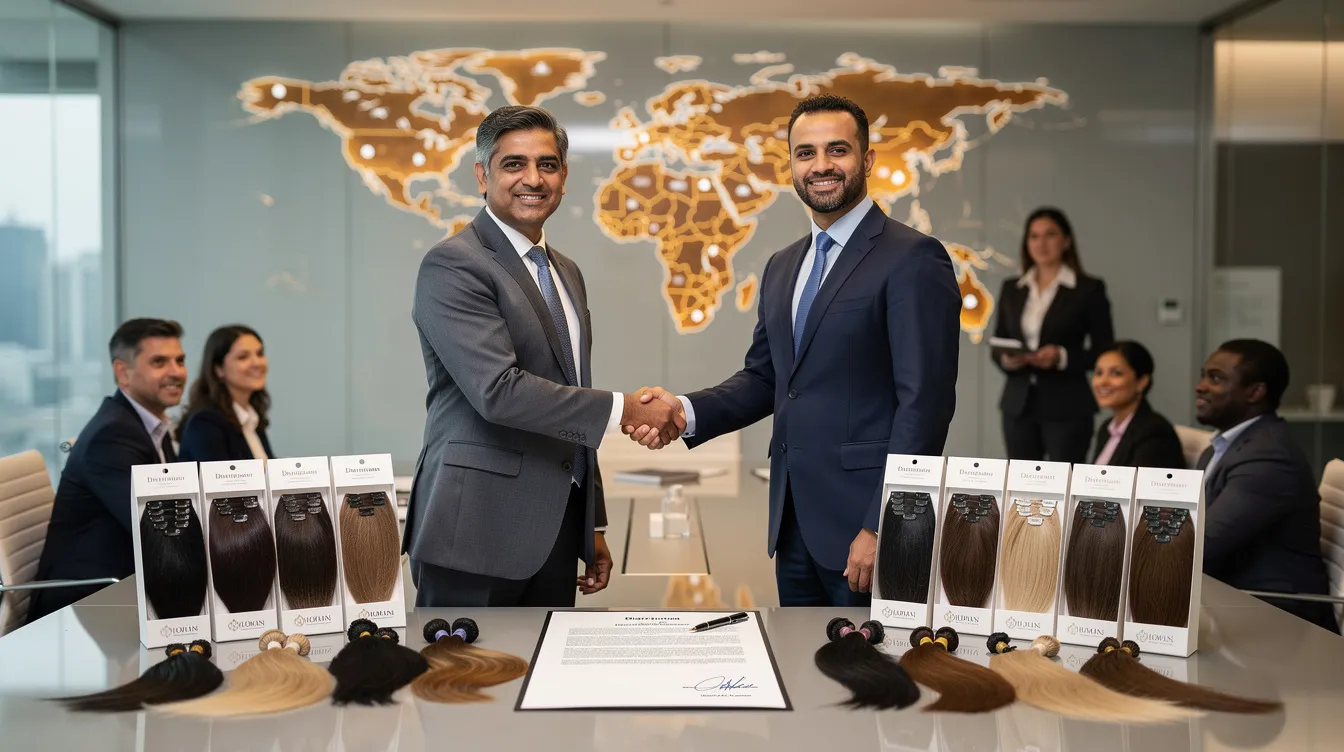
Hair extensions distributors in India operate under a partnership structure that is distinct from standard wholesale customer arrangements. An international buyer becomes a distributor for an Indian manufacturer by negotiating a written agreement that defines territory rights, minimum annual purchase commitment, pricing tier, marketing support, and exclusivity scope. Exclusive country-level distributorships in 2026 typically require USD 50,000 to USD 250,000 in annual purchase commitment depending on the target market; non-exclusive regional partnerships can start at USD 15,000 per year. This guide is for the international buyer weighing whether to step up from a transactional wholesale relationship to a formal distributor role, and what to ask for in the contract.
Hair Extensions By Nature structures distributor partnerships across more than 40 countries. We see the same contract questions recur from African, European, and GCC candidates: How much do I have to commit? What margin is reasonable? What territory protection will I get? What happens if I miss my minimum? This guide answers those questions directly and gives you the contract architecture to negotiate from a position of knowing what is normal in this industry.
Considering a distributor partnership? Request our Distributor Program Brief — a one-page outline of tier structure, margin bands, territory definitions, and qualification criteria. WhatsApp us with your target market and estimated annual volume.
Request Distributor Program Brief
Three Tiers of Buyer Relationships
Before discussing distributor-specific terms, it helps to see how Indian manufacturers typically stratify their international buyer base. Most serious Indian hair extension manufacturers run a three-tier system:
| Tier | Commitment | Typical Margin | Territory |
|---|---|---|---|
| Wholesale customer | Order-by-order, no minimum | Ex-factory pricing, no additional margin | None |
| Regional distributor (non-exclusive) | Quarterly purchase commitment | 20 to 30 percent off published wholesale | Region or city, non-exclusive |
| Country distributor (exclusive) | Annual purchase commitment | 30 to 40 percent off published wholesale | Full country, exclusive |
The step from wholesale customer to regional distributor is usually easy to make — it is a few emails and a signed one-page agreement. The step from regional distributor to exclusive country distributor is a significant commercial commitment, and it is where both sides need to be careful about the contract.
Annual Commitment Benchmarks by Market Tier
Not every country commands the same distributorship commitment. Indian manufacturers segment markets into tiers based on import volume, average order size, and salon density. The following USD annual commitment benchmarks are typical for an exclusive country distributorship in 2026:
- Tier 1 markets (USA, China, UK, Germany, UAE, Italy): USD 150,000 to 250,000+ annual commitment.
- Tier 2 markets (Nigeria, South Africa, Brazil, Russia, Australia, Canada, Saudi Arabia): USD 80,000 to 150,000 annual commitment.
- Tier 3 markets (Ghana, Kenya, Egypt, Morocco, Poland, Mexico, Vietnam): USD 50,000 to 80,000 annual commitment.
- Tier 4 markets (smaller Southeast Asia, Central Asia, Caribbean): USD 25,000 to 50,000 annual commitment.
Non-exclusive regional distributorships typically ask for 25 to 40 percent of the exclusive-country number, with quarterly rather than annual milestones.
What an Indian Manufacturer Looks For in a Distributor
Manufacturers do not grant exclusive territories lightly. Once an exclusivity is granted, the manufacturer forgoes direct sales in that market for the contract term. The screening process is usually structured around six criteria:
- Existing market presence. A functioning salon chain, beauty-retail business, or distribution network in the target market, preferably with 2+ years of track record.
- Capital capacity. The ability to fund the first three months of inventory at distributor pricing, typically 25 to 30 percent of the annual commitment.
- Sales infrastructure. A reachable customer base — direct salon relationships, retail outlets, an e-commerce operation, or a field sales team.
- Regulatory compliance. Import license in the target market (where required), local business registration, tax registration, and any product-specific regulatory approvals.
- Marketing capability. A plan for how the distributor will drive demand — trade shows, salon-partner programs, digital marketing, content production.
- Cultural fit and responsiveness. Willingness to communicate daily during the first 90 days of the partnership. Response gaps longer than 72 hours often predict poor long-term fit.
Contract Architecture — The 10 Clauses That Matter
When the manufacturer and distributor are ready to sign, the distribution agreement should address 10 core clauses. Anything missing is a future dispute waiting to happen.
- Territory. Clearly defined country or region. If “exclusive for UAE,” does that include Dubai free zones that re-export? Clarify in writing.
- Product scope. Which SKU categories are covered by the distributor agreement? Some manufacturers carve out private-label or OEM from exclusive distribution.
- Minimum annual purchase commitment. USD amount and quarterly phasing. What happens on a 10 percent shortfall versus a 25 percent shortfall? Graduated remedies are better than all-or-nothing termination.
- Pricing tier. Published discount off wholesale, price-protection clause (no manufacturer price cuts without distributor notice), currency and foreign-exchange handling.
- Payment terms. Advance vs net-30, LC vs wire, acceptable currencies.
- Marketing support. Co-branded collateral, product training for distributor’s sales team, trade-show co-funding, sample allowance, digital asset library access.
- Intellectual property. Right to use the manufacturer’s brand in the territory, limits on private-label rebranding, ownership of jointly created marketing assets.
- Exclusivity scope and carve-outs. Any global accounts the manufacturer reserves (e.g., Sephora, Ulta, a hotel chain) that carve out from the distributor’s territory.
- Term and renewal. 12, 24, or 36 months. Auto-renewal with mutual consent or affirmative renewal. Performance milestones that affect renewal.
- Termination and transition. Cause for termination, notice period, wind-down of existing inventory, customer handover, non-compete post-termination.
Red-Flag Terms to Negotiate Out
Some contract terms appear normal in Indian distribution templates but are worth pushing back on as a prospective distributor:
- Unilateral price changes. The manufacturer can raise prices with 7 days’ notice. Negotiate for a minimum 60 days’ notice and a grandfather clause on already-placed orders.
- 100 percent advance payment in perpetuity. Normal for first orders; not normal for an exclusive country distributor after 6 months of clean payment history. Negotiate for 50/50 or net terms after a probation period.
- No price-parity guarantee. Other wholesale customers in the same territory can be sold at lower prices than the distributor. Insist on most-favored-customer pricing within territory.
- Broad non-compete. Distributor cannot sell any other hair products for five years post-termination. Cap the non-compete at competitive Indian-origin hair only and at 12 months post-termination.
- No marketing support. Distributor bears full marketing cost while benefiting the manufacturer’s brand. Negotiate for at least sample allowance and co-branded collateral.
Operating a Distributor Partnership Profitably
Once the contract is signed, the hard work is operational. Distributors who succeed in the Indian hair extension supply chain share a few practices:
Inventory rotation. Hair extensions do not expire, but SKU popularity shifts with fashion cycles. A 120-day inventory turn is a healthy target; 180 days or longer indicates over-ordering or SKU-mix problems.
Local color and texture adaptation. Different markets prefer different profiles. Nigerian distributors lean heavily on 1B/2 wavy and curly. UK distributors sell more 4/6 brown and 613 blonde. UAE distributors mix premium Remy with synthetic for pricier retail. Match the SKU mix to the market.
Sample-based selling. For salon-direct distributors, the sales cycle is almost always sample-led. Budget 10 to 15 percent of revenue for in-field sample allocation.
Defect handling as a service. When a hair extension product fails at a salon, the salon does not care whether the fault is with the distributor or manufacturer. They want a replacement. A distributor who handles defects fast builds loyalty; one who pushes the problem back to India loses accounts.
Why Source From Hair Extensions By Nature?
Hair Extensions By Nature actively recruits country distributors in Tier 2 and Tier 3 markets. Our current country-level exclusive arrangements cover Nigeria, South Africa, and the UAE. Non-exclusive regional distributorships are in place in the US (Midwest salon network), UK, Germany, and several GCC cities. We are open to new exclusive partnerships in markets where we do not currently have coverage.
What a Hair Extensions By Nature distributor gets: 30 to 40 percent margin off published wholesale prices depending on volume commitment, priority allocation on new SKU launches, marketing kit including product photos, training videos, and co-branded print collateral, quarterly business reviews, and price protection during contract terms. Qualification is typically a 3-week process: credentials check, market-plan review, probation-order terms, and final contract.
Ready to qualify for a distributor partnership? Send your target market, existing business context, and estimated annual commitment. We will respond within 2 business days with next steps.
Start Distributor Qualification
Frequently Asked Questions
What’s the minimum annual commitment to become a country distributor for an Indian hair manufacturer?
It varies by market tier. Tier 1 markets (USA, UK, Germany, UAE, Italy) typically require USD 150,000 to 250,000 annually. Tier 2 markets (Nigeria, South Africa, Brazil, Russia) typically USD 80,000 to 150,000. Tier 3 (Ghana, Kenya, Poland, Mexico) USD 50,000 to 80,000. These are typical; specific numbers depend on manufacturer and SKU mix.
Can I get exclusive distributor rights for my country with no upfront commitment?
Generally no. An exclusive territory represents revenue the manufacturer forgoes in direct sales. Without a financial commitment, the manufacturer has no way to compare distributor performance to what direct sales would have generated. Expect either an annual purchase commitment or a non-refundable territory fee in the USD 10,000 to 50,000 range.
What margin can I expect as a distributor versus a wholesale customer?
Wholesale customers buy at ex-factory prices with no additional margin. Non-exclusive regional distributors receive 20 to 30 percent off published wholesale. Exclusive country distributors receive 30 to 40 percent off. The margin differential reflects commitment level and territorial risk sharing.
How long does an Indian distribution agreement typically run?
Standard contracts run 12, 24, or 36 months. 12-month contracts with renewal at mutual consent are most common for a first partnership. 36-month contracts are usually reserved for established partnerships with consistent performance history.
What happens if I miss my minimum annual purchase commitment as a distributor?
Well-drafted contracts have graduated remedies. Up to 10 percent shortfall: typically no penalty, commitment rolls forward to next period. 10 to 25 percent shortfall: price tier may drop to next-lower tier and/or exclusivity may convert to non-exclusive. Greater than 25 percent: manufacturer may terminate or re-negotiate. Negotiate these specifics up-front rather than accepting “at manufacturer’s discretion” language.
Can I distribute multiple hair brands as an Indian-manufacturer distributor?
Depends on the contract’s non-compete clause. Some manufacturers insist on category exclusivity (distributor sells only their brand in the hair extension category). Others allow mixed portfolios provided no direct competing Indian-origin brand is sold. Clarify this in the negotiation and get it in writing; it is a common post-signing dispute area.
Do Indian distributors get marketing support, or is that on me?
Standard marketing support from an Indian manufacturer to an exclusive distributor includes: product photography and video assets, co-branded brochures in PDF, product training for distributor’s sales team (usually remote), sample allowance for in-field use, and occasional trade-show co-funding. Direct customer acquisition is generally the distributor’s responsibility.
Ready to Open a Distribution Conversation?
Hair Extensions By Nature reviews new distributor inquiries weekly. If you have a target market, a working sales infrastructure in that market, and are prepared for a meaningful first-year commitment, the first step is a short credentials conversation on WhatsApp. From there we move to a market-plan review and probation-order terms within a week.
Start the Distribution Partnership Conversation →
Prefer email? Reach us at info@hairextensionsbynature.com or complete our quote request form.
Hair Extensions By Nature — Manufacturer and Exporter of Premium Indian Human Hair Extensions. Factory: Booth No 71, Sector 16 Huda Market, Faridabad, Haryana, India — 121002. Serving salons, distributors, and brands in 40+ countries.
Start Your Hair Extensions Dropship Business
Zero inventory. Premium Indian Remy hair. Ship worldwide under your brand. MOQ as low as 5 pieces.