OEM Hair Manufacturing India
OEM Hair Extensions Manufacturing India — 2026 Contract Manufacturing Guide
OEM hair extensions manufacturing in India is contract manufacturing where the buyer provides detailed product specifications — density, length, cap construction, color mapping, weft type, and cuticle alignment — and the factory produces to those specs under the buyer’s brand. OEM goes a step deeper than private label: private label customizes only packaging; OEM customizes the product itself. Standard 2026 Indian OEM terms: MOQ 50-200 pieces per SKU, tooling/sampling fee USD 800-3,000, lead time 8-12 weeks including 2-3 sample-approval rounds, and pricing uplift of 25-50 percent over stock wholesale. The buyer retains full IP over specifications; the factory agrees to exclusivity on the buyer-specified product combination. This guide walks the OEM workflow and the commercial and IP terms that sophisticated brand buyers should negotiate.
Hair Extensions By Nature runs OEM contract manufacturing for 8 international brands covering custom-density wigs, buyer-specified weft constructions, and custom color blends. OEM partners typically graduate from private-label year-1 relationships, committing to longer-term volume in exchange for full product customization.
Ready for OEM contract manufacturing? Request our OEM Program Brief — specification template, MOQ, tooling fees, sample-approval schedule.
OEM vs Private Label vs White Label — The Depth Distinction
| Dimension | White Label | Private Label | OEM |
|---|---|---|---|
| Product customization | None | None (stock SKU) | Full (density, length, cap, color, weft) |
| Packaging customization | Sticker, hangtag only | Full box, hangtag, insert | Full + co-design |
| MOQ per SKU | 10-20 pieces | 20-50 pieces | 50-200 pieces |
| Setup/tooling fee | USD 100-300 | USD 300-800 | USD 800-3,000 |
| Lead time (first order) | 2-3 weeks | 4-6 weeks | 8-12 weeks |
| Pricing uplift vs stock | 5-10 percent | 15-25 percent | 25-50 percent |
| IP/exclusivity | Packaging only | Packaging and branded SKU | Full product specification |
What the Buyer Provides in OEM
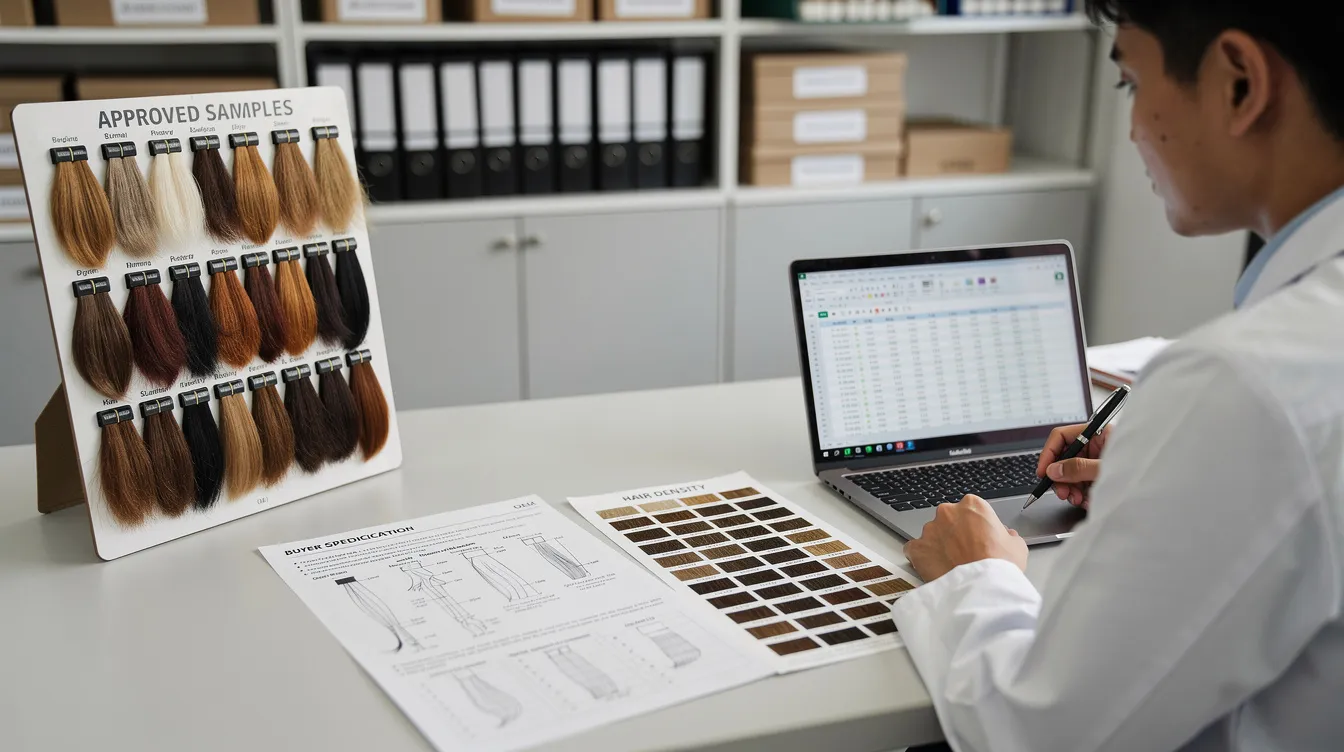
- Product specification sheet: Density (percent), length (inches), cap construction (lace type, silk top, monofilament), color code (buyer’s color mapping vs industry chart), texture (straight/wavy/curly), weft type (machine/hand-tied/hand-knotted), and cuticle alignment requirement.
- Approved hair sample: Physical reference sample or lab-confirmed baseline buyer wants factory to match.
- Quality criteria: Tangle-test thresholds, heat-resistance requirement, acceptable shed rate, color-fastness spec.
- Brand identity: Logo, artwork, hangtag design, packaging files.
- Volume commitment: Annual estimate so factory can plan materials and capacity.
- Tooling/sampling fee payment: USD 800-3,000 one-time investment in custom dies, color matching trials, and sample production rounds.
What the Factory Provides in OEM
- Sample production across 2-3 rounds until buyer sign-off.
- Custom tooling — dies for buyer’s cap shape, color-blend recipes, weft machine settings.
- Production run to buyer’s specification with QC-per-piece against buyer’s criteria.
- Packaging manufacturing and branded fulfillment.
- Commercial and export documentation.
- Contractual exclusivity — the specification + brand combination is not produced for any third party.
- Volume capacity reservation if buyer commits to annual minimum.
OEM Workflow — 10 to 12 Weeks End-to-End
- Weeks 1-2 — Specification alignment: Buyer submits spec sheet; factory reviews feasibility and returns quote + tooling plan.
- Weeks 3-4 — Sample production round 1: Factory produces 2-5 sample pieces to buyer’s specification; ships via DHL for buyer review.
- Week 5 — Sample review and iteration: Buyer tests samples; flags gaps; factory adjusts tooling/spec; sample round 2 produced.
- Week 6-7 — Sample round 2 and final approval: Buyer approves round-2 or requests final round-3 tweaks.
- Week 8 — Order confirmation and 50 percent advance: Buyer issues PO; factory invoices; buyer wires 50 percent.
- Weeks 9-11 — Bulk production and QC: Full MOQ produced; per-piece QC; branded packaging assembled.
- Week 12 — Final payment and dispatch: Buyer wires balance; factory dispatches with full export documentation.
Tooling and Sampling Fee — What You’re Actually Paying For
The USD 800-3,000 OEM tooling/sampling fee typically covers:
- 2-3 rounds of sample production with custom specification (each round costs factory USD 300-600 in labor and materials).
- Custom die-cutting for buyer’s cap shape (if applicable) — USD 200-500.
- Color-blend trials — USD 100-300 per color.
- Specification documentation, quality-criteria encoding, and production-line setup — labor USD 200-500.
- Packaging tooling and artwork — USD 200-500 (if scope includes custom packaging).
IP Protection Terms for OEM Agreements
OEM is where IP protection matters most because the specification itself is the buyer’s asset, not just the brand. Essential clauses:
- Specification IP: Buyer retains ownership of the product specification — factory agrees not to produce the specification for any third party.
- Brand + specification exclusivity: The combination of buyer’s brand applied to buyer’s specification is fully exclusive; factory commits to both individually and jointly.
- Sample retention: Factory retains approved samples under lock; returns or destroys on agreement termination.
- Factory non-compete scope: Factory agrees not to produce “substantially similar” specification for competitive brands during agreement term and for 12 months post-termination.
- Confidentiality: Factory personnel sign NDAs; buyer’s spec documents marked confidential.
- Audit rights: Buyer can inspect production with 14-day notice to verify spec compliance.
- Tooling ownership: Custom dies and tooling commissioned by buyer are buyer property; transferable on termination.
Pricing Math — OEM vs Stock Wholesale
Illustrative example: 100 pieces of custom 22-inch Remy lace-closure wig, 150 percent density, custom caramel-blonde blend:
- Comparable stock SKU wholesale: USD 250 per piece = USD 25,000.
- OEM pricing with 35 percent uplift: USD 337.50 per piece = USD 33,750.
- Packaging (branded box + hangtag + insert + dust bag): USD 8 per piece = USD 800.
- One-time tooling/sampling fee: USD 2,000.
- Total first-order investment: USD 36,550 vs stock USD 25,000.
- OEM premium vs stock: USD 11,550 — amortized across 100 pieces = USD 115.50 per piece.
- Retail pricing power of fully-spec’d custom brand: typically USD 200-400 per piece higher than stock equivalent, so OEM payback is within first order.
When to Graduate From Private Label to OEM
Most sophisticated hair extension brands follow this sequence:
- Year 1 — White label or private label: Validate product-market fit with minimal capital and flexibility to iterate SKU mix.
- Year 2 — Private label at scale: Lock in brand identity and packaging; 2-3 product categories.
- Year 3 — OEM for flagship SKUs: Move top-selling SKUs to OEM for full differentiation; custom density, custom color blend, custom cap.
- Year 4+ — OEM-dominant portfolio: Majority of brand revenue from OEM-specified exclusive products.
Why Source OEM From Hair Extensions By Nature?
Hair Extensions By Nature offers OEM contract manufacturing from our Faridabad factory. Program structure: 50-piece MOQ per SKU starter (industry standard 100-200), USD 1,200 tooling/sampling fee, 10-week lead time including 2 sample rounds. Our specification-review process includes technical consultation — our production manager walks buyers through feasibility and trade-offs before committing to tooling. IP and exclusivity clauses are standard in our OEM agreement.
Frequently Asked Questions
What is OEM hair manufacturing?
OEM (Original Equipment Manufacturing) is contract manufacturing where the buyer provides detailed product specifications — density, length, cap construction, color, weft type, cuticle alignment — and the factory produces to those specs. The buyer owns the brand and specification; the factory builds to order.
How is OEM different from private label?
Private label customizes only packaging, using the factory’s stock SKU as the product. OEM customizes the product itself — specification, materials, construction. Private-label MOQ 20-50 pieces; OEM MOQ 50-200 pieces. Private-label lead time 4-6 weeks; OEM 8-12 weeks.
What is the minimum order for OEM hair extensions?
Typically 50-200 pieces per SKU at Indian factories. Starter OEM programs may accept 50-piece minimums; established factories often require 100-200 pieces to justify tooling cost. Starter OEM investment including tooling is typically USD 8,000-30,000.
What is the OEM tooling fee for?
USD 800-3,000 one-time tooling/sampling fee covers 2-3 sample production rounds, custom die-cutting, color-blend trials, production-line setup, and packaging tooling if in scope.
How long does OEM hair manufacturing take?
8-12 weeks end-to-end including 2-3 sample rounds and buyer approvals. Subsequent repeat orders at the same specification take 4-6 weeks (sample rounds bypassed).
Do I own the specification in OEM?
Yes. Standard OEM agreements retain buyer ownership of product specification, brand, packaging, and any commissioned tooling. Factory commits not to produce the specification for any third party during and for 12 months after agreement term.
Can I start with OEM or should I do private label first?
Most brands start with private label (lower MOQ, lower lead time, lower investment) to validate product-market fit, then graduate to OEM for flagship SKUs once demand is proven. Starting OEM from day one works if the buyer has existing retail distribution or pre-orders lined up.
Ready for OEM Contract Manufacturing?
info@hairextensionsbynature.com or quote request form.
Hair Extensions By Nature — Manufacturer and Exporter of Premium Indian Human Hair Extensions. Factory: Booth No 71, Sector 16 Huda Market, Faridabad, Haryana, India — 121002. Serving salons, distributors, and brands in 40+ countries.
Start Your Hair Extensions Dropship Business
Zero inventory. Premium Indian Remy hair. Ship worldwide under your brand. MOQ as low as 5 pieces.