Synthetic vs — When to Buy Which for Your Market
Synthetic vs Human Hair Wholesale — When to Buy Which for Your Market
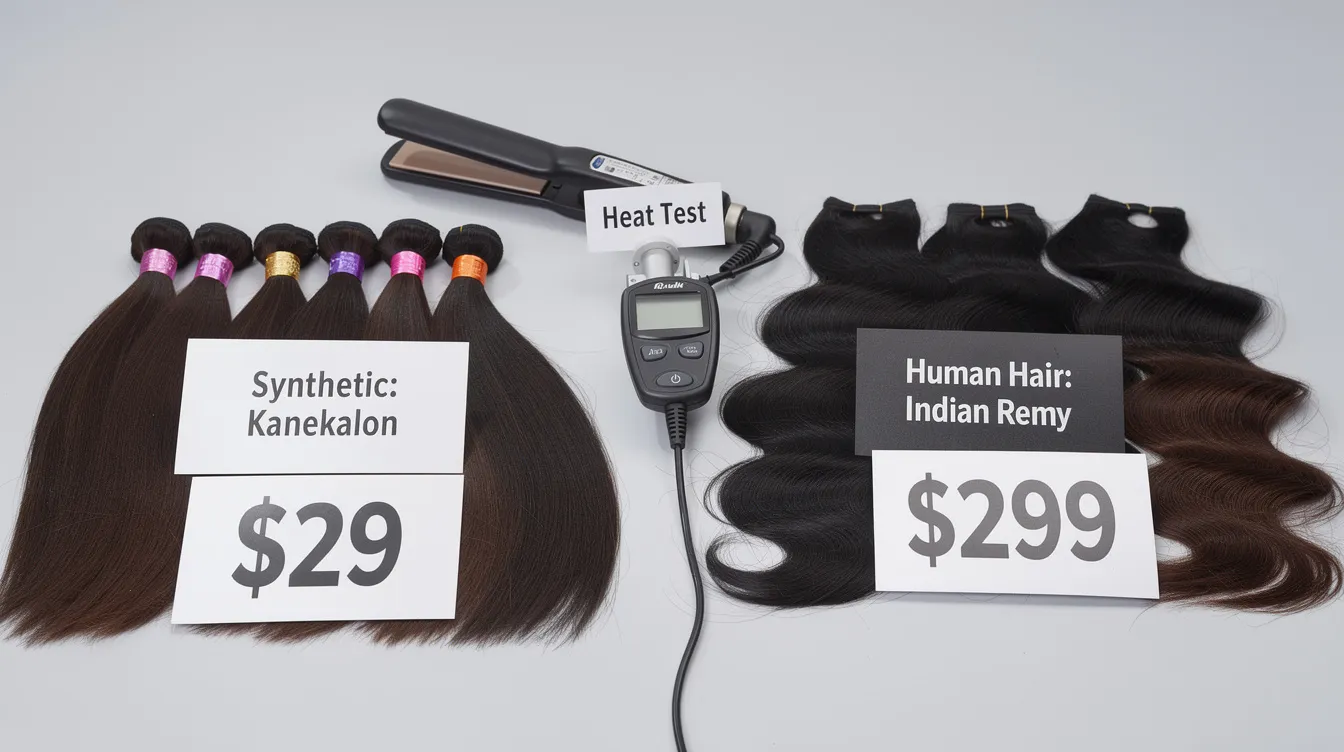
Synthetic vs human hair is not a quality question — it is a market-fit question. Wholesale buyers choose synthetic hair for price-sensitive consumer markets (USD 30 to 60 retail per piece), high-turnover retail, and fashion-color trend products (pastels, neons, fantasy shades). Wholesale buyers choose human hair for professional salon-installation markets, premium retail, long-wear daily-use customers, and salon-service menus where the hair is bleached or heat-styled. Synthetic hair wholesale costs USD 15 to 50 per piece at factory; human hair USD 80 to 350+ for comparable formats. Synthetic hair dominates African retail and budget consumer markets (60 to 70 percent of unit volume globally); human hair dominates professional and premium segments (80 to 90 percent of dollar volume). A smart wholesaler often stocks both. This guide explains how to decide.
Hair Extensions By Nature manufactures human hair at our Faridabad facility and partners with Korean and Japanese synthetic fiber suppliers for buyers building mixed portfolios.
Building a synthetic + human portfolio? Request our Portfolio Matrix with recommended ratios by market segment.
Kanekalon and Toyokalon — The Two Synthetic Fiber Families
Synthetic hair extensions use one of two fiber families:
| Fiber | Heat tolerance | Feel | Typical wholesale USD |
|---|---|---|---|
| Kanekalon | Up to 150°C (flat iron low setting) | Natural-like, modacrylic base | 25 – 50 per 200g bundle |
| Toyokalon | Up to 120°C | Softer, higher sheen | 15 – 35 per 200g bundle |
Kanekalon is the premium synthetic fiber; Toyokalon dominates budget tiers. Both are manufactured primarily in Japan (Kaneka) and South Korea.
Unit Economics Side by Side
| Metric | Synthetic | Human Hair (Remy) |
|---|---|---|
| Wholesale cost per piece (22″) | USD 15 – 50 | USD 80 – 350 |
| Retail price | USD 30 – 90 | USD 180 – 800+ |
| Wear cycle | 4 – 8 weeks | 3 – 12 months |
| Bleach / color tolerance | Not possible | Full salon-coloring |
| Heat styling | Limited (Kanekalon low temp) | Full salon heat |
| Color options available | Very wide (fantasy shades easy) | 30+ natural and colored |
| Typical turnover rate | 8 – 12x per year | 3 – 5x per year |
Market-Segment Recommended Ratios
Recommended synthetic-to-human ratio by target customer:
- African retail consumer (Lagos, Accra, Nairobi, Jozi townships): 75 percent synthetic, 25 percent human.
- African premium salon professional: 25 percent synthetic, 75 percent human.
- US / UK mass-market retail: 40 percent synthetic, 60 percent human.
- US / UK premium salon and boutique: 10 percent synthetic (fantasy color only), 90 percent human.
- GCC premium salon: 15 percent synthetic, 85 percent human.
- Fashion retail / influencer D2C brands: 30 to 50 percent synthetic (quick-cycle fantasy color), 50 to 70 percent human.
Why Source From Hair Extensions By Nature?
Hair Extensions By Nature specializes in human hair manufacturing. For distributors and brand owners building mixed portfolios, we can co-fulfill: we produce and ship the human hair portion from Faridabad, and we facilitate Kanekalon/Toyokalon synthetic sourcing through our Japanese and Korean fiber-supplier partnerships. For a distributor serving a mixed market, consolidated buying simplifies freight and accounting.
Frequently Asked Questions
Is synthetic hair always cheaper than human hair?
Yes, across all formats. Synthetic costs one-third to one-fifth of comparable human hair at factory. Retail markup is typically tighter on synthetic, and consumer price points sit USD 150+ below human hair equivalents.
Can synthetic hair be heat-styled?
Kanekalon tolerates low-heat flat iron (up to 150°C). Toyokalon less. Regular synthetic fibers melt at styling temperatures. Always check the fiber type before promising heat-styling to end customers.
Does synthetic hair look fake under professional lighting?
Modern Kanekalon fibers are near-indistinguishable from human hair under normal lighting. Under salon UV or high-CRI lighting, the artificial sheen can be visible on direct close inspection. For salon displays, showcase human hair; for retail shelf, synthetic holds up.
Why does synthetic hair dominate African retail?
Price accessibility and style cycling. Kanekalon braids, wigs, and weaves at USD 25 to 60 retail fit the budget of a much larger consumer base, and the 4-to-8 week wear cycle encourages frequent style changes — both factors expand addressable market.
Can salons use synthetic hair for professional installations?
For temporary installations and fantasy-color accents, yes. For permanent or semi-permanent installations, human hair is the professional standard because synthetic cannot withstand heat-styling required for blending with a client’s natural hair.
What’s the main fiber supply constraint for synthetic hair?
Kaneka (Japan) and Modacrylic Corporation supply most global Kanekalon. Supply has been tight since 2024 due to feedstock disruption; expect moderate synthetic price increases through 2026.
Should I stock fantasy colors in synthetic or human?
Synthetic. Fantasy colors (pastel pink, blue, neon, ombre) are quicker cycles and cheaper to produce in synthetic. Human hair fantasy colors require bleaching first then coloring — cost escalates significantly versus synthetic equivalent.
Ready to Build a Mixed Portfolio?
Request Mixed Portfolio Brief →
info@hairextensionsbynature.com or quote request form.
Hair Extensions By Nature — Manufacturer and Exporter of Premium Indian Human Hair Extensions. Factory: Booth No 71, Sector 16 Huda Market, Faridabad, Haryana, India — 121002. Serving salons, distributors, and brands in 40+ countries.
Start Your Hair Extensions Dropship Business
Zero inventory. Premium Indian Remy hair. Ship worldwide under your brand. MOQ as low as 5 pieces.