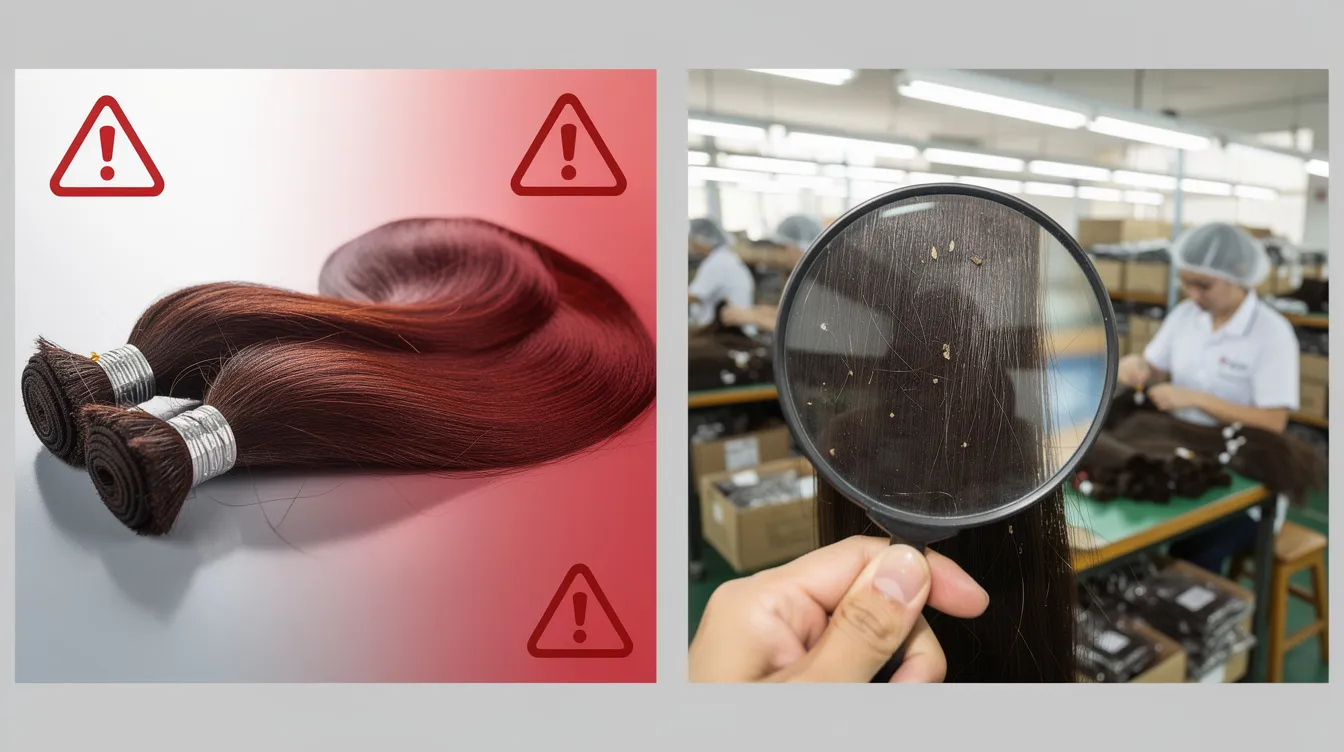
Avoid Fake Hair Vendors
Avoid Fake Hair Vendors — 12 Red Flags to Spot a Middleman in 2026
Avoiding fake hair vendors comes down to running twelve specific red-flag checks before any money changes hands. Fewer than 15 percent of vendors claiming to be Indian hair extension manufacturers on B2B marketplaces actually own the factories they show. The rest are middlemen who add 15 to 30 percent to the price while providing none of the manufacturer-level support, and at the worst end of the spectrum they are pure advance-payment scams. This guide walks through all twelve red flags, shows you the 10-minute verification that catches most of them, and tells you the disqualification threshold. Hair Extensions By Nature welcomes every one of these checks against us — run them, and you will see why legitimate manufacturers never resist documentation requests.
Running vendor vetting? Request our credentials pack: IEC, GSTIN, factory video, 2 references, domain WHOIS, and a signed Zero-Middleman Declaration. We respond within 4 business hours.
Red Flag 1 — Refusal or Delay in Sharing IEC Export License
An IEC (Importer Exporter Code) is a 10-digit mandatory registration for any entity exporting from India. It costs approximately USD 15 to obtain and is free to verify at dgft.gov.in. Any Indian vendor that refuses to share their IEC, delays sharing it, or shares a number that does not match their claimed legal entity is either not legally exporting or is a trading company that does not want to be identified as such. Disqualify on refusal; investigate further on delays or mismatches.
Red Flag 2 — Stock-Photo Product Imagery
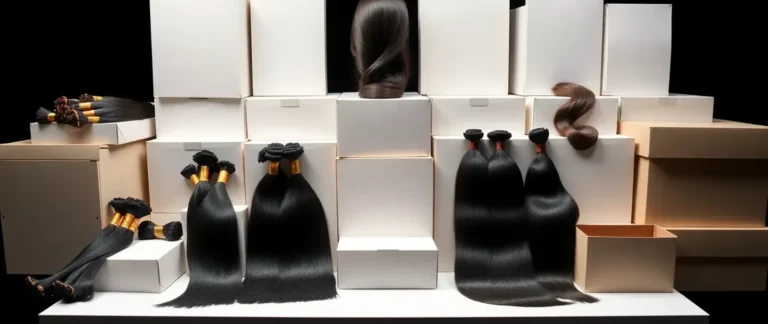
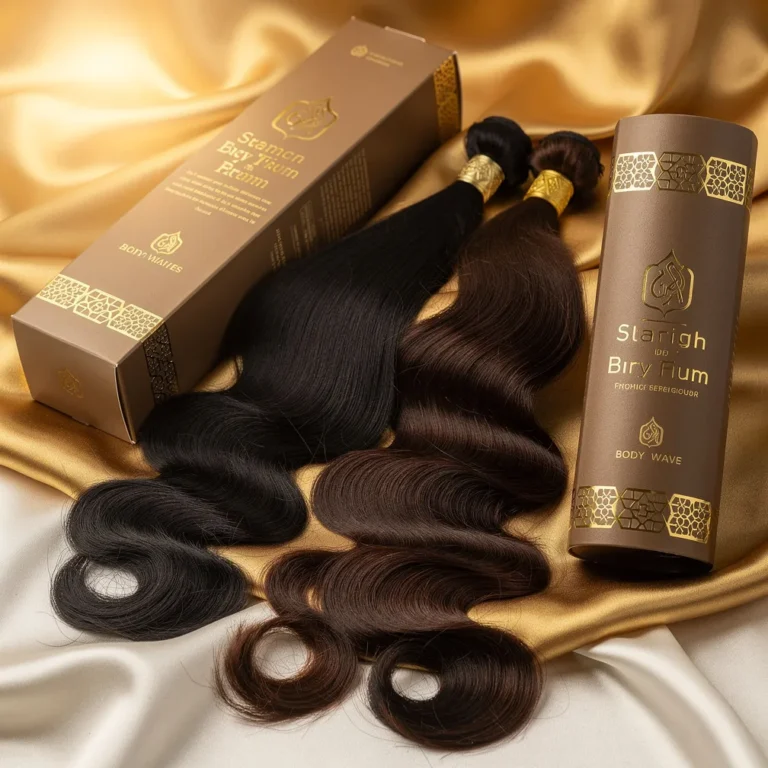
Reverse-image-search the vendor’s top product photos on Google or TinEye. If the same images appear on 5+ other vendor websites, the vendor is reselling generic stock imagery rather than showing their actual production. Real manufacturers invest in original product photography because their bundles have their own look. Stock photos correlate strongly with trader or scam operations.
Red Flag 3 — Pricing More Than 30 Percent Below Market Range
Our 2026 wholesale price benchmarks put 22-inch Remy machine-weft at USD 220 to 290 per kg ex-factory. A vendor quoting USD 130 for the same product is telling you one of three things: the hair is non-Remy and mislabeled, the “weight” is lighter than standard drawn weight, or the quote is a teaser that will evaporate after the sample order. Aggressive underpricing is a top-three scam indicator.
Red Flag 4 — Factory Address That Does Not Look Like a Factory
Paste the vendor’s factory address into Google Maps. Zoom to Street View. Legitimate factories look like factories: industrial buildings, loading bays, visible signage, commercial surroundings. Claimed factory addresses that turn out to be residential apartments, marketplace booths, or empty lots are almost always traders using a proxy address. In Faridabad and Delhi NCR, legitimate hair factories cluster in industrial sectors; in Chennai, they cluster around Pozhichalur, Tambaram, and the Red Hills area.
Red Flag 5 — No Verifiable Reference Clients
Ask for two reference clients willing to take a 15-minute phone call. Real manufacturers with 12+ months of export history can produce references easily. Vendors who hesitate, who “cannot share client names for confidentiality reasons,” or who produce references who turn out to be the vendor’s own staff under different email addresses, are hiding something. When a reference call does happen, listen for specifics: how long has the reference bought, what volume, have there been disputes, would they repeat-order today.
Red Flag 6 — 100 Percent Advance Payment Demands
Industry-standard first-order payment terms in India are 50 percent advance, 50 percent before shipment. A new vendor demanding 100 percent advance is either cash-flow stressed, uninsurable for their own suppliers, or running an advance-scam. Some legitimate manufacturers ask for 70 percent advance on custom orders — that is reasonable. 100 percent advance on a standard SKU first order is not.
Red Flag 7 — No Written MOQ or Sample Policy
Reputable manufacturers publish (or share on request) written MOQ by product category and a sample kit price list. Vendors who respond “MOQ depends on the order” or “sample pricing depends” without further specification are either making it up on the spot or reserving the right to move goalposts after you commit.
Red Flag 8 — Domain Registered Under 12 Months Ago
Check at whois.com. A vendor claiming “15 years of manufacturing experience” whose domain was registered six months ago is either a rebrand after reputation damage or a fresh trader set-up. Domain age is not infallible — legitimate businesses sometimes rebrand — but it warrants additional questions about business continuity and why the older domain (if any) was retired.
Red Flag 9 — No LinkedIn Presence for Founders or Staff
A legitimate manufacturer with 15+ employees almost always has LinkedIn profiles for at least the founder, the export manager, and the production head. Absence of any LinkedIn presence for a company claiming decades of operation is a weak but consistent red flag — it correlates with trader set-ups that lack a stable team.
Red Flag 10 — Unable to Provide a Live Video Factory Tour
Ask for a 15-minute live video walkthrough on WhatsApp or Zoom. Real factories can do this within 2 to 5 business days — a production head spends 15 minutes showing raw material storage, wefting machines, sorting tables, and the packing area. Vendors who offer pre-recorded “factory videos” that conveniently cover the same walk route, or who delay the video indefinitely, are often traders borrowing footage.
Red Flag 11 — English Fluency Mismatches in Technical Conversations
A vendor’s written English can be near-perfect on website copy but disintegrate in technical conversations about cuticle alignment, drawn weight, or QC protocol. This gap suggests that the written content is either outsourced or AI-generated, and that the vendor does not actually have in-house expertise on what they claim to manufacture. Legitimate manufacturers’ English may be imperfect, but technical detail comes through clearly.
Red Flag 12 — Pressure Tactics on First Order
“This price is only available if you order this week.” “We have other buyers asking for the same lot.” “The raw material price is going up Monday.” Legitimate manufacturers do not run flash-sale urgency tactics on B2B buyers. The industry works on quote validity periods (typically 15 to 30 days) and negotiated volume commitments, not high-pressure sales. Pressure on a first order is a strong scam indicator.
The 10-Minute Verification That Catches 60 Percent of Fakes
You can run the fastest 60 percent of fake-vendor detection in under 10 minutes per candidate:
- 2 minutes: WHOIS lookup for domain age.
- 2 minutes: Google Maps and Street View for factory address.
- 2 minutes: Reverse image search on top product photo.
- 2 minutes: LinkedIn search for company and named founder.
- 2 minutes: Review the quote against 2026 pricing bands.
The remaining 40 percent of fakes require the IEC verification, reference calls, and video walkthrough — all worth the additional 45 to 60 minutes before committing to a first order.
Disqualification Threshold
Any three of the 12 red flags triggered is a disqualification threshold. Two triggered flags warrants further investigation but not outright disqualification. One triggered flag is usually a resolvable concern (domain age, incomplete LinkedIn) rather than a systemic problem. Track your evaluation in a scorecard; reviewable patterns across multiple vendors over time help you refine your own thresholds.
Why Source From Hair Extensions By Nature?
Hair Extensions By Nature was founded by Hair Envy LLP, registered in 2018 with active GSTIN and active IEC. Our factory address (Booth No 71, Sector 16 Huda Market, Faridabad, Haryana) is visible on Google Maps and has been at that location since 2019. Our domain registration dates to early 2023 when we consolidated branding. Our founder maintains an active LinkedIn profile. We publish original product photography. Our 2026 pricing sits in the middle of the industry’s published bands. We do not run pressure-tactic first-order sales, and we accept the standard 50/50 payment split on first orders.
Every prospective customer can run the 12 red-flag checks against us. Most take under 30 minutes. None of them trigger, which is why our conversion rate from credentials pack to first order is high — not because we convince anyone, but because the facts verify.
Frequently Asked Questions
How many fake hair vendors are on Alibaba or IndiaMart?
Across Alibaba, IndiaMart, TradeIndia, and Global Sources, industry audits suggest fewer than 15 percent of vendors claiming to be Indian hair manufacturers actually own their manufacturing facilities. The remaining 85 percent range from legitimate traders (who add 15 to 30 percent markup but deliver real product) to outright scam operations.
What is the most common hair vendor scam pattern?
Advance-payment scams where a vendor requires 50 to 100 percent advance, then either ships non-Remy hair mislabeled as Remy, ships partial quantity, or disappears entirely. The second-most-common pattern is quality misrepresentation — taking legitimate sample orders but substituting lower-grade hair on bulk orders.
Should I avoid ordering from any trader or just scam vendors?
Traders are not inherently bad. For small orders from buyers who cannot meet direct manufacturer MOQs, traders provide a useful consolidation service at a 15 to 30 percent markup. The problem is specifically with traders who misrepresent themselves as manufacturers, because the buyer then pays the markup without knowing and loses direct-to-factory access for quality control and custom work.
What if a vendor refuses to provide IEC for “confidentiality” reasons?
Disqualify. IEC is public information registered with DGFT, freely searchable by anyone. The only reason to refuse to share it is because the vendor either does not have one or the IEC does not match the business name they are promoting.
How do I recover money paid to a fake hair vendor?
Recovery depends on the payment method. PayPal Business offers 180-day buyer-protection claims for non-delivery. Credit card charges paid through PayPal can be escalated through the card network. Wire transfers are effectively unrecoverable. Letter of credit releases funds only on verified shipment documentation, which protects against non-delivery fraud. If a scam has already happened, file complaints with DGFT (Indian export council), your local consumer protection agency, and the payment platform.
Does Alibaba’s Trade Assurance protect against fake vendor issues?
Partially. Trade Assurance covers payment protection and product quality disputes when you transact through Alibaba’s platform. It does not help if you transact directly with the vendor after discovery on Alibaba. For first orders with new Indian vendors, insist on completing the transaction through Trade Assurance or a similar escrow — it is worth the small fee.
Are red flags the same for Chinese vs Indian hair vendors?
Most red flags are universal, but the verification tools differ. For Chinese vendors, check through the State Administration for Industry and Commerce (SAIC) registry instead of DGFT. Factory address verification via Baidu Maps is the equivalent of Google Street View. Payment-protection mechanisms on Alibaba are the same.
Ready to Run the 12 Red Flags Against Us?
Request our credentials pack and run through the 10-minute verification set. If any flag triggers, tell us — we welcome the feedback. Most buyers who run the full check complete their evaluation of Hair Extensions By Nature in under 30 minutes and move directly to a sample order.
Send Me the Credentials Pack →
Prefer email? Reach us at info@hairextensionsbynature.com or complete our quote request form.
Hair Extensions By Nature — Manufacturer and Exporter of Premium Indian Human Hair Extensions. Factory: Booth No 71, Sector 16 Huda Market, Faridabad, Haryana, India — 121002. Serving salons, distributors, and brands in 40+ countries.
Start Your Hair Extensions Dropship Business
Zero inventory. Premium Indian Remy hair. Ship worldwide under your brand. MOQ as low as 5 pieces.