Raw Indian Temple Hair Vendors
Raw Indian Temple Hair Vendors — The 2026 Sourcing Guide for Processors and Brand Owners
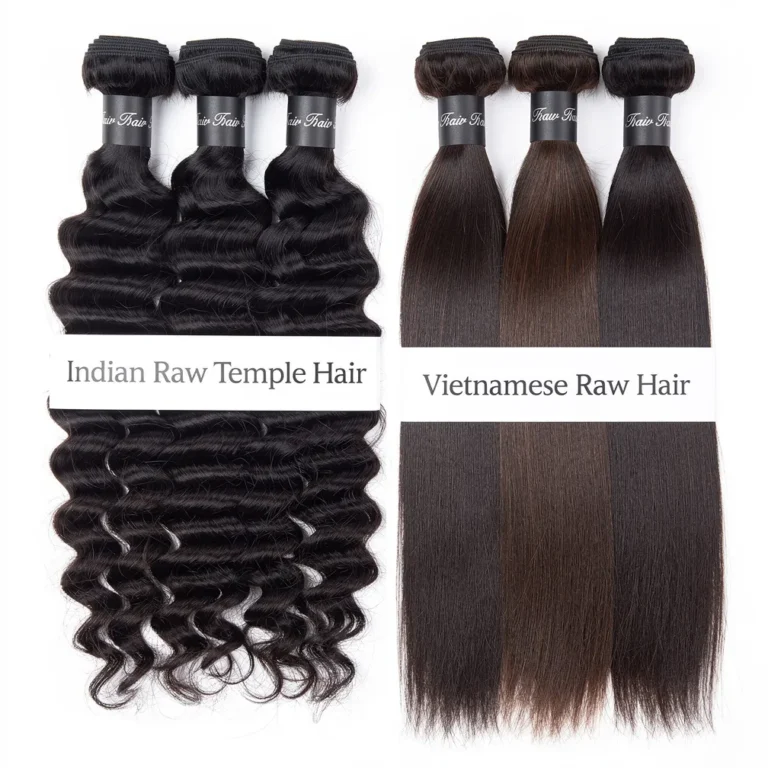
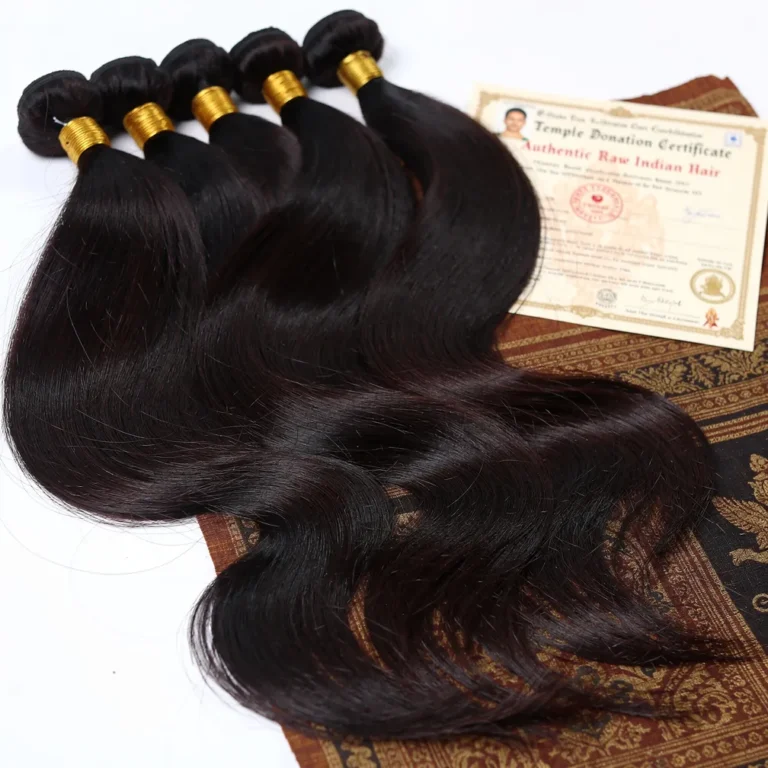
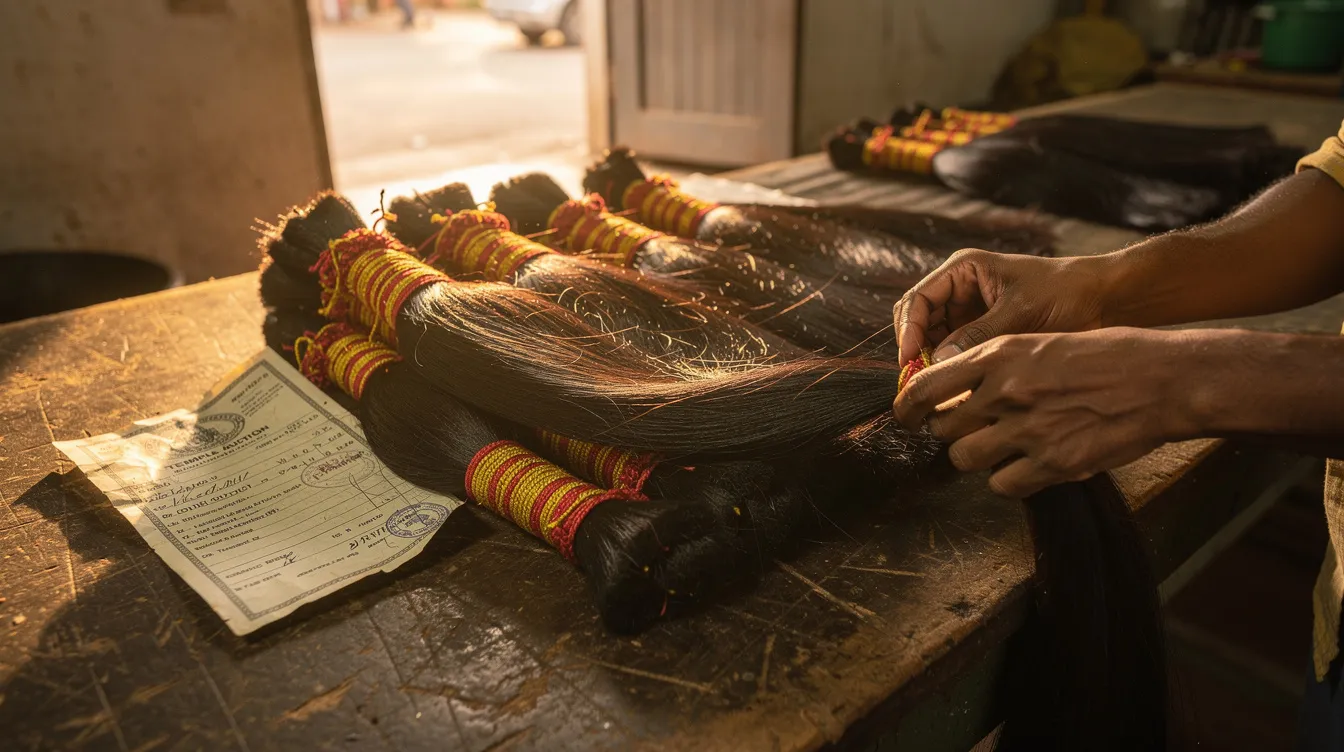
Raw Indian temple hair vendors are the upstream layer of the global human hair extension market. Authentic raw temple hair originates from four primary South Indian temples — Tirumala (Tirupati), Tiruchendur, Palani, and Srirangam — where devotees donate hair as a religious offering and temple trusts auction the collected hair to licensed processors. India’s temple hair supply stabilized at approximately 750 tonnes of auctioned raw hair in 2025, with Tirumala Tirupati Devasthanams (TTD) alone accounting for more than 500 tonnes. A trustworthy raw temple hair vendor either won an auction lot directly, works under a long-term aggregator agreement with a temple contractor, or buys from a licensed processor that can produce auction receipts on request.
This guide is written for the buyer who sits upstream of a finished-extensions brand — a processor in China or Vietnam, a private-label brand owner sourcing material for their own manufacturing partner, a distributor who wants to own their supply at the raw stage, or a new entrant trying to understand why prices from “temple hair vendors” on B2B marketplaces range from USD 70 to USD 400 per kilogram for what is nominally the same product. Hair Extensions By Nature works with licensed aggregators in South India and sources raw hair from auction channels to support our own finished-goods manufacturing in Faridabad. What follows is how the system actually works.
Need raw temple hair for processing or private-label manufacturing? We source from verified South Indian auction channels and supply single-donor ponytails, sorted bulk hair, and graded wet-washed lots. WhatsApp us for current availability and pricing.
Check Raw Temple Hair Availability
The Indian Temple Hair Supply Chain — From Devotee to Dispatch
Temple hair in India is sometimes called “black gold” because its supply is effectively constant: millions of devotees visit major South Indian temples every year, and a small fraction offer their hair as part of a vow. Neither supply nor demand is going away. What varies is access — who gets to buy hair at the auction, and at what price.
The chain, simplified, looks like this: donor → temple-operated tonsuring hall → temple trust inventory → public auction → licensed processor → aggregator or direct-export buyer → finished-extension manufacturer → wholesale buyer. Every hop adds cost and friction. A raw temple hair vendor selling to an overseas processor sits somewhere in the middle of this chain. The fewer hops between the auction and the buyer, the more predictable the vendor’s pricing, quality, and availability.
Primary Auction Sources
Of the temples that conduct hair auctions in India, four dominate both in volume and quality:
- Tirumala (Tirupati) — Andhra Pradesh. The world’s largest single-source of donated human hair, managed by TTD. Auctions run roughly every 45 to 60 days. Lot sizes at auction typically start at 500 kilograms. Hair is offered in multiple grades by length, texture, and condition.
- Tiruchendur (Murugan temple) — Tamil Nadu. Second-largest donor base in South India. Auctions are less frequent than TTD but produce high-quality medium-to-long hair.
- Palani (Murugan temple) — Tamil Nadu. Smaller volume, often with a higher proportion of wavy and fine-textured donor hair.
- Srirangam (Ranganathaswamy temple) — Tamil Nadu. Historically significant, mid-sized volumes, known for producing single-donor ponytail material.
Additional auctions occur at Madurai’s Meenakshi temple, Sabarimala (Kerala), and a handful of smaller temples. Volumes at these sites are limited and typically absorbed by regional aggregators.
Who Can Actually Bid at a Temple Hair Auction
Temple auctions are not open to the general public in the way retail auctions are. TTD specifically runs a licensed-bidder system: only registered entities with GST, a valid PAN card, trade license, and a financial pre-deposit can participate. Most registered bidders are long-established Chennai or Andhra processors who have bid at TTD auctions for 15 to 30 years. They know the lot grading system. They know which lots are worth a premium. They finance their bids through bank letters of credit issued against inventory.
An overseas buyer cannot typically bid at TTD directly. What an overseas buyer can do is work with a licensed bidder under one of three arrangements: (a) direct purchase of finished lots after auction, (b) pre-committed aggregator agreement where the bidder wins specific lots on behalf of the buyer, or (c) a long-term supply contract for monthly volumes at agreed quality grades. Option (c) is the most reliable for processors buying more than 2 tonnes per month.
Raw Temple Hair Grades and What They Mean for Price
At the auction, temple hair is offered in graded lots. A non-native buyer seeing “raw Indian temple hair” on a vendor website should know that this single phrase can cover products that differ in price by 5x. Understanding the grading is the first step to not overpaying.
| Grade | Description | 2026 USD/kg band |
|---|---|---|
| Single-donor ponytail (SDP) | Intact ponytail, tied at root, from one donor. Highest Remy integrity. | 320 – 520 |
| Double-drawn bulk Remy | Mixed-donor, length-matched, all cuticles in single direction | 240 – 360 |
| Single-drawn bulk Remy | Mixed-donor, not length-matched, cuticles in single direction | 180 – 260 |
| Non-Remy raw temple hair | Cuticles not aligned; lower processing cost but higher tangle rate | 90 – 150 |
| Mixed bulk / fallen hair | Collected hair not from tonsure; usually not from temples | 40 – 90 |
Lengths add another dimension. A 12 to 16 inch single-donor ponytail might sit at the low end of the SDP band; a 26 to 30 inch single-donor ponytail can exceed USD 700 per kilogram for verified Tirumala origin in 2026. If a vendor is quoting USD 80 per kg for something labeled “Tirumala temple SDP 24 inch,” the label is almost certainly wrong.
The 10-Point Raw Temple Hair Vendor Vetting Checklist
- Auction receipt evidence. Ask for scanned or photographed TTD auction receipts matching the claimed lot. Dates, lot numbers, and weights should tally with the offered quantity.
- Licensed-bidder registration. Vendors who bid themselves can provide their TTD bidder license reference. Those who buy from licensed bidders should name their source and supply a chain-of-custody affidavit.
- Active IEC export license. Verifiable on dgft.gov.in. Without an IEC, export paperwork will not clear.
- GST compliance with matching entity name. GSTIN status and legal entity name verifiable on gst.gov.in.
- Physical factory or aggregation premises. A working sorting facility visible on a video walkthrough, not a trading office with sample bundles on a shelf.
- Published grading protocol. A written grading standard the vendor uses internally — length ranges, texture classifications, Remy test procedure. Without this, “grade” claims are meaningless.
- Export experience to your destination. Ability to produce at least two prior air waybills or ocean bills of lading to the buyer’s country. Temple hair exports to China, Vietnam, USA, UK, and West Africa have specific documentation quirks; a novice exporter will slow your first shipment.
- Willingness to ship on partial payment. Industry norm for repeat buyers is 30 percent advance, 70 percent on bill of lading. A vendor who insists on 100 percent advance for your second-or-later order is signaling cash-flow stress.
- Published quality testing regime. Cuticle-alignment check, length verification, weight check, basic water-rinse silicone test before packing.
- Years in business. Temple hair vendors with fewer than three years of export history, no matter how polished the website, carry materially higher counterparty risk.
Typical Raw Temple Hair MOQs and Lead Times
Raw temple hair MOQs are larger than finished-extension MOQs because auction lots are large and splitting them incurs cost. A first order for a new buyer at a reputable aggregator typically looks like:
- Single-donor ponytails: 5 to 10 kg first order, 25 to 50 kg repeat orders.
- Sorted bulk Remy: 20 to 50 kg first order, 100 kg+ repeat orders.
- Un-sorted bulk (non-Remy): 50 to 100 kg first order.
Lead times from order confirmation to dispatch depend on auction timing. If your order matches available post-auction inventory, lead time is 5 to 12 working days. If you are ordering ahead of an upcoming auction, lead time can stretch to 45 to 75 days. Serious processors plan on 3-month forward orders synced to the TTD auction calendar.
Export Logistics for Raw Temple Hair
Raw temple hair ships under HS code 0501.00 — “human hair, unworked, whether or not washed or scoured; waste of human hair.” This classification matters because it differs from HS 6703 (worked or prepared human hair) and HS 6704 (wigs, eyebrows, and eyelashes). Customs authorities in importing countries levy different duty rates on 0501 versus 6703.
Destination countries matter too. Chinese customs classifies raw hair under its own subcategories with specific import license requirements. Vietnam processes raw temple hair through HCMC and Haiphong ports with streamlined duty in free trade zones. US imports under HTSUS 0501 are duty-free but subject to USDA Animal and Plant Health Inspection Service (APHIS) review — this adds a few days at port but is routine for legitimate shipments. UK and EU imports under CN 0501 are duty-free under MFN rates.
Air freight is standard for single-donor ponytails and small bulk Remy orders (under 50 kg). Sea freight, in FCL or LCL containers, is standard for bulk orders over 200 kg because air freight starts to dominate cost. Budget USD 8 to 14 per kg for air freight from Chennai to USA/UK/EU; USD 2 to 4 per kg equivalent for LCL sea freight on the same lanes.
Why Source Through Hair Extensions By Nature?
For processors in China, Vietnam, or other finishing markets, and for private-label brand owners who run their own manufacturing, raw temple hair is a strategic input, not a shopping decision. Hair Extensions By Nature supplies raw temple hair to selected partners under long-term supply agreements synced to the TTD and Tiruchendur auction calendars. We do not retail raw hair; we work with processors and brand owners on monthly tonnage commitments.
What a qualifying partner gets: traceable raw material with auction-receipt references, consistent grade output against a published grading protocol, quarterly volume commitments at locked pricing, and integrated shipping documentation. The value is not being the cheapest raw hair vendor in the market — it is being the most auditable and predictable. For a processor whose finished-extension margin depends on raw material consistency, that predictability is worth more than a USD 15 per kilogram price difference.
Run a processing facility or a private-label brand? We qualify new partners via a short credentials check and volume projection. If you are shipping one or more tonnes of finished extensions per quarter and want raw supply predictability, message us.
Frequently Asked Questions
What is the difference between raw temple hair and raw virgin hair?
Raw temple hair is a subset of raw virgin hair — specifically, virgin hair collected through the South Indian temple donation and auction system. All temple hair is virgin. Not all virgin hair is temple hair. Virgin hair can also come from paid-donor programs, salon collection, or non-temple sources. Temple hair commands a price premium because its single-donor, chemically untouched, cuticle-aligned nature is structurally easier to audit.
Can I attend a TTD temple hair auction as an observer?
TTD auctions are closed-door events restricted to registered bidders. Observers are not formally permitted. If you want to understand the auction mechanics firsthand, a better approach is to schedule a factory tour with a licensed bidder during a post-auction sorting run. Most established Chennai aggregators will accept pre-scheduled B2B buyer visits and walk you through the bought lot’s sorting.
How do I spot fake “temple hair” offers on Alibaba?
Three quick tests. First, check the price against the 2026 band above — if single-donor 20 inch is quoted below USD 250 per kg, it is almost certainly not temple origin. Second, ask for a specific TTD or Tiruchendur auction receipt — genuine vendors can produce them, fakes cannot. Third, ask for a video of the ponytail opening: authentic single-donor ponytails are tied at the root with red-yellow sacred thread used in temple tonsure halls.
What’s the lead time for raw temple hair from India to China or Vietnam?
Air freight Chennai to Shanghai or Ho Chi Minh City is typically 3 to 5 transit days plus customs. Sea freight on the same lanes is 10 to 20 transit days plus customs. Most processor partners budget 14 to 30 days door-to-door depending on mode and season.
Is it legal to import raw human hair into the United States?
Yes. The US has no prohibition on human hair imports under HTSUS 0501 or 6703. Shipments are screened by USDA APHIS for animal-derived substances and by US Customs for documentation. Standard clearance adds 2 to 5 days at port. Importers of record should carry a power-of-attorney relationship with a licensed customs broker.
What quality tests should I run on a raw temple hair sample before bulk ordering?
Four tests make a practical starter kit. A cuticle-direction test (rub the hair between fingers from root to tip and then reverse — aligned Remy will feel smooth one way, rough the other). A water-rinse silicone test (soak 10 grams in clear water for 10 minutes — any chemical coating clouds the water). A burn test (a few strands burned should produce grey ash and a keratin smell, not plastic). A wash cycle test (10 to 12 shampoo cycles to check shedding and tangle behavior).
Can a Chinese or Vietnamese processor claim “temple hair” origin when re-selling finished extensions?
Technically yes if the raw material genuinely originated from Indian temple auctions, but many finished-extension sellers in the Asia processing hubs mix sources and still label output as temple hair. For the downstream buyer, the cleanest way to audit origin is to buy from a finisher who can produce an unbroken paper trail — auction receipt, inbound shipping document to their processing facility, internal lot numbers, and outbound shipping document to you.
Ready to Discuss a Raw Temple Hair Supply Agreement?
For processors and brand owners with meaningful quarterly volumes, raw temple hair is a relationship, not a transaction. Hair Extensions By Nature qualifies new raw-supply partners through a brief credentials check and volume planning conversation. If you are shipping finished extensions in tonnes per quarter, the efficiency gain from predictable raw supply typically outweighs a lower spot-market price.
Open a Supply-Partner Conversation on WhatsApp →
Prefer email? Contact us at info@hairextensionsbynature.com or complete our quote request form.
Hair Extensions By Nature — Manufacturer and Exporter of Premium Indian Human Hair Extensions. Factory: Booth No 71, Sector 16 Huda Market, Faridabad, Haryana, India — 121002. Serving salons, distributors, and brands in 40+ countries.
Start Your Hair Extensions Dropship Business
Zero inventory. Premium Indian Remy hair. Ship worldwide under your brand. MOQ as low as 5 pieces.