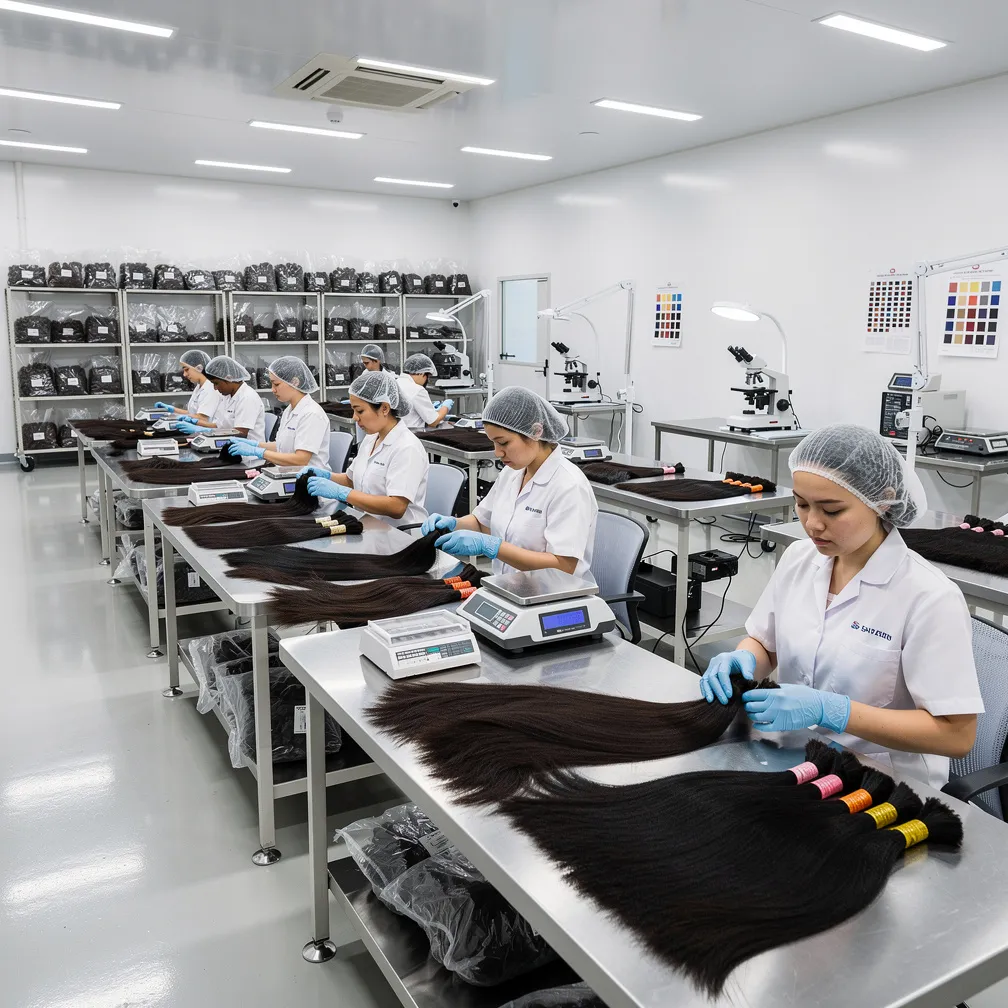
Hair Extension Manufacturing Process Step
Hair Extension Manufacturing Process Step by Step [Factory Guide 2026]
Hair extensions are manufactured through a sequential process that begins with raw hair sorting and ends with packaged, export-ready product — typically spanning 7 to 21 days depending on the level of customization. The process involves raw material selection and grading, chemical-free or low-chemical washing, cuticle alignment verification, color processing (if applicable), weft or bond construction, multi-stage quality control, and final packaging. Each step directly affects the quality, longevity, and customer satisfaction of the finished product, which is why understanding the manufacturing process is essential for any wholesale buyer evaluating factory partners.
This factory tour in article form is based on the actual production workflow at Hair Extensions By Nature, a direct manufacturer located in Faridabad, Haryana, India. We open our production process to wholesale buyers — both through this guide and through live video walkthroughs — because informed buyers make confident purchasing decisions.
See our manufacturing process firsthand. Hair Extensions By Nature offers live video factory walkthroughs for qualified wholesale buyers. WhatsApp us to schedule a virtual tour of our production facility.
Step 1: Raw Hair Receiving and Sorting
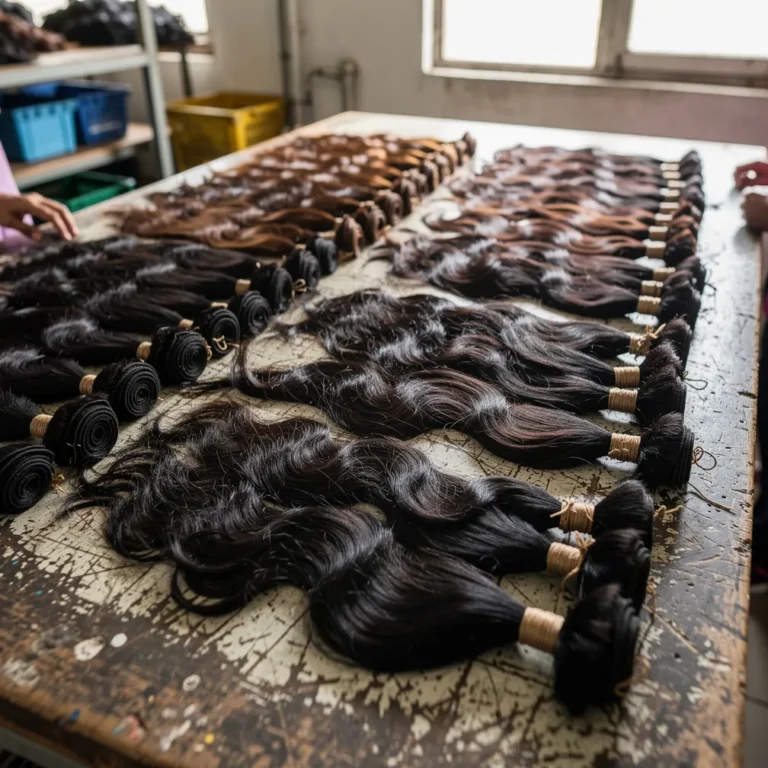
The manufacturing process begins when raw hair arrives at the factory from temple auctions, village collectors, or direct purchase channels. At this stage, the hair is unsorted, unwashed, and in its most natural state — often tangled and mixed with varying lengths.
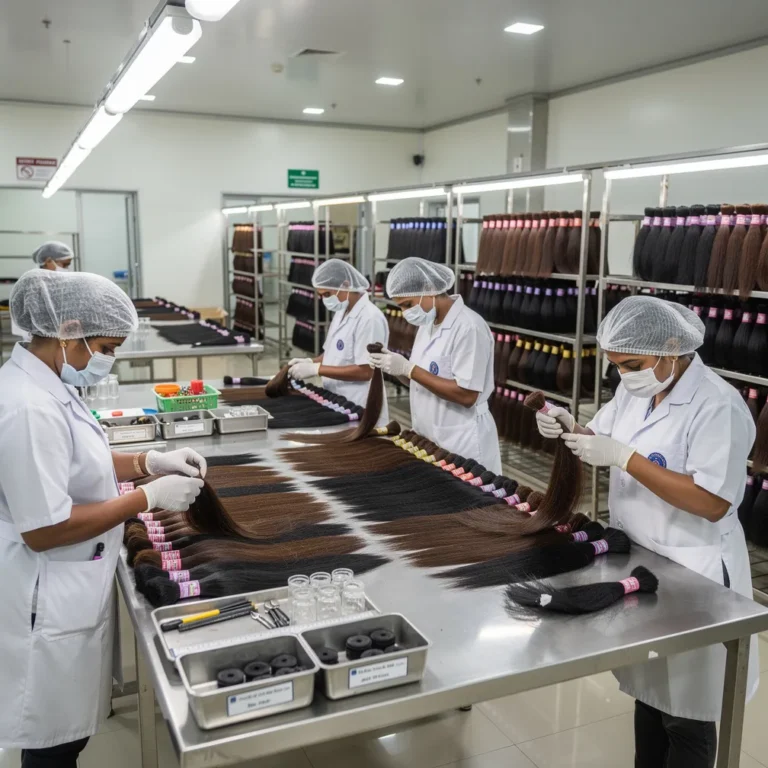
Trained sorters perform the first critical quality gate by separating hair into groups based on:
- Length: Hair is measured and grouped into 2-inch increment categories (8-10 inch, 10-12 inch, and so on up to 30+ inches)
- Texture: Naturally straight, wavy, and curly hair is separated since each texture requires different processing
- Quality grade: Hair is assessed for strand thickness, cuticle integrity, and overall condition. Damaged, grey, or excessively thin strands are removed
- Color: Natural color variations from jet black to dark brown are separated for consistent batch processing
This sorting stage is almost entirely manual — experienced workers develop a tactile skill for assessing hair quality that no machine can replicate. At our facility, sorting teams handle each batch within 24-48 hours of arrival to prevent degradation of the raw material.
Step 2: Washing and Cleaning
Raw hair arrives with natural oils, dust, temple ash (in the case of temple-sourced hair), and other residues that must be removed without damaging the cuticle layer. The washing process is one of the most important steps in determining final product quality.
At Hair Extensions By Nature, we use a chemical-free or low-chemical washing approach:
- Pre-soak: Hair is soaked in lukewarm water to loosen surface debris and soften tangles
- Gentle wash: A mild, sulfate-free detergent solution is used to remove oils and residue without stripping the cuticle
- Rinse cycle: Multiple rinses in clean water ensure all detergent is removed
- Conditioning: A light conditioning treatment restores moisture balance and facilitates detangling
- Drying: Hair is air-dried or dried at low temperatures to prevent heat damage to the cuticle structure
The critical distinction between quality manufacturers and cheap processors is the washing method. Acid-bath processing — used by low-cost producers — strips the cuticle entirely, creating artificially smooth hair that tangles severely after the silicone coating washes off. Buyers should specifically ask their supplier whether acid baths are used in any part of the washing process.
Step 3: Cuticle Alignment and Detangling
Cuticle alignment is the single most important quality step in hair extension manufacturing. Genuine Remy hair must have all cuticle layers running in the same direction — from root to tip — throughout the entire bundle. This alignment is what prevents tangling during the product’s usable life.
The alignment process involves:
- Direction verification: Workers verify the root-to-tip direction of each hair strand or small strand group
- Hackle combing: Hair is drawn through a hackle (a bed of fine, upright metal pins) to remove tangles, short hairs, and debris while maintaining directional alignment
- Drawing: For double-drawn product, shorter hairs are manually removed so the finished bundle is uniformly full from root to tip
- Final alignment check: A tactile test (running fingers from tip to root) confirms cuticle direction. Properly aligned hair feels smooth root-to-tip and shows slight resistance tip-to-root
This step is entirely hand-performed by skilled workers. A single mistake in directional alignment will cause the finished product to tangle prematurely. Factories that rush this step — or skip it entirely — produce hair that fails within weeks of customer use.
Step 4: Color Processing
Not all hair extensions undergo color processing — raw hair and natural black hair skip this step. However, hair destined for colors other than natural black goes through one or more of the following processes:
| Process | Purpose | Time Required | Quality Impact |
|---|---|---|---|
| Bleaching | Lighten hair to accept new color | 2-6 hours per batch | Reduces hair strength if over-processed |
| Dyeing | Apply target color | 1-3 hours per batch | Minimal impact with quality dyes |
| Toning | Adjust color tone (warm/cool) | 30-60 minutes | Negligible |
| Steam texturing | Create body wave or curls | 1-4 hours | Minimal with proper technique |
For a detailed breakdown of coloring methods and best practices, see our companion guide on how hair extensions are colored and processed.
Step 5: Weft and Product Construction
After washing, alignment, and optional color processing, the hair is constructed into its final product form. The construction method varies by product type:
Machine Weft: Hair is fed through an industrial sewing machine that stitches it onto a reinforced thread base. Machine wefts are the most common and cost-efficient construction, producing flat, narrow tracks of hair. Production speed: a skilled operator produces 500-800 grams per day.
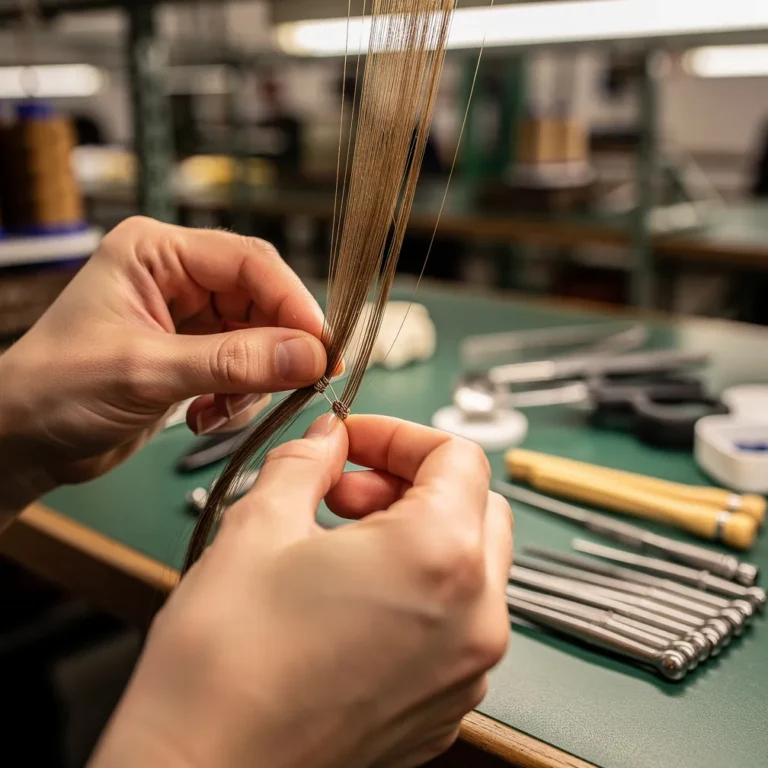
Hand-Tied Weft: Individual small bundles of hair are hand-knotted onto a thin, flexible base thread. This produces an ultra-flat, flexible weft ideal for seamless salon installations. Production speed: a skilled worker produces only 100-200 grams per day, which is why hand-tied wefts command a premium price.
Tape-In Construction: Pre-aligned hair bundles are sandwiched between two medical-grade adhesive tape strips. This requires precise weight distribution — each tape tab must contain a consistent gram count (typically 2.5-3 grams per tab) for balanced installation.
Clip-In Assembly: Machine or hand-tied wefts are cut to specified widths, and pressure-sensitive snap clips are sewn onto the weft at measured intervals. A standard 7-piece clip-in set requires precise width cutting and clip placement for each piece.
Keratin/Fusion Bonds: Individual hair strands (typically 0.5-1 gram each) are tipped with a keratin-based adhesive using a heated fusion tool. This is one of the most labor-intensive construction methods.
Step 6: Quality Control
Every batch passes through multi-point quality control before packaging. At Hair Extensions By Nature, our QC process includes:
| QC Check | Method | Pass Criteria |
|---|---|---|
| Weight verification | Digital scale (0.1g precision) | Within +/-2% of stated weight |
| Length measurement | Ruler on flat surface | Within +/-0.5 inch of stated length |
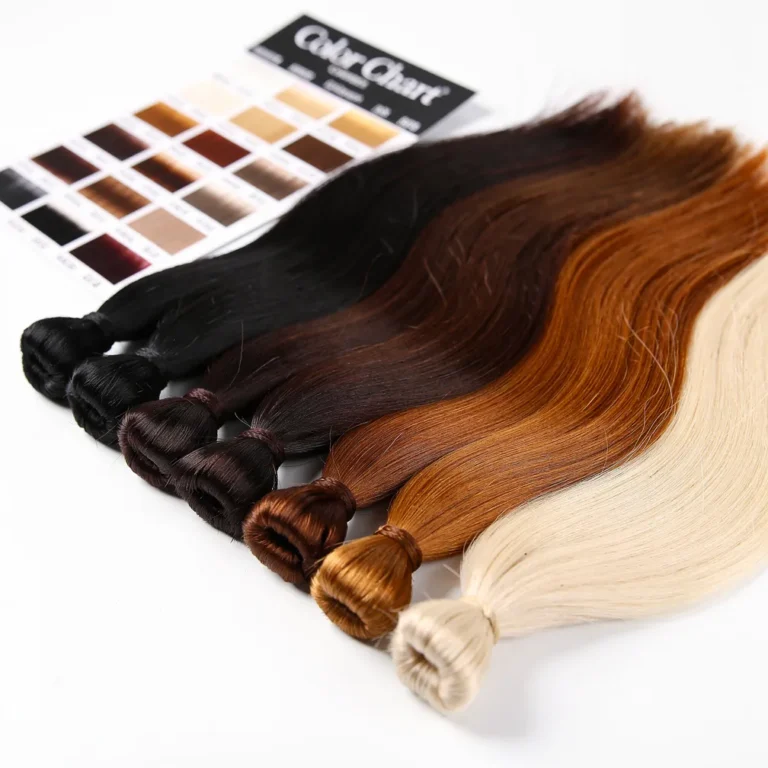
| Color matching | Ring chart comparison under D65 lighting | Matches target color within 0.5 shade |
| Cuticle alignment | Finger-slide test | Smooth root-to-tip, resistance tip-to-root |
| Weft integrity | Gentle pull test | No shedding beyond 2-3 strands per tug |
| Tangle test | Finger-comb through dry hair | No tangling during comb-through |
| Adhesive test (tape-ins) | Peel adhesion test | Tape holds under standard salon conditions |
Batches that fail any QC checkpoint are pulled from the production line, reworked, or downgraded. This is where the difference between a factory with real quality standards and one without becomes visible — ask your manufacturer to explain their QC process in specific, verifiable terms.
Step 7: Packaging and Export Preparation
The final manufacturing step prepares the product for shipment. This includes:
- Inner packaging: Each bundle or set is wrapped in tissue paper or placed in a satin pouch to prevent friction damage during transit
- Labeling: Product labels with SKU, weight, length, color code, and lot number are attached for inventory tracking
- Private label packaging: For branded orders, custom boxes, inserts, and branded materials are applied per the buyer’s specifications
- Outer packaging: Products are boxed in moisture-resistant cartons with cushioning material for international shipping
- Export documentation: Commercial invoice, packing list, certificate of origin, and any required compliance documents are prepared
Want to see this process in action? Hair Extensions By Nature welcomes factory visits and provides video walkthroughs for international wholesale buyers. Contact us to arrange a virtual or in-person tour of our Faridabad facility.
Why Source From Hair Extensions By Nature
Hair Extensions By Nature (legal entity: Hair Envy LLP) operates a complete manufacturing facility in Faridabad, Haryana, India where every step described above — from raw hair sorting through final packaging — is performed in-house. We are not a trading company that outsources production. Our factory-direct model means our buyers get consistent quality, transparent pricing, and direct access to the production team responsible for their orders.
We invite every serious wholesale buyer to verify our manufacturing capabilities through a factory visit or video walkthrough before placing their first order. Contact us at +91 9289358222 (WhatsApp) or info@hairextensionsbynature.com. Our facility is at Booth No 71, Sector 16 Huda Market, Faridabad, Haryana, India – 121002.
Frequently Asked Questions
How long does it take to manufacture hair extensions?
The complete manufacturing cycle takes 7-21 days depending on the product type and level of customization. Natural black machine-weft extensions can be completed in 7-10 days, while custom-colored hand-tied wefts or complex wig constructions may require 15-21 days. This timeline covers sorting, washing, alignment, processing, construction, QC, and packaging.
What is cuticle alignment and why does it matter?
Cuticle alignment means all hair strands in a bundle run in the same direction, from root to tip. This is essential because misaligned cuticles create friction between strands, causing severe tangling and matting within days of use. Genuine Remy hair extensions must have consistent cuticle alignment — it is the single most important quality characteristic that determines product lifespan.
What is the difference between machine weft and hand-tied weft?
Machine weft hair is sewn onto a thread base using an industrial sewing machine, producing a flat, narrow track. Hand-tied weft is individually knotted by hand onto a thin thread, creating an ultra-flat, flexible weft that lays closer to the scalp. Hand-tied wefts take 3-5 times longer to produce and cost significantly more, but they provide a more seamless installation.
How do factories ensure consistent quality in hair extensions?
Quality-focused factories implement multi-point quality control including weight verification on precision scales, length measurement, color matching under standardized lighting, cuticle alignment testing, weft integrity pull tests, and tangle resistance checks. Each batch is tracked with a lot number for traceability. Factories should be able to describe their QC process in specific, verifiable detail.
What chemicals are used in hair extension manufacturing?
Ethical manufacturers minimize chemical use. Raw hair is washed with mild, sulfate-free detergents. Color processing uses professional-grade dyes, developers, and toners. The most harmful practice is acid-bath processing, which strips cuticles using strong acids — reputable manufacturers avoid this entirely. Buyers should specifically ask whether acid baths are used in any part of the process.
Start Your Hair Extensions Dropship Business
Zero inventory. Premium Indian Remy hair. Ship worldwide under your brand. MOQ as low as 5 pieces.