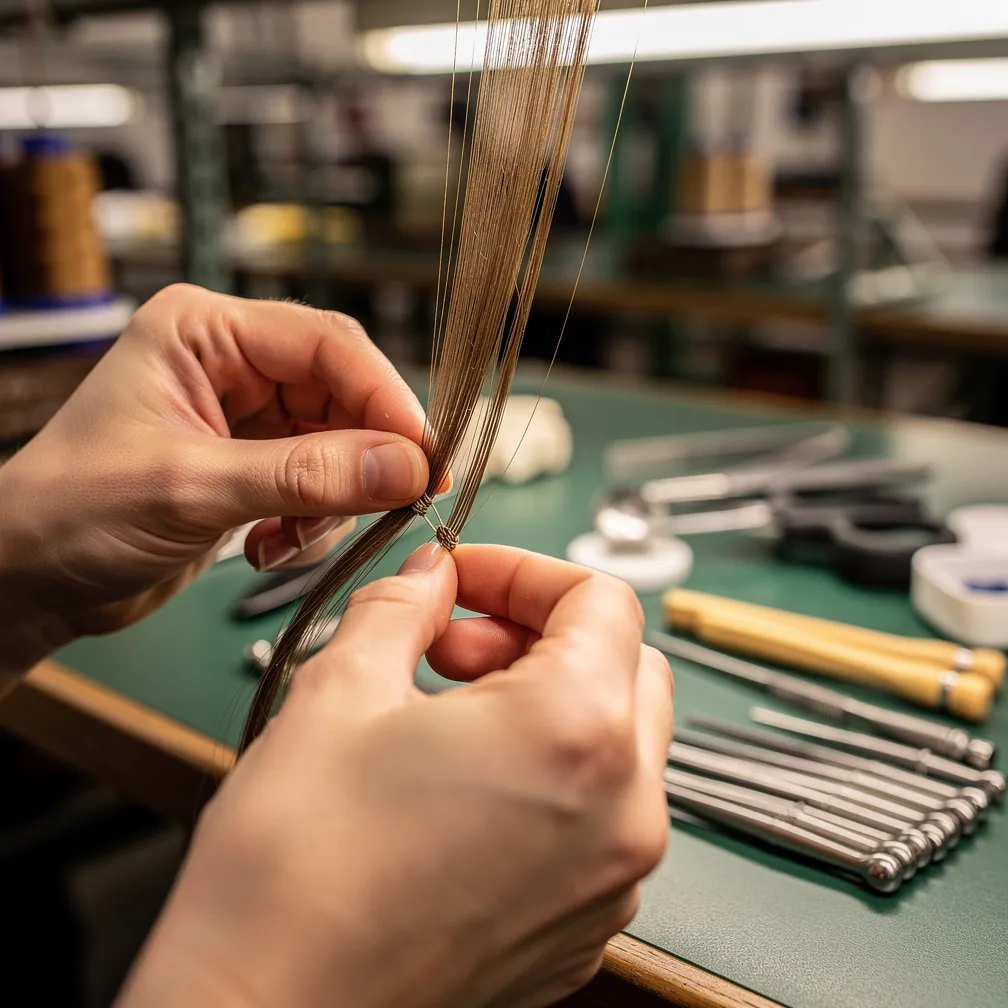
Hand Tied Weft Hair Extensions Making Process
Hand Tied Weft Hair Extensions Making Process — Premium Manufacturing Guide
Hand-tied weft hair extensions are manufactured by skilled artisans who individually knot small bundles of hair — typically 15-20 strands per knot — onto a thin, flexible base thread at precise 2-3 millimeter intervals. This entirely manual process produces a weft that is 50-70% thinner than machine-sewn alternatives, creating the ultra-flat, seamless profile that premium salon clients demand. A single row of hand-tied weft takes 45-90 minutes to produce compared to 5-10 minutes for machine weft, which explains both the premium pricing and the exceptional quality of the finished product.
This manufacturing guide is published by Hair Extensions By Nature, a direct manufacturer in Faridabad, India that produces both hand-tied and machine weft extensions for wholesale buyers worldwide. Understanding the production process behind hand-tied wefts helps salon owners and brand builders justify the premium pricing to their customers — and make informed sourcing decisions when choosing a manufacturing partner.
Source premium hand-tied wefts directly from the manufacturer. Hair Extensions By Nature produces hand-tied weft extensions using skilled artisans and Remy Indian hair. WhatsApp us for wholesale pricing and sample availability.
The Hand-Tied Weft Construction Process
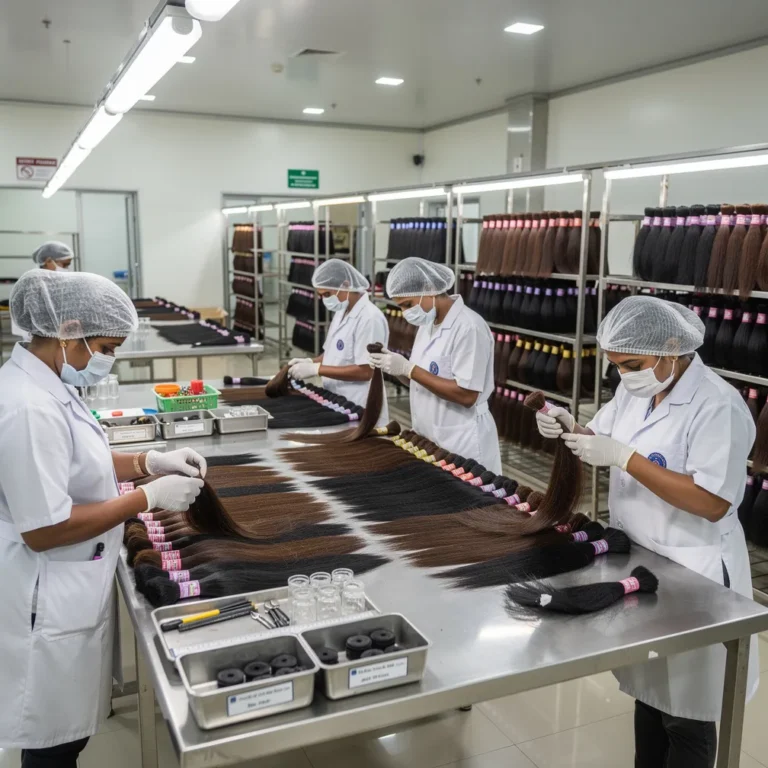
The hand-tied weft making process requires precision and patience at every step. Here is the detailed production workflow from prepared hair to finished weft:
Step 1 — Hair Preparation: Cuticle-aligned Remy hair is sorted by length, weight-measured into small bundles, and laid out in the correct root-to-tip direction. Any short or broken strands are removed. For double-drawn hand-tied wefts, all shorter hairs have already been removed during an earlier processing step.
Step 2 — Thread Setup: A thin, high-strength polyester or cotton base thread is stretched taut across a horizontal frame or jig. The thread must maintain consistent tension throughout the knotting process — too loose and the weft will be uneven; too tight and it will not have the flexibility that makes hand-tied wefts desirable.
Step 3 — Hand Knotting: The artisan takes a small bundle of 15-20 strands, folds them over the base thread, and executes a precise hand knot that secures the hair while maintaining the ultra-thin profile. Knots are placed at 2-3 millimeter intervals along the thread. Each knot must be tight enough to prevent shedding but not so tight that it creates a visible bump.
Step 4 — Row Building: The artisan works along the entire length of the thread, building the weft row to the specified width (typically 8-16 inches per row, depending on the buyer’s specification). Multiple rows are produced to create a full set.
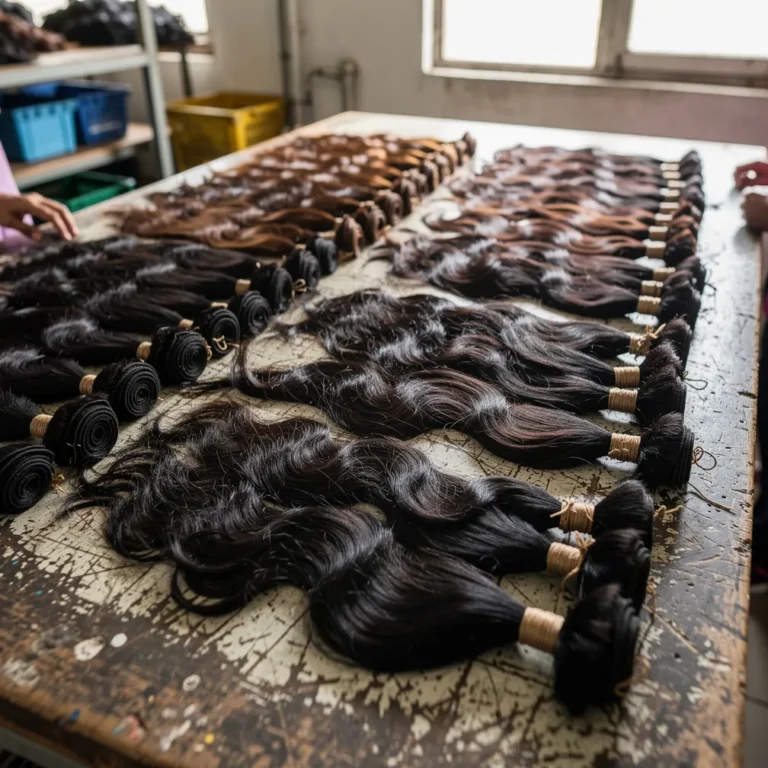
Step 5 — Sealing: After knotting, the base thread ends are sealed to prevent unraveling. Some manufacturers apply a thin line of flexible sealant along the weft for additional security, though the best hand-tied wefts rely primarily on knot quality.
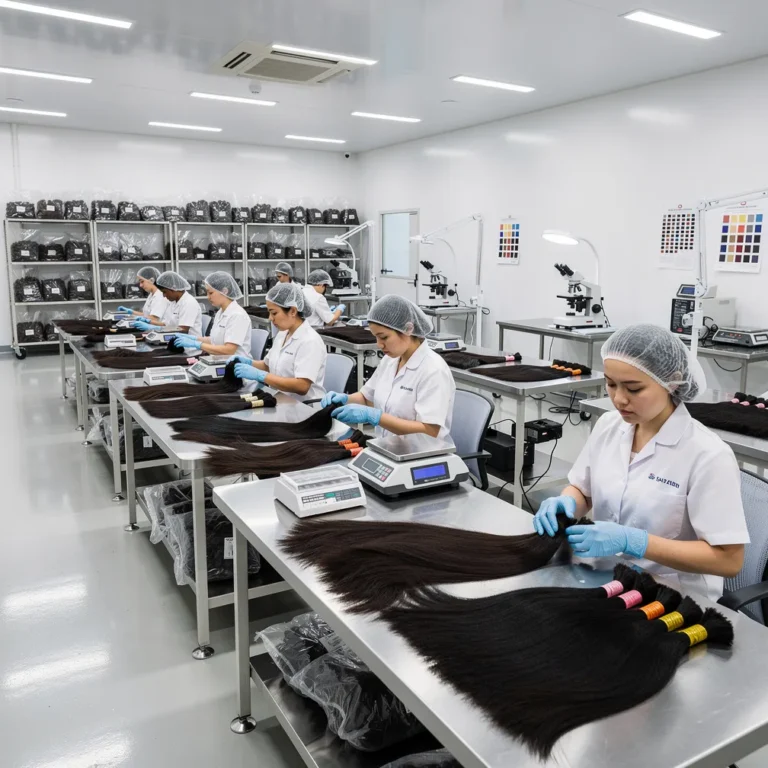
Step 6 — Quality Inspection: Each weft is inspected for knot consistency, hair distribution evenness, shedding resistance, and overall thickness profile. Wefts that do not meet specifications are reworked or rejected.
Hand-Tied vs. Machine Weft: Complete Comparison
| Characteristic | Hand-Tied Weft | Machine Weft |
|---|---|---|
| Production Time (per row) | 45-90 minutes | 5-10 minutes |
| Daily Output (per worker) | 100-200 grams | 500-800 grams |
| Weft Thickness | Ultra-thin (0.5-1mm) | Standard (2-3mm) |
| Flexibility | Highly flexible; returns to flat | Semi-rigid; can create bumps |
| Cutting | Cannot be cut (weft unravels) | Can be cut and sealed |
| Installation Method | Beaded row, NBR, invisible bead | Sew-in, braided, clip-in |
| Client Comfort | Extremely comfortable; undetectable | Comfortable; may be detectable at track |
| Wholesale Cost | 2-3x higher than machine weft | Base pricing |
| Retail Price Point | $200-600+ per set | $80-250 per set |
| Target Market | Premium salons, luxury brands | Broad market, price-competitive |
Skill Requirements and Worker Training
Hand-tied weft production is one of the most skill-intensive tasks in hair extension manufacturing. A worker cannot be trained to produce consistent, sellable hand-tied wefts in a matter of days — the learning curve is significant:
- Training period: 3-6 months of supervised practice before a worker produces sellable quality
- Speed development: An additional 3-6 months to reach production-level speed (100+ grams per day)
- Manual dexterity: Requires fine motor skills comparable to detailed textile work or jewelry making
- Consistency: Experienced hand-tiers develop a rhythm that produces uniform knot spacing and tension — this consistency is what separates factory-quality from amateur attempts
- Retention: Because of the training investment, manufacturers with experienced hand-tied teams guard this workforce — it is a genuine competitive advantage
This skill requirement is the primary reason why not all hair extension manufacturers offer hand-tied wefts. When evaluating a supplier’s hand-tied capability, ask how many trained hand-tiers they employ and what their monthly production capacity is. Vague answers suggest the capability may be outsourced.
Why Hand-Tied Wefts Command Premium Pricing
The price premium for hand-tied wefts is entirely justified by production economics and product performance:
- 5-10x more labor per unit: A machine operator produces 500-800 grams per day; a hand-tier produces 100-200 grams. The labor cost per gram is proportionally higher
- Skilled labor premium: Trained hand-tiers command higher wages than machine operators due to the specialization and training investment
- Lower production capacity: Factories have limited hand-tied capacity, creating supply constraints that support pricing
- Superior end-product: The thinner, more flexible weft delivers a measurably better client experience, supporting premium retail pricing
- Salon service revenue: Hand-tied weft installation services (beaded row, NBR method) command $400-1200+ per appointment in US and UK salons
For salon owners, the math is compelling: hand-tied weft extensions purchased wholesale for $120-180 per set can be installed for $600-1200 as a salon service, delivering a combined product-and-service margin of 70-85%.
Build your premium extension service with factory-direct pricing. Hair Extensions By Nature manufactures hand-tied wefts with trained artisans and Remy Indian hair. Our wholesale pricing gives salon owners the margins to build a profitable hand-tied extension program.
Specifications to Confirm When Ordering Hand-Tied Wefts
When placing a wholesale order for hand-tied weft extensions, confirm the following specifications in writing with your manufacturer:
| Specification | Standard Range | Why It Matters |
|---|---|---|
| Row width | 8-16 inches per row | Must match installation technique |
| Rows per set | 4-8 rows typical | Determines fullness and coverage |
| Total weight per set | 100-200 grams | Affects volume and wear comfort |
| Hair draw type | Single-drawn or double-drawn | Double-drawn = fuller ends |
| Return beading | With or without return bead loops | Depends on installation method |
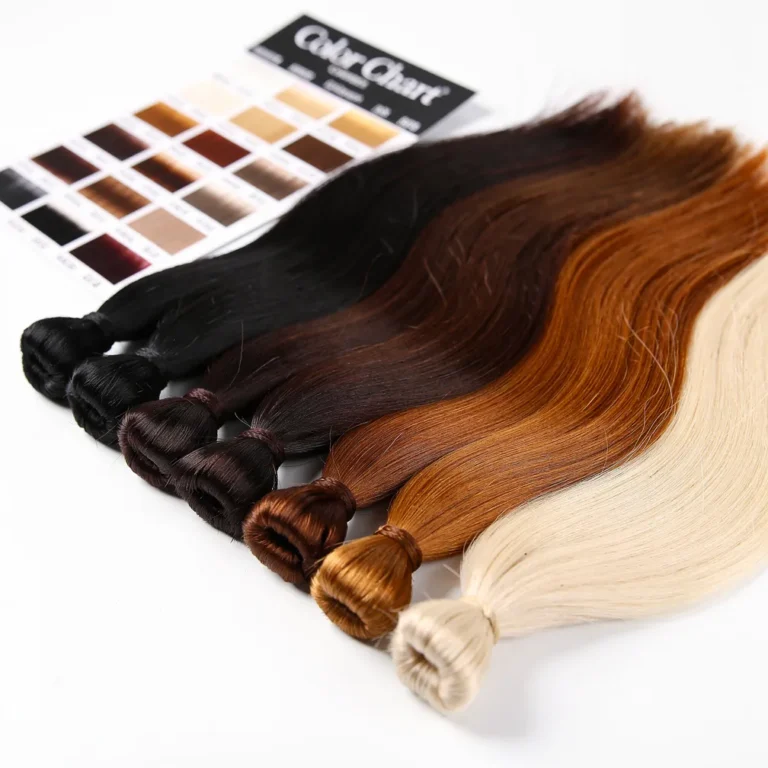
| Thread color | Matched to hair color | Invisible weft line when installed |
Why Source From Hair Extensions By Nature
Hair Extensions By Nature (legal entity: Hair Envy LLP) maintains a trained team of hand-tied weft artisans at our manufacturing facility in Faridabad, Haryana, India. We produce hand-tied wefts using cuticle-aligned Remy Indian hair, with full control over every step from raw hair sorting through finished weft construction. Our hand-tied production is done entirely in-house — not outsourced to third parties.
We supply hand-tied wefts to salon brands and distributors in the US, UK, Canada, Australia, and Europe with MOQs that accommodate both established businesses and growing brands. Contact us at +91 9289358222 (WhatsApp) or info@hairextensionsbynature.com. Our facility is at Booth No 71, Sector 16 Huda Market, Faridabad, Haryana, India – 121002.
Frequently Asked Questions
How long does it take to make hand-tied weft extensions?
A single row of hand-tied weft takes 45-90 minutes to produce. A complete set of 4-8 rows requires a full working day or more from a skilled artisan. By comparison, machine weft of equivalent length takes only 5-10 minutes per row. Total production lead time for a wholesale order of hand-tied wefts is typically 15-21 days including hair preparation and quality control.
Why are hand-tied weft extensions more expensive than machine weft?
Hand-tied wefts cost 2-3 times more because production requires 5-10 times more labor per gram, skilled artisans who undergo 3-6 months of training, and intensive quality inspection. A hand-tier produces 100-200 grams per day versus 500-800 grams for a machine operator. The price premium directly reflects the labor intensity and skill required to produce the ultra-thin, flexible weft.
Can hand-tied weft extensions be cut?
No. Hand-tied weft extensions cannot be cut because the knotting structure would unravel, causing hair to shed from the cut edge. This is a key difference from machine wefts, which can be cut and sealed. Salon professionals must order hand-tied wefts in the exact row widths needed for their installation technique.
What installation methods are used for hand-tied weft extensions?
Hand-tied wefts are installed using beaded row methods, Natural Beaded Rows (NBR), invisible bead extensions, and similar professional techniques where the weft is secured to a horizontal bead or wire anchored to the client’s natural hair. These methods take advantage of the hand-tied weft’s ultra-thin profile to create a seamless, undetectable result.
What is the minimum order quantity for wholesale hand-tied weft extensions?
MOQs for hand-tied weft extensions from direct manufacturers typically start at 20-50 sets, depending on hair specifications and color requirements. Due to the labor-intensive production, some manufacturers have higher minimums for custom specifications. Hair Extensions By Nature offers flexible MOQs for hand-tied wefts — contact us for specific quantities based on your requirements.
Start Your Hair Extensions Dropship Business
Zero inventory. Premium Indian Remy hair. Ship worldwide under your brand. MOQ as low as 5 pieces.