Wholesale Hair Factory Audit
Wholesale Hair Extensions Factory Audit — The 2026 40-Point Checklist
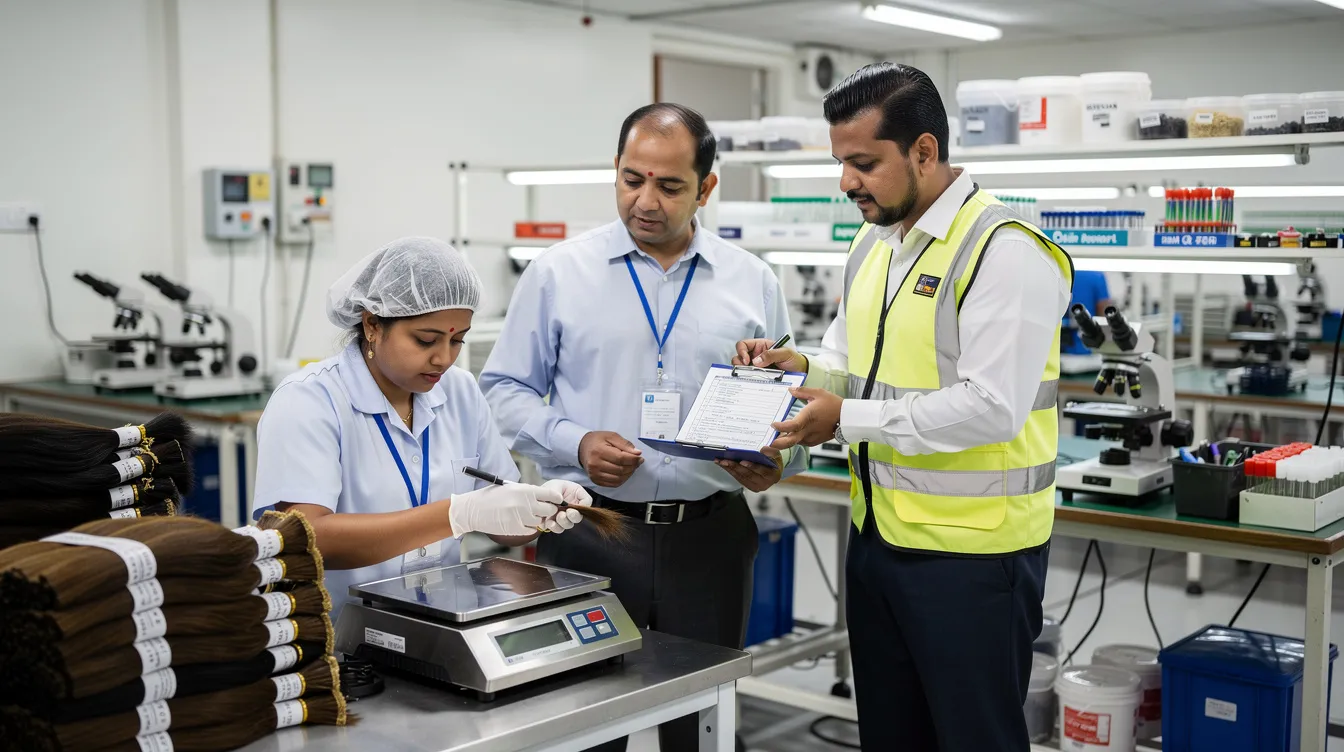
A hair extension factory audit checklist is the final verification step before committing to a substantive wholesale relationship with an Indian manufacturer. A comprehensive audit covers 40 points across seven categories — legal and compliance documentation, manufacturing facility observation, production capacity, quality control systems, supply chain traceability, commercial and operational terms, and post-sale support. The full audit takes 2 to 3 hours on-site at the factory or 45 to 60 minutes via a structured video walkthrough. Scoring 5 points per item produces a 200-point total; suppliers scoring below 140 are materially higher risk as long-term partners. This guide gives you the full checklist and how to score it.
Hair Extensions By Nature welcomes both remote video audits and scheduled in-person visits from prospective customers. Our current customer base includes salon chains and distributors who have audited us before placing their first PO — we share their audit notes internally to continuously improve. What follows is a practical buyer-side checklist that works whether you are flying to Delhi or joining a WhatsApp video call.
Planning to audit Hair Extensions By Nature? Book a 45-minute remote factory walkthrough. We cover all 40 checklist items with live camera access and documentation sharing.
Book Factory Audit Walkthrough
Category 1 — Legal and Compliance (6 points, 30 pts max)
- Active IEC export license verified on dgft.gov.in.
- Active GSTIN verified on gst.gov.in with matching entity name.
- MSME registration or similar small-enterprise certification in India.
- Active company registration (Pvt Ltd, LLP, or proprietorship) with MCA records available.
- No active disputes on Alibaba, TrustPilot, BBB, or Indian consumer forums.
- ISO certification (9001 quality management or equivalent) where applicable — nice-to-have, not always deal-breaker.
Category 2 — Manufacturing Facility Observation (8 points, 40 pts max)
- Physical factory location matches stated address, cross-checked on Google Maps or during in-person visit.
- Clean and organized production floor with visible workflow from raw material intake to finished goods packing.
- Dedicated raw material storage area with labeled bins or racks.
- Dedicated finished goods storage area with inventory tracking (spreadsheet, ERP, or visible labels).
- Adequate lighting and ventilation for hair sorting and wefting work.
- Safety measures — fire extinguishers, emergency exits, first aid kit visible.
- Worker welfare — visible drinking water, toilets, break area, reasonable working conditions.
- Staff count consistent with claimed production capacity. A factory claiming 200 kg per month output needs at least 10 to 15 workers.
Category 3 — Production Capacity and Process (6 points, 30 pts max)
- Wefting machines operational and in use during walkthrough.
- Hand-tied wefting station visible if the supplier claims hand-tied capability.
- Cuticle-alignment process explained and observable on a sample batch.
- Color processing area (if supplier produces colored hair).
- Wig-making station (if supplier produces wigs).
- Monthly production capacity stated clearly (in kg per month or pieces per month) and broadly consistent with staff count and machinery.
Category 4 — Quality Control Systems (7 points, 35 pts max)
- In-house QC team with named QC manager.
- Documented QC protocol (written SOP) covering incoming raw material, in-process, and finished goods.
- Weight verification at pack-out with digital scales.
- Length verification using standardized measurement tools.
- Cuticle-direction check at finished goods stage.
- Pre-shipment QC photos sent to customers as standard practice.
- Reject and rework policy — what happens to hair that fails QC.
Category 5 — Supply Chain Traceability (5 points, 25 pts max)
- Raw hair source documentation — temple auction receipts or licensed aggregator invoices.
- Lot traceability — can the factory trace a specific finished batch back to its raw material lot?
- Chain of custody from raw intake to finished dispatch documented.
- Ethical sourcing statement — clear position on fair compensation to hair donors and temple auction participation.
- No acid-bath or non-Remy mixing confirmed in writing and observable in process.
Category 6 — Commercial and Operational Terms (6 points, 30 pts max)
- Published MOQ by product category.
- Transparent pricing structure — USD per kg or per piece, with volume discount tiers.
- Standard payment terms (50/50 for first order, net-15 or net-30 for repeat customers).
- Defined lead times by product category.
- Shipping partnerships — FedEx, DHL, Aramex accounts visible on past AWBs.
- Pro forma invoice template professional, itemized, with validity period.
Category 7 — Post-Sale Support (2 points, 10 pts max)
- Defect handling SLA — written policy for short shipments, quality defects, length variance.
- Named account manager or primary contact with WhatsApp responsiveness documented.
Scoring Guide
Each item scores 0 to 5 points based on observed adherence. Section subtotals add to the overall 200-point audit score.
| Score | Decision |
|---|---|
| 180 – 200 | Strong partner — proceed to first order confidently. |
| 160 – 179 | Acceptable — negotiate to improve weak areas, proceed with smaller first order. |
| 140 – 159 | Borderline — insist on improvements; re-audit after 60 days. |
| Below 140 | High risk — disqualify and return to shortlist. |
Remote vs In-Person Audits
Remote video audits cover the same 40 items but rely on the supplier’s cooperation in sharing camera access and documentation. They take 45 to 60 minutes and cost nothing beyond your time. Suitable for orders up to USD 25,000 from suppliers with strong reference checks.
In-person audits take 2 to 3 hours on the factory floor plus pre- and post-briefing with the supplier. Costs include international flights, 2 to 3 nights in Delhi or Chennai, and local transport — typically USD 1,500 to 3,000 per supplier. Worth it for annual commitments over USD 50,000 or before signing a multi-year exclusive distributor agreement.
Why Source From Hair Extensions By Nature?
Hair Extensions By Nature scored 182 out of 200 on an internal audit run against this checklist in January 2026 — one of our customers invested the time to run the full protocol against us and shared his notes. Our weakest category (the one point-losing area) was formal ISO certification, which we initiated in Q1 2026 and expect to complete later this year. We welcome any prospective customer to run the full audit against us, remotely or in person, before a first commercial order.
Specifically for the audit: we share our IEC and GSTIN on first request, provide live video walkthrough of the Faridabad facility on pre-scheduled calls, disclose raw material sourcing via aggregator invoices (temple auction receipts on extended relationship tiers), operate an in-house QC team under a documented SOP, and maintain FedEx, DHL, and Aramex export relationships. Our pre-shipment QC photos are standard, not exceptional.
Frequently Asked Questions
How long should a hair extension factory audit take?
Remote video audit: 45 to 60 minutes of live video plus 15 to 30 minutes of documentation review. In-person audit: 2 to 3 hours on-site plus briefing time. Document pre-work of 1 to 2 hours.
What is the typical cost of an in-person factory audit in India?
USD 1,500 to 3,000 per supplier including flights, 2 to 3 nights’ accommodation in Delhi or Chennai, local transport, and meals. Combine 2 to 3 supplier audits in one trip to amortize travel cost.
Should I hire a third-party audit firm or run the audit myself?
For orders under USD 50,000, self-audit is usually adequate if you can travel or run the remote protocol. For larger commitments (USD 100,000+ or multi-year exclusivity), third-party audit firms like SGS, TÜV, or QIMA cost USD 500 to 1,200 and add credibility. Some large buyers use both — a self-audit for relationship-building and a third-party audit for formal record.
What audit items do suppliers most often resist or hide?
Raw material source documentation (many traders cannot produce auction receipts), financial stability indicators, and worker welfare access during in-person visits. Resistance on these items is a signal worth probing further.
Can I audit a factory without the supplier knowing in advance?
Unannounced audits are generally not welcomed in Indian manufacturing culture and can damage the business relationship. Pre-announce the audit with 7 to 14 days’ notice. What you can do is ask on-site questions that reveal whether the factory operation is continuous (not staged for your visit): casual conversations with workers, observation of routine activities like deliveries and shift changes, questions about recent production batches.
What if a supplier passes the audit but fails on the first order?
Passing an audit means the factory is legitimate and structurally capable. It does not guarantee zero defects on every shipment. First-order issues are usually SKU-specific or batch-specific rather than systemic. Handle them through the supplier’s defect SLA. Systemic re-failures on subsequent orders warrant a re-audit.
Is an ISO certification necessary for a hair extension factory?
Not strictly — ISO is a process-quality certification, not a product-quality certification. Many excellent Indian hair extension factories operate without ISO. However, for medical-wig distributors, luxury brands, or large retail-chain customers, ISO 9001 is often a procurement checkbox. If your customer base asks for it, make ISO certification a requirement in your supplier selection.
Ready to Audit Hair Extensions By Nature?
We run factory audits for prospective customers on a weekly basis. Remote walkthroughs can be scheduled within 2 business days. In-person visits require 7 to 10 days’ notice and we can coordinate with adjacent factory visits in Faridabad if you are auditing multiple candidates in one trip.
Prefer email? Reach us at info@hairextensionsbynature.com or complete our quote request form.
Hair Extensions By Nature — Manufacturer and Exporter of Premium Indian Human Hair Extensions. Factory: Booth No 71, Sector 16 Huda Market, Faridabad, Haryana, India — 121002. Serving salons, distributors, and brands in 40+ countries.
Start Your Hair Extensions Dropship Business
Zero inventory. Premium Indian Remy hair. Ship worldwide under your brand. MOQ as low as 5 pieces.