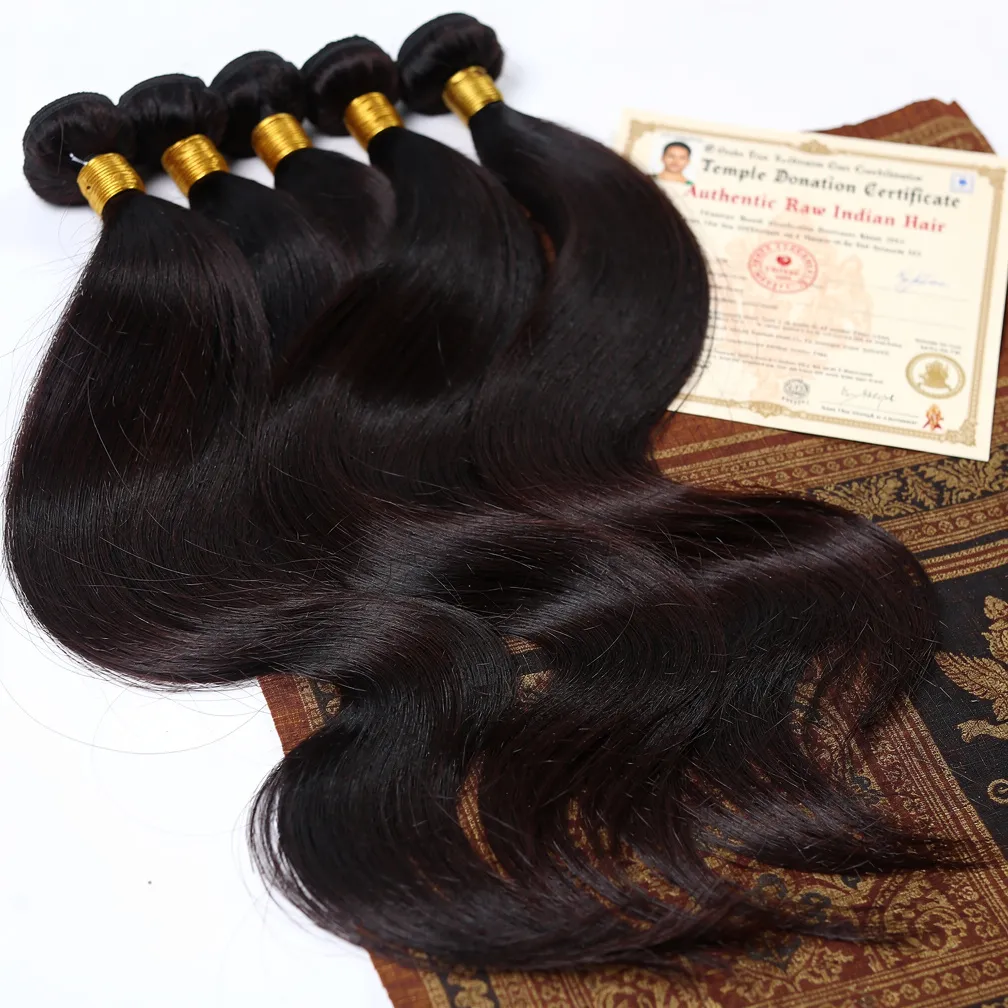
Raw Indian Temple Hair Wholesale
Raw Indian Temple Hair Wholesale — Everything Buyers Need to Know
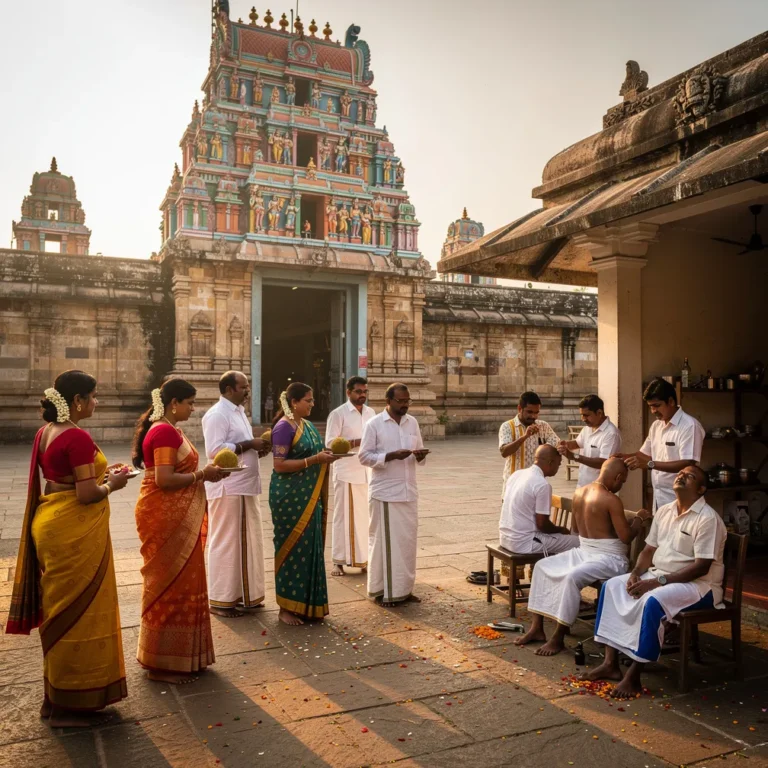
Raw Indian temple hair is the highest-quality category of human hair available in the wholesale market — unprocessed hair collected from Hindu temple tonsuring ceremonies, with cuticle layers fully intact, naturally aligned, and free from any chemical treatment. The primary source is the tonsuring tradition at Tirupati Balaji Temple in Andhra Pradesh and temples across Tamil Nadu, where devotees voluntarily shave their heads as an act of religious devotion. The hair collected through this practice is publicly auctioned by the temple trusts to licensed processors and manufacturers, making it one of the most ethically transparent and traceable sources of human hair in the global supply chain. For wholesale buyers supplying premium salon brands, luxury retailers, or quality-conscious international distributors, understanding the raw temple hair grading system, authenticity markers, and realistic price benchmarks is essential for making informed procurement decisions in 2026. For more details, see our guide on Hair Extension Return Policies. For more details, see our guide on Hair Extension Textures Explained.
Hair Extensions By Nature sources raw temple hair directly from authenticated South Indian collection networks and processes it at our Faridabad manufacturing facility, maintaining full traceability from temple to finished product.
Source authenticated raw temple hair for your premium range. Hair Extensions By Nature supplies Grade A and Grade B raw Indian temple hair to wholesale buyers across 30+ countries. Request specifications and pricing from our export team.
Request Raw Hair Specifications on WhatsApp
The Temple Hair Collection System — How It Works
Understanding the supply chain origin of raw temple hair is not merely academic — it is essential for authenticating supplier claims and verifying that hair marketed as temple-origin genuinely comes from temple donation sources.
The most significant temple hair collection center in the world is the Tirumala Tirupati Devasthanams (TTD) in Tirupati, Andhra Pradesh. The temple receives approximately 10,000-15,000 tonsuring devotees per day, with hair collection infrastructure managed by temple staff. The collected hair is sorted, cleaned, stored, and periodically auctioned to registered processors and manufacturers through a formal tender process. The auction is publicly advertised, and the winning bidders must be registered entities with valid manufacturing or trading licenses.
Other significant temple collection centers include temples in Tamil Nadu (Palani, Madurai, Kanchipuram), Andhra Pradesh, and Karnataka. Each temple manages its own collection and auction process, contributing to India’s total export-grade raw hair supply.
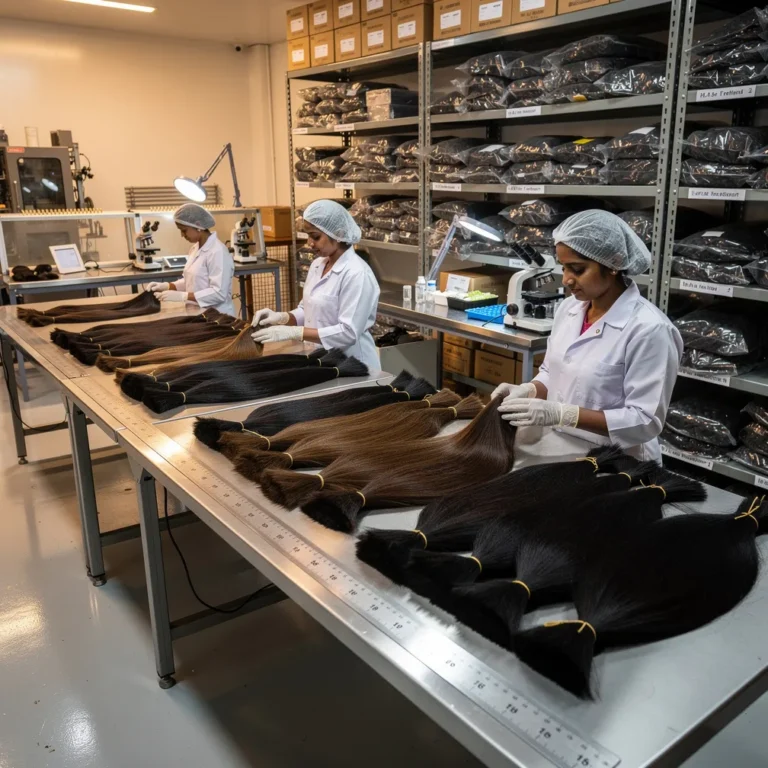
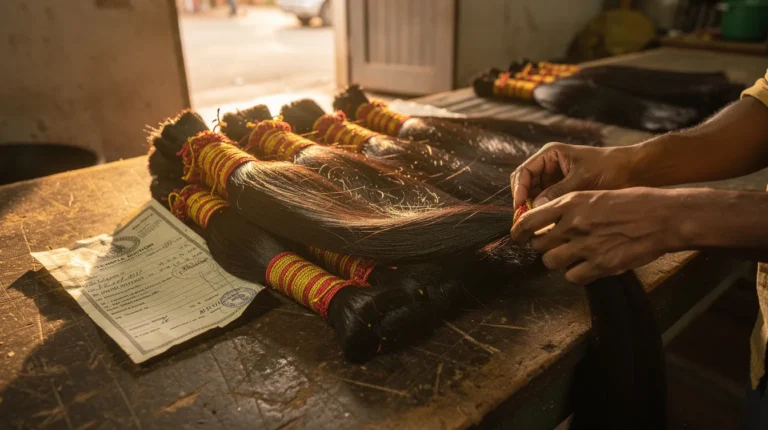
After auction purchase, raw hair goes through initial sorting, cleaning, and length categorization at the processor’s facility before being made available to manufacturers and exporters. Hair Extensions By Nature participates in this supply chain directly, purchasing through authenticated channels with documentation available for buyer review.
For broader context on India’s hair export supply chain, read our Complete Guide to Sourcing Hair Extensions from India.
Raw Temple Hair Grading System
No single universal grading standard exists across all Indian raw hair suppliers — which is a major cause of mislabeling and quality confusion in the market. The grading framework below reflects the industry-standard criteria used by professional processors and exporters, including Hair Extensions By Nature.
| Grade | Cuticle Status | Processing | Texture | Color | Lifespan | Use Case |
|---|---|---|---|---|---|---|
| Grade A — Premium Raw | Fully intact, aligned | Wash only; zero chemical | Natural straight to slight wave | Natural dark brown to black (1B, 2) | 3-5 years | Premium brands, luxury wigs, collector range |
| Grade B — Standard Raw | Intact, aligned; minor cuticle variance | Wash, condition; no bleach or color | Natural straight to slight wave | Natural dark (1B, 2, natural brown) | 2-3 years | Mid-premium wholesale, salon supply |
| Grade B+ — Processed Raw | Intact; minor steam processing | Steam treatment to set wave pattern | Body wave, deep wave, curl | Natural dark; dyeable | 18-24 months | Texture-specific wholesale lines |
| Grade C — Short / Mixed | Intact but mixed direction (fallout) | Wash; minimal treatment | Mixed; natural | Natural dark | 12-18 months | Value bundles; bulk weft production |
| Grade D — Combing Hair | Mixed direction; shorter lengths | Acid wash to align; silicone coat | Straight after treatment | Variable; often colored | 6-12 months | Economy market, clip-ins, fashion |
Grade A and Grade B raw temple hair are the categories most wholesale buyers seeking authentic unprocessed Indian hair should specify. Grade B+ is appropriate for buyers supplying markets that require wave or curl textures with raw hair quality longevity. Grade C and D should not be marketed as raw temple hair — their characteristics are materially different from genuine unprocessed temple-origin hair.
Raw Temple Hair Price Per Kg by Length — 2026 Benchmark
| Length | Grade A Price (per kg) | Grade B Price (per kg) | Grade B+ Processed (per kg) | Notes |
|---|---|---|---|---|
| 6-8 inch (short) | USD 120 – 150 | USD 90 – 120 | USD 100 – 130 | Short lengths are rarer; used for bulk weft fill |
| 10-12 inch | USD 140 – 180 | USD 100 – 140 | USD 120 – 155 | Popular length for high-volume production |
| 14-16 inch | USD 190 – 240 | USD 140 – 190 | USD 160 – 210 | Standard wholesale length range |
| 18-20 inch | USD 260 – 330 | USD 200 – 265 | USD 220 – 290 | High demand; significant length premium |
| 22-24 inch | USD 350 – 440 | USD 280 – 360 | USD 300 – 390 | Premium pricing; limited natural supply |
| 26-28 inch | USD 450 – 580 | USD 370 – 470 | USD 400 – 510 | Rare; very high retail value |
| 30 inch and above | USD 600+ | USD 500+ | USD 540+ | Extremely limited; confirm availability before ordering |
Note: Prices are per kilogram of sorted, washed raw hair, factory-gate Faridabad. 2026 indicative ranges. Final pricing confirmed per order based on current availability, exact specification, and order volume.
Get current raw temple hair pricing from our factory. Hair Extensions By Nature maintains stock of Grade A and Grade B raw temple hair across multiple lengths. Contact our export team for current availability and per-kg pricing for your order quantity.
Request Raw Hair Pricing on WhatsApp
How to Verify Authentic Raw Temple Hair
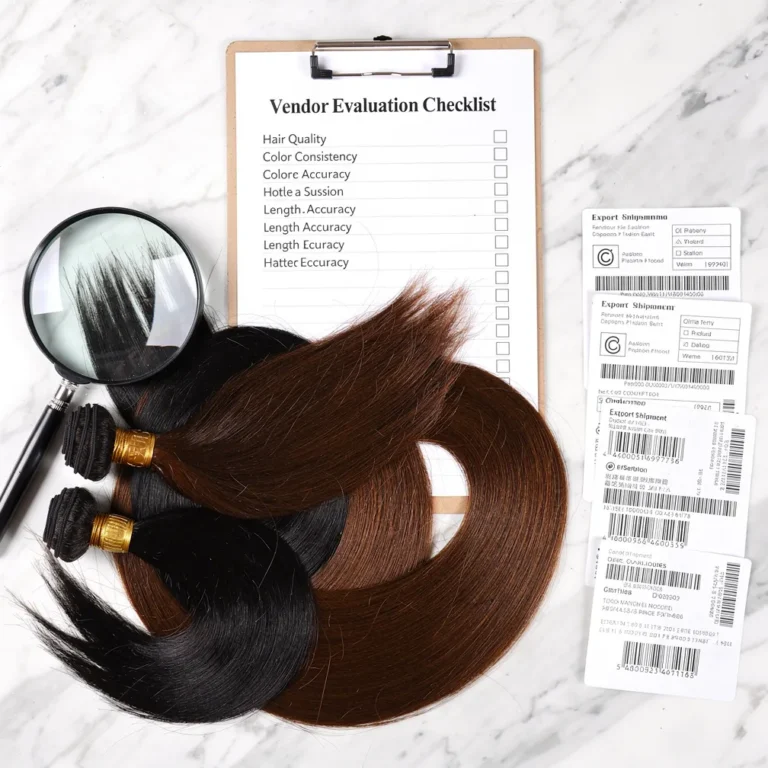
Given the price premium that genuine Grade A raw temple hair commands, mislabeling is a persistent challenge in the market. Suppliers offering processed, acid-washed, or non-temple-origin hair under a “raw temple hair” designation is a known issue. Use the following verification methods to confirm authenticity before large orders.
Documentation Verification
Authentic temple hair should be backed by a Certificate of Origin from the manufacturer, and a responsible supplier should be able to describe their procurement process — whether they purchase directly from temple auctions, from licensed processors who buy at auction, or through the secondary market. Ask specifically: “Where does your raw temple hair come from, and how do you verify temple auction origin?”
Physical Tests for Authenticity
Genuine raw temple hair has identifiable physical characteristics:
- No shine uniformity: Raw hair has natural, slightly uneven sheen — not the uniform high-gloss coating of silicone-treated hair
- Natural wave variation: Authentic temple hair shows slight natural variation in wave pattern across the bundle, reflecting individual donor variation
- Burns as protein: The burn test confirms 100% human hair with no synthetic content (see our quality verification guide for full burn test methodology)
- Strong cuticle resistance: The finger-slide test shows very clear directional resistance from tip toward root — more pronounced than in processed Remy hair because cuticles are fully intact and unstripped
- Color variation: Natural raw temple hair shows slight variation in shade within a bundle — some strands naturally lighter or darker — rather than the uniform dyed appearance of artificially colored hair
The Wash Test
Raw temple hair should maintain near-identical texture and manageability after 8-10 wash cycles with sulfate-free shampoo as it had before washing. No significant increase in tangling, no texture degradation, and no visible changes to wave pattern. Hair that changes dramatically after 3-4 washes was not raw — it was conditioned and coated to simulate raw characteristics.
Processing Options for Raw Temple Hair
One of the primary advantages of raw temple hair as a base material is its versatility. Because no prior chemical treatment has compromised the hair structure, it can be professionally processed into any texture, color, or style the buyer requires — with superior results compared to re-processing already-treated hair.
| Processing Option | Description | Result | Lifespan Impact |
|---|---|---|---|
| None (Natural) | Wash, dry, sort only | Natural straight to slight wave, natural black color | Maximum longevity (3-5 years) |
| Steam Texture | Steam processing to set wave or curl pattern | Body wave, deep wave, loose curl, tight curl | Minor reduction; 2-3.5 years |
| Single Process Color | Lift and tone to lighter shades (4, 6, 27) | Warm or cool lighter tones | Moderate reduction; 1.5-2.5 years |
| Full Bleach + Tone | Full lightening to blonde (613, 613A) | Platinum or golden blonde | Significant reduction; 12-18 months |
| Ombre / Balayage | Selective lightening of lower lengths | Two-tone gradient effect | Moderate reduction on treated portion |
| Weft / Tape Assembly | Machine or hand-tied into weft, or tape-in construction | Finished extension product from raw base | Determined by base hair; no additional reduction |
Raw Temple Hair vs Processed Remy — Summary for Wholesale Buyers
Raw temple hair commands a significant premium over processed Remy, but that premium is justified by measurably superior longevity, better color receptivity, stronger cuticle integrity, and the ethical sourcing story that premium brand positioning increasingly requires. For wholesale buyers supplying high-end salons, luxury retail, or premium wig collections, the raw temple hair tier is the correct sourcing category.
For buyers supplying mid-market retail, high-volume distribution, or price-sensitive markets, processed Remy at Grade A double-drawn standard delivers excellent performance at a significantly lower cost per unit. The choice between raw and Remy is ultimately a positioning and margin decision, not a quality binary.
Discuss your raw hair requirements with our experts. Hair Extensions By Nature supplies authenticated raw temple hair and processed Remy grades to international wholesale buyers. Email info@hairextensionsbynature.com or WhatsApp +91 9289358222. Factory: Booth No 71, Sector 16 Huda Market, Faridabad, Haryana, India – 121002.
Contact Our Export Team on WhatsApp
Frequently Asked Questions
What is raw Indian temple hair?
Raw Indian temple hair is unprocessed human hair collected from Hindu temple tonsuring ceremonies — primarily at Tirupati Balaji Temple in Andhra Pradesh and temples across Tamil Nadu — where devotees voluntarily shave their heads as a religious offering. It is the highest quality category of human hair because its cuticle layers are fully intact, naturally aligned, and free from any chemical treatment. It is the most versatile and longest-lasting base material for hair extension manufacturing.
What is the price of raw Indian temple hair per kg in 2026?
Raw Indian temple hair prices per kilogram in 2026 range from approximately USD 140-180 for 10-12 inch Grade A, USD 190-240 for 14-16 inch Grade A, USD 260-330 for 18-20 inch Grade A, and USD 350-440 for 22-24 inch Grade A. Prices increase significantly with length due to the limited natural supply of longer-length temple hair. Grade B pricing is typically 20-25% lower than Grade A at each length bracket.
How do I verify that raw temple hair is authentic and not processed?
Verify authenticity through supplier documentation (procurement process description, Certificate of Origin), physical tests (strong directional cuticle resistance in finger-slide test, natural uneven sheen, no uniform coating), the wash test (texture unchanged after 8-10 clarifying washes), and color variation check (natural hair shows slight shade variation within bundles). Ask the supplier to describe their procurement chain from temple auction to final product.
What is the difference between raw temple hair and Remy hair?
Raw temple hair is unprocessed — no chemicals, bleaching, or treatment of any kind. Remy hair means cuticle-aligned but may have been washed, conditioned, and possibly lightly processed during sorting. Raw temple hair has superior cuticle integrity and longer lifespan (3-5 years vs 12-18 months for processed Remy), but it is also significantly more expensive. Remy double-drawn is the best choice for buyers where budget is a factor but quality standards must remain high.
Can raw temple hair be dyed or processed after purchase?
Yes — raw temple hair is the most receptive base material for color processing because its cuticle structure is fully intact and undamaged by prior chemical treatment. It lifts evenly, takes color consistently, and can be steam-processed into any texture including body wave, deep wave, and curl patterns. Processing reduces lifespan proportionally to the intensity of treatment, but even processed raw temple hair typically outlasts pre-processed Remy in longevity tests.
What is the minimum order for raw Indian temple hair wholesale?
Raw Indian temple hair is typically sold by weight with a minimum order of 1 kg per length category. Most manufacturers prefer a minimum order of 3-5 kg across a single shipment to make export logistics cost-effective. For buyers requiring specific sorting — by exact length, grade, and texture — minimum quantities may be higher to ensure sorting consistency. Contact the manufacturer to confirm current minimum requirements for your specific product specification.
Is raw temple hair ethically sourced?
Yes — raw temple hair from authenticated South Indian temple sources is considered the most ethically transparent human hair in the global market. Devotees voluntarily donate their hair as a sincere religious offering during tonsuring ceremonies. The hair is then auctioned by the temple trust through a publicly documented process, with proceeds funding temple operations and charitable programs. No donor is compensated financially — the donation is entirely voluntary as part of sincere religious practice.
How long does raw Indian temple hair last?
Grade A raw Indian temple hair that has not been chemically processed typically lasts 3-5 years with appropriate care. Steam-processed variants (body wave, deep wave) last 2-3.5 years. Lightly color-processed raw temple hair lasts 1.5-2.5 years. These lifespans significantly exceed processed Remy (12-18 months) and far exceed acid-washed or silicone-coated non-Remy (3-6 months), making raw temple hair the highest-value category for premium retail and salon supply.